
National Honours Stir Power Struggle Between House And Senate
 Follow us on Google News
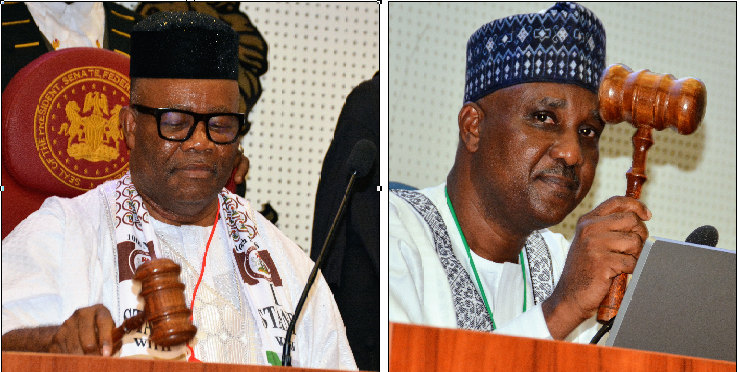
National Honours Stir Power Struggle Between House And SenatePresident Bola Tinubu’s conferment of national honours on notable Nigerians during Independence Day has reignited debate over the hierarchy within the National Assembly and raised questions about the effectiveness of Nigeria’s bicameral legislature, writes Oluwafemi Morgan.
On October 1, Nigeria’s 64th Independence Day, Tinubu awarded national honours to the Speaker of the House of Representatives, Tajudeen Abbas, and Senate President, Godswill Akpabio, sparking concerns about how these honours reflect the dynamics between the Senate and the House of Representatives.
Political observers noted that the dissatisfaction among members of the House of Representatives regarding the “lesser” honours given to their principal officers highlighted underlying tensions between the two chambers. Some argued that this issue points to a flawed federal system that requires constitutional and administrative reforms.
During his Independence Day speech, Tinubu conferred the title of Commander of the Order of the Federal Republic (CFR) on Abbas and Commander of the Order of the Niger (CON) on his deputy, Benjamin Kalu. In contrast, Akpabio was awarded the Grand Commander of the Order of the Niger (GCON), and his deputy, Barau Jibrin, received the CFR. For the judiciary, Chief Justice of Nigeria Kudirat Kekere-Ekun also received the GCON.
Restive Representatives
Members of the House of Representatives expressed frustration over the perceived marginalization of their chamber. In a recent plenary session, the House adopted a motion brought forward by Deputy Spokesperson Philip Agbese, which decried the treatment of the House as inferior to the Senate. Agbese argued that the titles bestowed and the continued reference to the Senate as the “upper chamber” undermine the House and misrepresent its status.
The House members voted to affirm that both chambers are co-equal and directed relevant committees to engage the Presidency to amend the National Honours Act of 1964 to reflect this.
In response, President Tinubu upgraded Abbas’s honour from CFR to GCON to quell the rising tension between the two chambers, describing the change as a remedy for a “historical error.”
The National Honours Act
The National Honours Act grants the President the power to confer honours, specifying ranks such as the Grand Commander of the Order of the Federal Republic (GCFR) and GCON, typically reserved for top government officials. The GCFR is the highest honour, exclusively awarded to presidents and heads of state, while the GCON is granted to high-ranking figures like the Senate President, Vice President, and Chief Justice. Lower honours such as CFR and CON are given to citizens who have made significant contributions to public life.
Two-Chamber System Debate
The recent dispute has reignited calls for a review of Nigeria’s bicameral legislature, which was adopted in 1999 along with the presidential system of government. While the Senate, with three representatives per state, is seen as a body representing regional interests, the House of Representatives has deeper constituent representation. However, some argue that the Senate has become a hub for powerful political figures, including former governors, who wield more influence than House members.
The designation of the Senate as the “upper chamber” has stuck, despite no constitutional provision affirming this. Joint plenary sessions are held in the Senate, presided over by the Senate President, which further reinforces the perception of the Senate’s superiority.
Calls for Unicameral Legislature
Some political analysts, including activist Omoyele Sowore, have called for the abolition of the bicameral legislature, arguing that it is costly and inefficient. The salaries and allowances of legislators, which are among the highest in the world, have fueled this debate, with some advocating for a unicameral system to reduce government expenditure. However, others caution that scrapping the bicameral system could lead to political imbalances, particularly in Nigeria’s diverse, multi-ethnic society.
Analysts’ Views on Hierarchy
Political scientists remain divided on the issue of hierarchy within the National Assembly. Some argue that the Senate, with its more prominent political figures, should retain its higher status. Others believe that both chambers are equal, with distinct legislative responsibilities, and that the Speaker of the House should receive honours equivalent to those of the Senate President.
Professors like Patrick Oromareghake of Dennis Osadebe University argue that the House plays a more direct role in representing the people and should not be seen as inferior. Meanwhile, Professor Ameachi Egboh of Nnamdi Azikiwe University criticized the disparity in honours between the Speaker and the Senate President, calling for equal recognition of both chambers.
Conclusion
The recent controversy over national honours has exposed deeper tensions within Nigeria’s legislative system, with growing calls for reform. As the debate continues, it may lead to a broader reassessment of the country’s governance structures and how power is distributed within its institutions. Whether these tensions will result in meaningful change remains to be seen, but they have certainly sparked a necessary conversation about the future of Nigerian democracy.
For more information on this article and other related posts from Bushradiogist, please join our WhatsApp channel by clicking this link https://whatsapp.com/channel/0029VaUumOODTkK7AZL1Fw3o. For advertisement inquiries only, kindly send a message to 090 1907 0863 on WhatsApp.






Comments
0 comments