
No Pleas For My Freedom, I Did Nothing Wrong’ – Nnamdi Kanu Fires Back
 Follow us on Google News
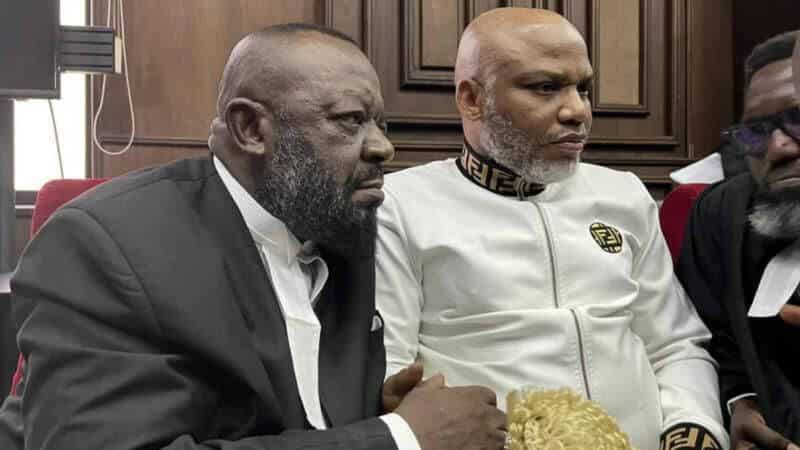
The leader of the Indigenous People of Biafra (IPOB), Nnamdi Kanu, has firmly stated that no one should appeal for his release, insisting he has committed no crime.
Kanu’s lawyer, Aloy Ejimakor, disclosed this in a statement on Saturday, following recent appeals from South East leaders for Kanu’s release. Among those calling for his freedom are Deputy Speaker of the House of Representatives, Benjamin Kalu, and other legislators from the region, who have urged President Bola Tinubu to intervene.
In a statement shared on his social media, Ejimakor revealed that Kanu expressed displeasure over these appeals during a visit on Friday.
The statement read:
“During my visit with Onyendu Mazi Nnamdi Kanu yesterday, he made it clear that while he appreciates the efforts and widespread support from well-meaning individuals and groups, he has instructed his legal team to clarify the following:
‘The call for my release is not a plea for mercy, pardon, executive clemency, or amnesty. It is simply a demand for compliance with the existing Federal High Court judgment that declared my detention unconstitutional, as well as international tribunal decisions that have ruled my detention unlawful. Alternatively, my release could be achieved through constitutional provisions that allow the Attorney-General of the Federation—under the President’s direction—to discontinue any prosecution.’
Kanu emphasized that no one should beg or plead on his behalf because he has committed no crime. He reiterated that self-determination—the core issue at stake—is an inalienable right protected under Nigerian law, the United Nations, the United Kingdom, and Kenyan legal frameworks. The attempt to criminalize this right, he said, should not be reinforced by misguided appeals for mercy or clemency. According to Kanu, his release should be viewed strictly as adherence to the rule of law, not an act of compassion.
‘While those advocating for my release may have good intentions, framing it as a request for pardon or clemency could be misinterpreted as giving the executive branch or the courts a license to continue violating the rule of law by pursuing a prosecution that contradicts constitutional principles and Nigeria’s international obligations,’ Ejimakor concluded.







Comments
0 comments