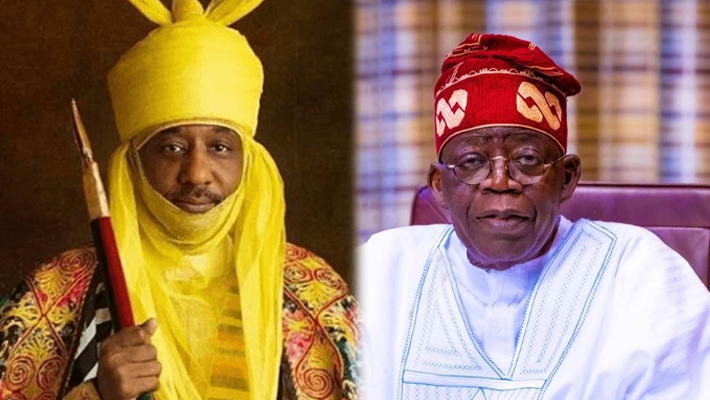
Speaking at the Oxford Global Think Tank Leadership Conference in Abuja on Tuesday, October 28, the former Governor of the Central Bank of Nigeria (CBN) praised President Bola Tinubu for his bold decision to remove the fuel subsidy but questioned how the increased revenue from the move is being utilized.
Sanusi noted that Nigeria’s current economic crisis is a result of years of ignoring sound financial advice. He recalled the 2012 attempt by the Jonathan administration to remove the fuel subsidy, which was thwarted by protests led by political opponents — the same group now grappling with the consequences of that resistance.
He said:
“If Nigeria had allowed the Jonathan government to remove subsidy in 2012, the pain would have been just a fraction of what we face today.”
The Emir revealed that, during his tenure as CBN Governor, the bank projected only a slight rise in inflation if the subsidy had been removed, with a plan to stabilize prices within a year.
“I put my credibility on the line then. I said, remove the subsidy — inflation might rise from 11% to 13%, but I would bring it down in a year. We wouldn’t be facing 30-something percent inflation today.”
Sanusi explained that the CBN at the time implemented strategies to avert hyperinflation and a currency collapse similar to Zimbabwe’s. He defended the current value of the Naira, arguing that stability — even at a lower rate — is preferable to uncertainty.
“Yes, we’re at ₦1,400 to the dollar, but it’s better to have stability at ₦1,400 for six months than to see ₦1,400 today and ₦2,000 tomorrow.”
He concluded by stressing that Nigeria’s real problem lies not in reforms but in wasteful public spending and oversized government structures.
“Why do we need 48 ministers, long convoys, and endless foreign trips?” he asked pointedly.

 Follow us on Google News





Comments
0 comments