
Fresh Twist In PFIPC Investigation As House Gives IGP 48-Hour Ultimatum Over Adeyemi
 Follow us on Google News
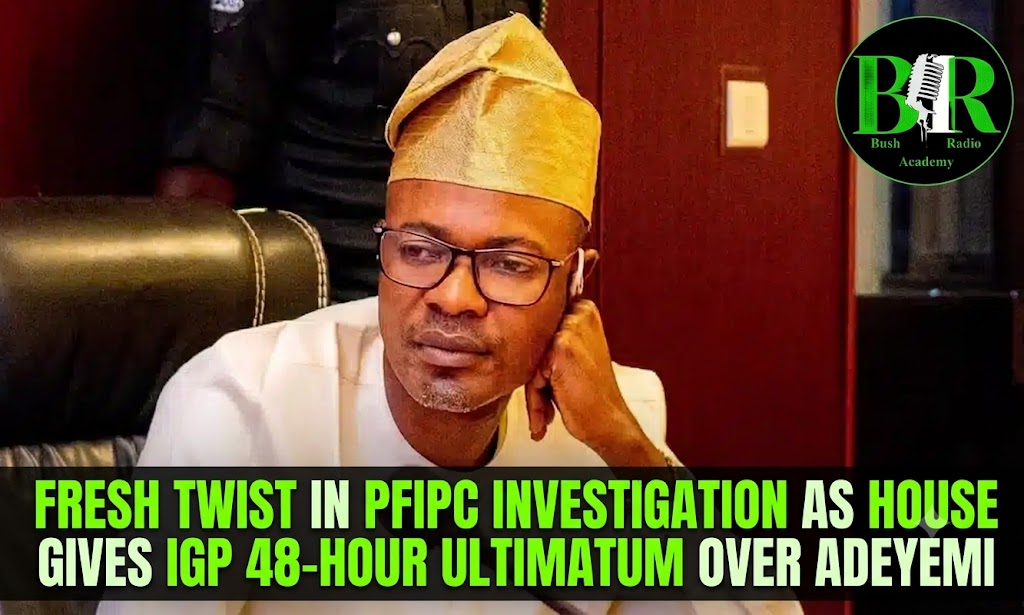
The House of Representatives ad hoc committee investigating the activities of the controversial Presidential Foreign Investment Promotion Council (PFIPC) has directed the Inspector-General of Police (IGP), Olatunji Disu, to produce the organisation’s self-proclaimed Director-General, Adeniyi Adeyemi, before the panel by noon on Wednesday.
The directive was issued on Monday during the committee’s investigative hearing at the National Assembly in Abuja as lawmakers intensified their probe into the council’s operations.
Representing the IGP at the hearing, Assistant Commissioner of Police Bashir Abdullahi was instructed to ensure Adeyemi’s appearance within the 48-hour deadline.
The committee is investigating allegations that the PFIPC—described by government officials as an organisation without legal backing—obtained office space inside Phase III of the Federal Secretariat in Abuja and secured a budget allocation of ₦1.32 billion in the 2026 Appropriation Act.
The latest development followed updates from the Nigeria Police Force on its ongoing investigation into allegations against Adeyemi.
According to Abdullahi, the police received multiple petitions, including one from the Office of the Chief of Staff to the President, accusing Adeyemi of falsely presenting himself as the Director-General of both the Presidential Economic Advisory Council and the PFIPC.
Committee Chairman Yusuf Gagdi said Adeyemi’s presence was essential to enable lawmakers verify critical documents and establish the facts surrounding the investigation.
“This committee must hear directly from the individual involved because the integrity of several public institutions and officials is at stake,” Gagdi said.
He stressed that Adeyemi’s appearance was no longer optional, adding that it was necessary for the committee to conclude its investigation and prepare its final report.
Following the resolution, the committee directed its clerk to formally communicate the order to the Inspector-General of Police.
Earlier, ACP Abdullahi informed lawmakers that although police investigations were still ongoing, an eight-count criminal charge had already been filed against Adeyemi before the Federal High Court.
He disclosed that the suspect had previously been arrested and arraigned but declined to reveal further details, warning that doing so could interfere with ongoing investigations and judicial proceedings.
“We must be careful not to disclose information that could prejudice the investigation or influence the outcome of the court case,” Abdullahi told the committee.
Despite the police’s caution, lawmakers requested clarification on several documents already obtained during their inquiry.
The police confirmed receiving a petition dated October 17, 2025, from the Office of the Chief of Staff to the President, which triggered investigations that later resulted in charges bordering on conspiracy and fraud.
Investigators also confirmed another petition accusing Adeyemi of falsely claiming to head both the Presidential Economic Advisory Council and the PFIPC.
According to the police, he allegedly used those claims to obtain office accommodation within the Federal Secretariat, sought approval to recruit about 300 employees, attempted to secure a proposed $1.3 billion allocation in the 2026 federal budget for the purported agency, and planned to organise a World Investment Summit under its name.
One of the major moments during the hearing came when the committee compared signatures on documents allegedly issued from the Office of the Chief of Staff with verified official records supplied by the police.
Asked whether the signatures matched, the police representative replied that they were different, raising fresh concerns over possible document forgery.
Commenting on the findings, Gagdi said the investigation had expanded beyond a single disputed letter.
“We are now dealing with what appears to be forged official documents, including a purported Act of the National Assembly allegedly used in an attempt to create a non-existent government agency,” he said.
The committee chairman further disclosed that investigators had identified about 29 documents suspected to have been forged.
According to him, the documents include purported approvals and correspondence allegedly originating from the Presidency, the Office of the Head of the Civil Service of the Federation, the Office of the Secretary to the Government of the Federation, the Ministry of Finance and several other government institutions.
He said representatives of many of the affected agencies had already appeared before the committee and denied issuing the documents attributed to them.
Gagdi added that the committee had deliberately avoided pressing the police for information that could compromise ongoing criminal proceedings, stressing that lawmakers would continue conducting an independent investigation.
He said the committee’s final report could include recommendations for additional action by relevant security and law enforcement agencies.







Comments
0 comments