
10 Key Things Tinubu Revealed In His Independence Day National Address
 Follow us on Google News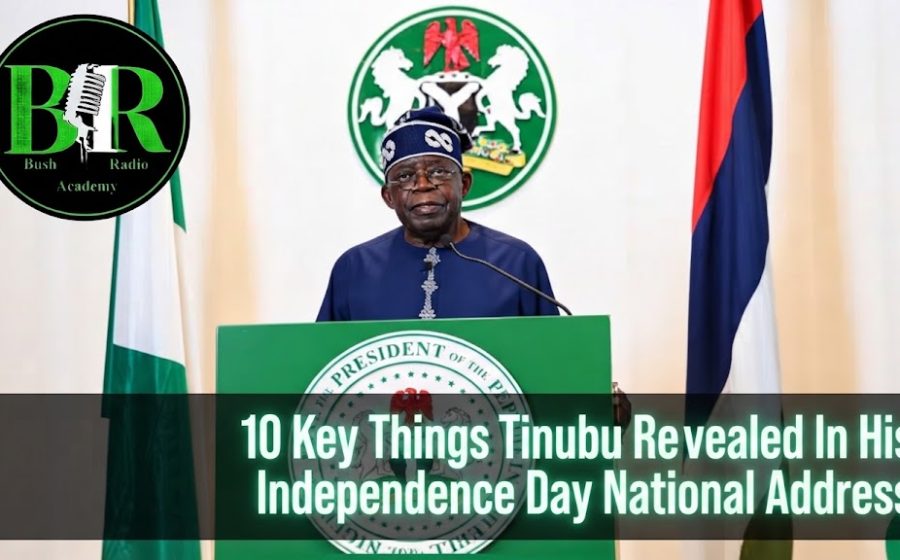
President Bola Ahmed Tinubu has outlined the next phase of his administration’s economic programme, saying the government is moving from an era focused primarily on economic reforms and stabilisation toward one centred on shared prosperity and improved living conditions for Nigerians.
According to Bush Radio Academy, Tinubu made the remarks in his Independence Day national address on October 1, 2026, as Nigeria marked its 66th anniversary. The President said the government’s focus would increasingly be on making the benefits of economic changes more visible in the daily lives of citizens.
Tinubu said the administration’s priorities now include reducing the cost of living, expanding food production, creating productive employment, improving electricity supply and widening access to education. He maintained that economic progress should be measured not only through national statistics but also by the conditions experienced by households.
The President identified the reduction of living costs as a central priority, saying the government would pursue this by lowering the cost of producing and transporting goods and services. He pointed to cheaper agricultural production, improved electricity supply for manufacturers, better transport infrastructure and greater competition as factors that could eventually reduce prices. He did not, however, give a specific timeline for when Nigerians should expect the full impact of these measures.
Tinubu also defended the economic reforms implemented since 2023 and rejected calls for a return to the previous subsidy system. He acknowledged that the reforms had created significant difficulties for households and businesses but argued that they were intended to address structural problems in the economy rather than merely ease their immediate effects.
The President cited economic indicators that he said demonstrated progress under the reforms, including economic growth of more than four per cent in 2026, lower oil theft, a more stable foreign exchange market and improved foreign reserves. He also said Nigeria recorded more than $6 billion in non-oil export revenue in 2025. These figures were presented by the President as evidence of improved economic stability and diversification.
Tinubu placed increased domestic production and non-oil exports at the centre of his vision for prosperity. He said the government wants more Nigerians involved in manufacturing, agriculture and other productive activities, with Nigerian businesses producing goods for both the domestic and international markets.
Agriculture also featured prominently in the President’s plans. He said the government would expand mechanised irrigation and dry-season farming, improve access to seeds and fertiliser, increase mechanisation and invest in storage and transportation. According to Tinubu, these measures are intended to increase agricultural output, reduce post-harvest losses and help lower the cost of food.
The President also linked infrastructure and energy development to economic growth. He said roads, railways and ports were being built and completed to improve connections between farms, factories and markets. He further said Nigeria’s gas resources would be used to support new industries and help businesses revive factories in established industrial centres.
Youth employment, entrepreneurship and digital access were another major part of the address. Tinubu described Nigeria’s large young population as a potential source of economic growth and said government policy would place greater emphasis on jobs, enterprise, industrial development, digital connectivity and skills development. He also said Nigerian businesses would need access to infrastructure and financing to expand.
The President acknowledged that many households continue to struggle with food, school fees, healthcare and transportation costs. He said the government would strengthen targeted assistance for vulnerable households and improve the National Social Register to ensure that support reaches people who need it.
Tinubu also highlighted the Nigerian Education Loan Fund as part of efforts to expand access to higher education for students from lower-income families. He mentioned CREDICORP’s consumer credit programme as another initiative designed to help working Nigerians acquire essential assets such as vehicles, solar systems and digital devices.
The President said the ultimate objective of the administration was to reduce poverty through sustained economic growth and the creation of millions of productive opportunities. He acknowledged that challenges accumulated over decades could not be eliminated within a single four-year term but said the government would continue working with states and local governments to improve primary healthcare, basic education and other essential public services.
Tinubu concluded by urging Nigerians to remain focused on the country’s future, saying the next phase should be about turning the foundation created by economic reforms into broader prosperity and improved opportunities for citizens.






Comments
0 comments