
How Adams Oshiomhole’s Evidence-Based Engagement Is Shaping Tinubu’s 2027 Campaigns
 Follow us on Google News
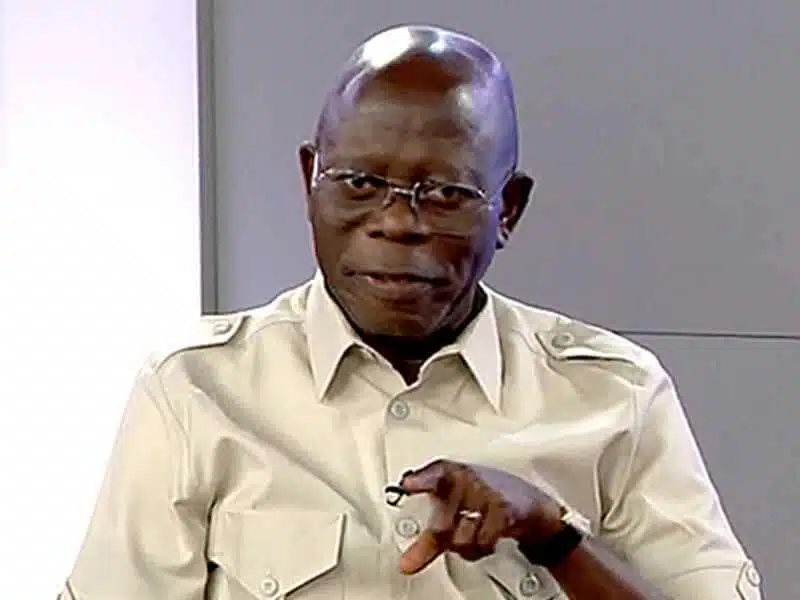
It is not every day that one gets the opportunity to share a seat with a political heavyweight of Senator Adams Oshiomhole’s stature on a commercial flight. So, when I found myself seated beside him on a one-hour flight from Abuja to Uyo, I seized the opportunity for an engaging conversation on Nigeria’s political economy, governance, economic reforms, and the country’s development trajectory.
One quality that stands out about Senator Oshiomhole is his remarkable capacity to engage robustly on complex national issues without arrogance, condescension or unnecessary political grandstanding. Perhaps this is a reflection of his labour movement background and three decades of active participation in Nigeria’s public affairs, during which he has consistently demonstrated an ability to influence public discourse and connect with different segments of society.
Although our conversation was relatively brief, given that I was proceeding to Ikot-Ekpene while he was heading to Uyo for the APC presidential campaign flag-off, its intellectual depth was remarkable. We traversed critical issues ranging from inflation management, infrastructure financing, monetary policy, interest rates, agricultural productivity and food security to employment generation, human capital development, youth empowerment, gender inclusion, technical and vocational skills acquisition, local government autonomy and fiscal federalism. We also examined the strategic significance of infrastructure investments, including the Lagos-Calabar Coastal Highway, in unlocking regional connectivity, stimulating private sector investment and strengthening national competitiveness.
Comrade Oshiomhole provided an illuminating perspective on President Bola Ahmed Tinubu’s economic reform programme and its ambition to reposition Nigeria for sustainable growth. We discussed the reported 4 per cent GDP growth performance, the imperative of consolidating macroeconomic stabilisation, and the need to translate improved economic indicators into measurable improvements in household welfare, productive capacity and employment opportunities.
On fuel subsidy removal, Oshiomhole was particularly emphatic. He argued that his present position is not inconsistent with his historical leadership of the Nigeria Labour Congress. His fundamental concern, he explained, has always been the elimination of corruption, inefficiency and fiscal leakages associated with the subsidy regime. The objective, therefore, should be to redirect public resources towards productive investments and social infrastructure that deliver greater economic and social returns.
It became clearer to me why his public engagements over the past fortnight have been particularly compelling. From Uyo to Ado-Ekiti, Iyamho, Kaduna, Calabar and Port Harcourt, in his capacity as APC Deputy Director-General (Mobilisation), he has demonstrated an impressive ability to translate complex policy choices into accessible political conversations. This is an important asset in a political environment where public confidence, policy communication and credible evidence are increasingly central to electoral persuasion.
Beyond national mobilisation, Oshiomhole has maintained a visible connection with his Edo North Senatorial District. His engagements across Ibillo, Igarra, Afowa, Fugar, Afuze, Otuo and other communities reflect an appreciation of grassroots accountability. His interventions in education, healthcare, computer-based learning infrastructure and skills acquisition demonstrate how political representation can be connected to tangible community development outcomes.
My takeaway from this encounter is simple: successful political mobilisation requires more than slogans; it requires policy literacy, persuasive communication, demonstrable results and sustained grassroots engagement. As the 2027 electoral cycle gathers momentum, Oshiomhole’s experience and mobilisation capacity will remain significant assets to the APC and President Tinubu.
Indeed, his political journey may yet have another consequential national chapter after 2027.
Taiwo Akerele, PhD
Written from Uyo, on the sidelines of a management retreat.



Comments
0 comments