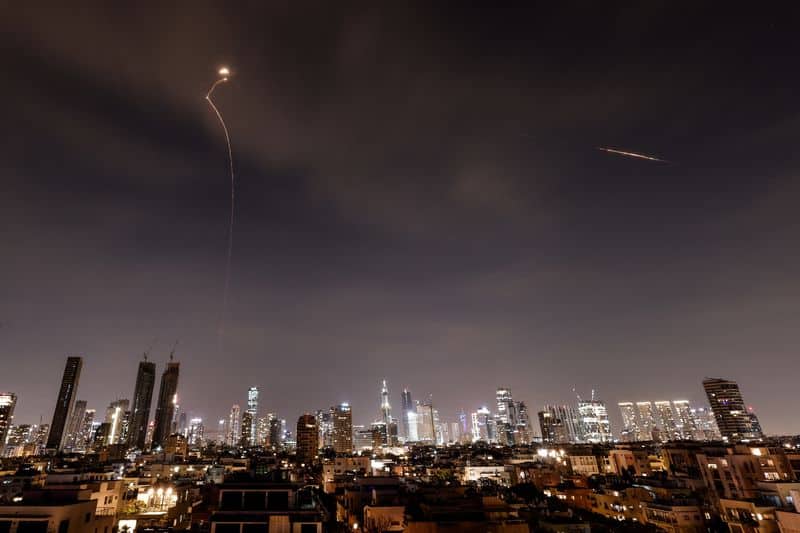
The latest attacks came at a time when global financial markets showed signs of recovery, with oil prices easing and Asian equities gaining amid hopes that the nearly four-week-long conflict could be moving toward de-escalation.
Speaking at the Oval Office, Trump suggested that diplomatic contact with Iran was already taking place.
“We’re in negotiations right now,” he told reporters.
“They did something yesterday that was amazing actually. They gave us a present and it arrived today. It was a very big present, worth a tremendous amount of money.
“That tells me we’re dealing with the right people.”
Although he did not provide specifics, Trump linked the development to the Strait of Hormuz, a key global oil shipping route that Iran has reportedly restricted in response to US and Israeli actions.
Iranian authorities have not confirmed any formal talks. However, The New York Times reported that Washington had sent a 15-point proposal to Tehran through Pakistan, which is reportedly acting as a mediator between both sides.
It remains unclear whether Israel, which has been conducting strikes on Iran and Hezbollah positions in Lebanon, is aware of or involved in the proposed diplomatic efforts.
Despite the talk of diplomacy, Iran’s Revolutionary Guards announced a new missile offensive targeting Israel as well as military installations hosting US forces in Kuwait, Jordan, and Bahrain.
Tehran has continued retaliatory operations, accusing Israel and its allies of supporting US military actions in the region.
Drone Attacks Reported Across Gulf States
Authorities in Kuwait confirmed that drones hit a fuel storage facility at Kuwait International Airport, triggering a fire and causing what officials described as minor damage.
In Bahrain, air raid sirens were activated, while Jordanian officials reported debris falling near Amman without casualties. Saudi Arabia also said it intercepted multiple drones in its eastern region.
Israel, in response, said it was carrying out further strikes on what it described as Iranian-linked military infrastructure following the renewed missile attacks.
Iran, however, accused Israel of targeting the Bushehr nuclear facility, which it described as a civilian site.
In Tehran, residents described worsening conditions under continuous bombardment. One 35-year-old woman told AFP that daily life had become dominated by explosions and missile strikes.
Conflict Spreads to Lebanon
The violence has also escalated in Lebanon, where state media reported Israeli strikes killed six people near Sidon, including areas close to a Palestinian refugee camp.
Israel has expanded its operations against Hezbollah, saying it aims to secure territory in southern Lebanon up to the Litani River, roughly 30 kilometres from the border.
Global attention remains focused on the Strait of Hormuz, through which a significant portion of the world’s crude oil passes. Iran has assured the International Maritime Organisation that neutral vessels will be allowed safe passage, but warned that ships linked to the US and Israel would be barred.
Signs of possible diplomatic progress contributed to a drop in global oil prices, with crude falling by more than six percent after weeks of increases driven by the conflict.
Meanwhile, French President Emmanuel Macron urged Iran to seriously engage in negotiations, following discussions with Iranian President Masoud Pezeshkian.

 Follow us on Google News