Election Day Turmoil: Nyanya Polling Unit Erupts Over Alleged Bribery
 Follow us on Google News
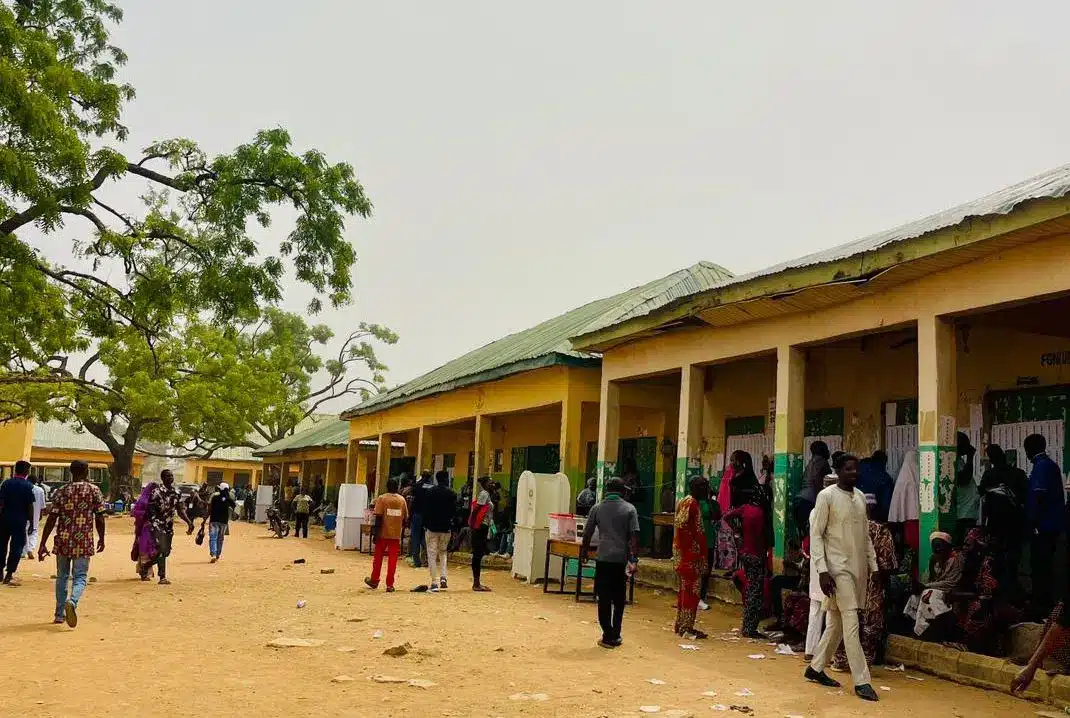
Tension erupted at Polling Unit 035 in Nyanya, Abuja Municipal Area Council, on Saturday after agents of the Peoples Democratic Party (PDP) and the African Democratic Congress (ADC) accused the ruling All Progressives Congress (APC) of attempting to bribe voters.
The incident briefly disrupted voting at the polling centre before security operatives intervened to restore order. Officers from the Nigeria Police Force and the Nigeria Security and Civil Defence Corps reinforced security following protests by opposition party agents.
An opposition agent, speaking anonymously to Vanguard, alleged that suspected APC intermediaries approached voters in line with cash offers.
“Some people we suspect to be APC intermediaries came to speak with voters. They were giving ₦1,000, but we openly rejected and spoke against it. That was why the situation became unruly for a while, but calm was restored after they left,” the agent said.
An ADC agent also criticised the handling of the situation by security personnel, claiming:
“They are sharing ₦1,000 per voter and security personnel are watching. How can such a thing be allowed? We will not tolerate it.”
The confrontation sparked heated exchanges among voters from different parties and temporarily disrupted the orderly queue. At one point, a voter cautioned protesting agents that continued unrest could result in the cancellation of results at the polling unit.
Voting eventually resumed under close security monitoring. Commercial activity around the area was largely suspended for the elections, with most businesses closed except essential services, including Nyanya General Hospital.
Allegations of vote-buying remain a persistent issue in Nigerian elections, raising concerns among electoral observers, civil society groups, and the Independent National Electoral Commission (INEC). Observers have consistently warned that the practice undermines free and fair elections by influencing voters through financial incentives.
Vote buying often involves distributing cash, food, or other material benefits directly at polling units or through intermediaries stationed nearby. Despite penalties prescribed under the Electoral Act, enforcement has been inconsistent. Analysts link the persistence of the practice to poverty, unemployment, and weak monitoring systems.
In recent years, election monitoring groups have reported more discreet methods of inducement, including coded transactions, electronic transfers, and deploying agents near polling centres to sway voters.