Sh*ck Fiscal Move: Senate Cuts Oil Price Assumption, Approves Massive ₦17.88tn Loan Plan
 Follow us on Google News
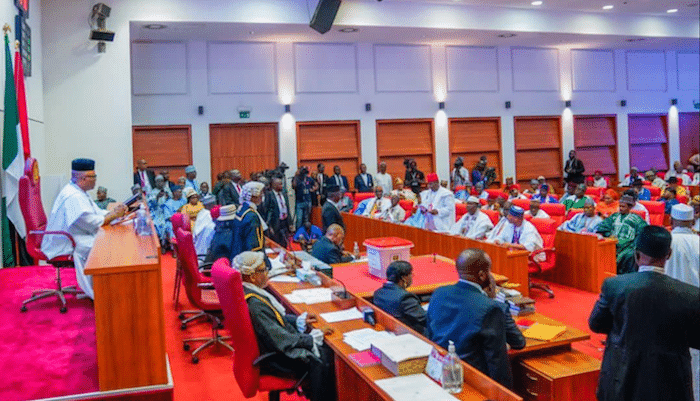
The Senate has adjusted the oil price benchmark for the 2026 fiscal year, cutting it from $64.80 to $60 per barrel in the proposed ₦54.46 trillion Federal Government budget framework, while maintaining all other macroeconomic and fiscal assumptions contained in the 2026–2028 Medium Term Expenditure Framework and Fiscal Strategy Paper (MTEF/FSP).
The revision, approved on Tuesday, December 16, 2025, followed recommendations from the Senate Committee on Finance, presented by its chairman, Senator Sani Musa (APC, Niger East).
Explaining the decision, Musa said the committee opted for a more cautious benchmark in response to global uncertainties, particularly geopolitical tensions in Europe and the Middle East that continue to drive volatility in crude oil prices.
The Senate also endorsed revised oil benchmarks for subsequent years, setting the 2027 price at $65 per barrel, up from $64.30, and the 2028 projection at $70 per barrel, revised upward from $65.50.
Despite the lower 2026 oil price assumption, lawmakers retained crude oil production estimates of 1.84 million barrels per day for 2026, 1.88 million barrels per day for 2027 and 1.92 million barrels per day for 2028, expressing confidence in ongoing reforms to stabilise and grow output.
On exchange rate assumptions, the Senate approved projections of ₦1,512 per dollar for 2026, ₦1,432.15 for 2027 and ₦1,383.18 for 2028. These figures, the committee said, align with the Central Bank of Nigeria’s strategy to strengthen the naira through improved coordination between fiscal and monetary policies.
Inflation is projected to decline steadily over the medium term, with rates estimated at 16.5 per cent in 2026, 13 per cent in 2027 and nine per cent in 2028, reflecting the monetary authorities’ commitment to curbing price pressures.
The Senate also sustained real GDP growth projections of 4.68 per cent for 2026, 5.96 per cent for 2027 and 7.9 per cent for 2028, citing ongoing economic reforms and the anticipated impact of recently enacted tax laws, expected to take firmer effect from 2026.
A key emphasis of the committee’s report was the effective implementation of the new Tax Acts as essential drivers of economic reform and growth. In this regard, it recommended the adoption of a National Scanning Policy under the National Single Window of the Nigeria Revenue Service, in collaboration with relevant agencies, to enhance revenue assurance, reduce leakages, improve transparency, facilitate trade and strengthen national security.
Budget Size and Borrowing Profile
Under the approved framework, total federal expenditure for 2026 is projected at ₦54.46 trillion. Retained revenue is estimated at ₦34.33 trillion, while new borrowings—both domestic and foreign—are pegged at ₦17.88 trillion. Debt service obligations are projected at ₦15.52 trillion.
The framework also allocates ₦1.376 trillion for pensions, gratuities and retirees’ benefits, with the fiscal deficit estimated at ₦20.13 trillion.
Capital expenditure, excluding transfers, was maintained at ₦20.131 trillion, alongside statutory transfers of ₦3.152 trillion and a sinking fund provision of ₦388.54 billion. Total recurrent (non-debt) expenditure was approved at ₦15.265 trillion, while special intervention funds for recurrent and capital spending were fixed at ₦200 billion and ₦14 billion, respectively.
In its closing remarks, the committee commended the Senate and members of the Finance Committee for their dedication to what it described as a critical national task, expressing optimism that effective implementation of the framework would promote sustainable economic growth and stability.