Video Drama: Senator Challenged As DSS Intervenes Near El-Rufai’s Vehicle
 Follow us on Google News
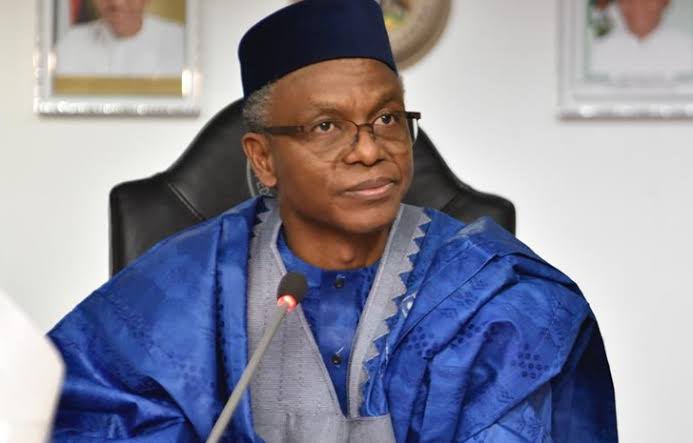
The lawmaker representing Kaduna Central in the National Assembly, Lawal Adamu Usman, was reportedly prevented from entering a vehicle carrying former Kaduna State governor, Nasir El-Rufai, after court proceedings on Wednesday.
The senator, who recently defected from the All Progressives Congress (APC) to the African Democratic Congress (ADC), was seen in a video attempting to enter a black SUV conveying El-Rufai.
The footage showed a heavy security presence, including personnel managing a crowd of journalists, supporters, and bystanders outside the court premises.
As the vehicle door was opened, the senator moved toward it alongside El-Rufai but was reportedly stopped by operatives of the Department of State Services (DSS), who prevented him from entering.
During the incident, one of the security operatives was heard questioning the situation, saying, “He’s a senator, and so what?”
Meanwhile, El-Rufai has stated that Nigeria’s economic challenges are not due to a lack of talent, capital, or ideas, but rather the misallocation of the country’s most capable human resources.
In a statement shared on his Facebook page on Wednesday, he argued that the country’s growth issues stem from how its skilled individuals are drawn into less productive activities.
According to him, many Nigerians respond to economic incentives that reward immediate gains, especially in environments where small differences in skill lead to significant financial rewards.
El-Rufai explained that the current economic structure tends to favour rent-seeking activities over productive enterprise, which he said hampers long-term growth.
He cited key economic indicators, noting that Nigeria’s GDP growth was about 4.1 per cent in 2024, while GDP per capita stood at approximately $1,084, placing the country among lower-income economies.
He also highlighted that about 93 per cent of the workforce is engaged in informal employment, with a tax-to-GDP ratio of around 8.2 per cent.
According to him, these figures reflect an economy where business expansion is risky, visibility can attract pressure, and long-term investments struggle to compete with short-term gains.
El-Rufai warned that when skilled individuals are diverted away from productive sectors, it slows entrepreneurship, innovation, and overall economic growth.
He also pointed to challenges such as unreliable power supply, port delays, and limited formal employment opportunities as obstacles to business expansion.
Despite these challenges, he noted that there are positive signs, particularly in non-oil exports such as cocoa, fertiliser, cashew, and processed agricultural goods.
El-Rufai said that when the right incentives are in place, Nigerian businesses are capable of competing and expanding.
He proposed reforms aimed at encouraging productivity, including reducing excessive government discretion, improving regulatory transparency, strengthening property rights, and creating an enabling environment for businesses.
He concluded that Nigeria’s economic future depends on how effectively the system rewards productivity, rather than on political rhetoric or individual personalities.
According to him, sustained growth will occur only when the system favours producers over rent-seekers, adding that Nigeria’s challenge is not a lack of talent, but how that talent is utilised.