
Latest
2027 Election: Opposition Faces Its Toughest Battle Yet — From Within

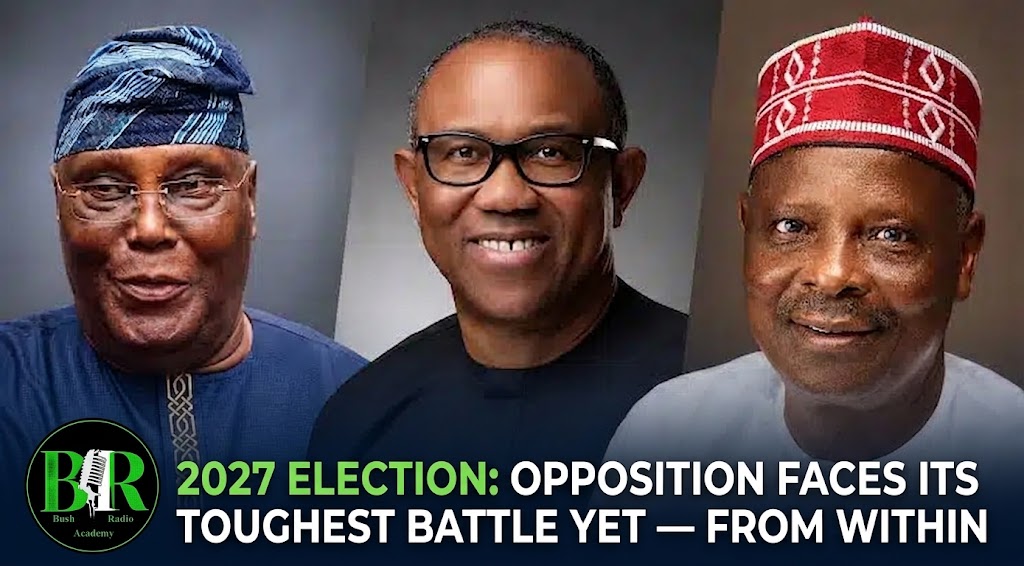
On August 2, a coalition of 100 Nigerians opposed to President Bola Tinubu, operating under the banner of G-100, urged opposition leaders to unite behind a single presidential candidate ahead of the 2027 general election.
The group’s proposal was straightforward: opposition parties and politicians should put aside their individual ambitions and form a united front capable of mounting a stronger challenge to Tinubu at the polls.
G-100 specifically called on opposition figures, including former Vice President Atiku Abubakar of the African Democratic Congress (ADC) and Peter Obi of the Nigeria Democratic Congress (NDC), as well as their associates, Rotimi Amaechi and Rabiu Kwankwaso, to work towards selecting a consensus candidate.
The Opposition’s Struggle for Unity
The call for unity comes after several attempts by opposition politicians to build a formidable alliance against Tinubu.
Obi and Kwankwaso initially joined the ADC-led coalition alongside Atiku and other influential political figures. The alliance was intended to create a united opposition capable of avoiding the division that characterised the 2023 presidential election.
On April 25, the coalition agreed to support a single presidential candidate. However, the arrangement later ran into internal disagreements and legal controversies.
Obi and Kwankwaso eventually left the alliance and joined the Nigeria Democratic Congress. Obi cited what he described as “endless court cases, internal battles, suspicion, and division” within the ADC as some of the reasons for his decision.
Their departure has once again raised questions about whether Nigeria’s opposition can overcome its internal differences before the 2027 election.
When Personal Ambition Becomes the Problem
For the opposition, the biggest challenge may not simply be finding a strategy to defeat Tinubu, but deciding who should lead the alternative.
Many of the politicians being encouraged to unite already have presidential ambitions. Consequently, persuading one of them to step aside in favour of another could prove far more difficult than forming the coalition itself.
In its August 2 open letter, G-100 warned that Nigeria could not afford opposition politicians pursuing separate ambitions at a time when the country requires a credible alternative.
The group argued that opposition leaders must first agree on the kind of Nigeria they intend to build and the reforms they are prepared to pursue.
The central question, however, remains whether politicians who have spent years building personal political structures and presidential ambitions will be prepared to surrender them for a consensus candidate.
Although the camps surrounding Atiku and Obi have expressed support for greater cooperation, both sides have remained cautious about the idea of a single candidate.
Will Their Supporters Follow?
Even if opposition leaders eventually agree on a consensus candidate, another major hurdle awaits them: convincing their supporters to accept the choice.
The supporters of Peter Obi, for example, may not automatically transfer their loyalty to Atiku if he emerges as the consensus candidate. The same applies to Atiku’s supporters if Obi gets the ticket.
The 2023 presidential election provides an indication of the scale of the challenge.
Tinubu won 8,794,726 votes, while Atiku secured 6,984,520, Obi received 6,101,533 and Kwankwaso polled 1,496,687.
On paper, the combined votes of the major opposition candidates were significantly higher than Tinubu’s total. However, simply adding the figures does not necessarily mean those voters would automatically unite behind whichever politician emerges as the opposition candidate in 2027.
Political loyalty is often more complicated than arithmetic.
‘It Will Be Easier to Drag an Elephant Through the Eye of a Needle’
Speaking exclusively to Naija News, CUPP spokesman and convener of the New Direction for Nigeria (NEDMO), Mark Adebayo, expressed serious doubts about the possibility of the opposition producing a consensus candidate.
Adebayo said he had advocated for opposition unity for more than a year and previously supported the idea of Atiku stepping aside in the interest of the country and backing Peter Obi.
According to him, neither Obi nor Atiku can defeat Tinubu independently, but a strategic alliance between the two could significantly strengthen the opposition.
He argued that Atiku, given his political structures and experience, could have supported Obi to create a formidable electoral force.
However, he said the opportunity had been missed because the two politicians ultimately pursued separate paths.
Adebayo said the situation has now become considerably more difficult, describing the possibility of either Atiku or Obi abandoning his presidential ambition as comparable to “dragging a full-grown elephant through the eye of a needle.”
He argued that Atiku is unlikely to step aside because he regards 2027 as one of his final opportunities to pursue the presidency, while Obi would face significant resistance from his supporters if he withdrew in Atiku’s favour.
According to Adebayo, the growing rivalry between the opposition camps could ultimately benefit Tinubu.
He noted that supporters of the ADC and NDC have already begun attacking one another, accusing the camps of trading insults, blackmail and negative rhetoric.
For him, the inability of the opposition to present a united front has already weakened its chances ahead of 2027.
‘Unity Cannot Simply Be Announced’
Despite the difficulties, Atiku’s Senior Special Assistant on Public Communication, Phrank Shaibu, said the former vice president remains committed to opposition unity.
Shaibu described the G-100 proposal as worthy of serious consideration, arguing that the challenges facing Nigeria are greater than the ambitions of any individual politician or political party.
He said Atiku had consistently supported dialogue, coalition-building and cooperation among opposition forces.
However, Shaibu stressed that unity could not simply be declared without a credible process.
According to him, any agreement must emerge from genuine consultation, mutual respect and a transparent process capable of earning the confidence of political parties, candidates and Nigerians.
He also rejected the idea of describing any individual politician as an obstacle to opposition unity.
Instead, he said the major challenge was establishing a fair and credible process capable of producing the strongest possible alternative to Tinubu.
Shaibu noted that Atiku, Obi and Kwankwaso all have significant political constituencies and legitimate ambitions. Therefore, those pushing for unity must create an environment where those interests can be discussed without suspicion, ego or predetermined outcomes.
He said the focus should be on determining who can build the broadest national coalition, attract support across regions and demographics and provide the leadership Nigeria needs.
Can One Candidate Defeat Tinubu?
On whether a single opposition candidate would automatically be enough to defeat Tinubu, Shaibu cautioned that unity at the presidential level alone would not guarantee victory.
He said opposition parties would also need strong grassroots structures across the country’s 8,809 wards, credible candidates, effective mobilisation and a strong election-day organisation.
He added that protecting votes and restoring public confidence would be equally important.
According to Shaibu, the opposition should therefore look beyond simply deciding who steps aside for whom.
Instead, the goal should be to build a broad national movement capable of presenting Nigerians with a credible alternative and defending their democratic choice.
For now, the opposition faces a difficult balancing act: it must convince politicians with powerful personal ambitions to compromise while simultaneously persuading millions of supporters to embrace a candidate they may not have originally chosen.


Adeleke Moves From Tinubu To Wike, Sparks Fresh Political Speculation

Political Tension? APC Reveals Why Governorship Candidate Skipped Tinubu’s Campaign

Delta Gov Oborevwori Reveals Monthly Salary, Says It’s Lower Than A Permanent Secretary’s

Oshiomhole Panel Blasts Obaseki, Recommends Renaming And Relocation Of Museum

2027 Election: Opposition Faces Its Toughest Battle Yet — From Within

OKPEBHOLO DECLARES WAR ON REVENUE LEAKAGES, SECRET ACCOUNTS AND ILLEGAL TAX COLLECTION IN EDO

BREAKING: US Ends Temporary Protection For 12 Countries — See Full List

2027: Full List Of Presidential Candidates, Parties That Signed Peace Accord

Peter Obi Can’t Be President” — Dino Melaye Reveals His Reason!
