
Explosive! Sule Lamido Reveals Secret Behind Obasanjo’s 1999 Presidential Endorsement
 Follow us on Google News
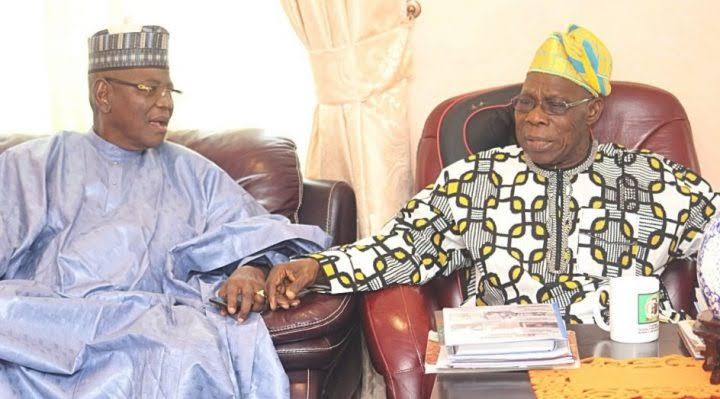
Former Jigawa State Governor and ex-National Secretary of the now-defunct Social Democratic Party (SDP), Sule Lamido, has revealed that former President Olusegun Obasanjo was selected as the preferred Yoruba candidate for Nigeria’s presidency in 1999—over Chiefs Bola Ige, Olu Falae, and Abraham Adesanya—in a bid to promote national unity.
Lamido made the revelation in his newly published autobiography, Being True to Myself, unveiled on May 13. In Chapter 9, titled “Abdulsalami’s Transition and Formation of the PDP,” Lamido explained that the goal was to support a Yoruba figure who would be seen as a Nigerian president, not merely an ethnic leader.
“The Yoruba people had their eyes on three potential candidates: Chiefs Olu Falae, Bola Ige, or Abraham Adesanya,” Lamido wrote. “But we believed none of them had the appeal or capacity to serve as a truly effective Nigerian president.”
He described a crucial distinction made at the time—between selecting a “Yoruba Nigerian President” and a “President of the Nigerian Yoruba”—with Obasanjo fitting the former mold.
Why Obasanjo Was Chosen
According to Lamido, a number of prominent politicians, including Alex Ekwueme, Abubakar Rimi, and Obasanjo, had emerged as contenders under the newly formed Peoples Democratic Party (PDP). However, retired military generals within the party urged stakeholders to unite behind Obasanjo.
“Firstly, he had earned the trust of a wide section of Nigerians. Secondly, he carried the image of a national leader among the Yoruba,” Lamido wrote.
Obasanjo’s military career—serving as Chief of Staff, Supreme Headquarters under General Murtala Mohammed and later as Head of State—added to his national stature, Lamido explained.
Lamido also praised Obasanjo’s conduct in 1979, when he transferred power to Shehu Shagari of the National Party of Nigeria (NPN), despite pressure from his Yoruba base to support Chief Obafemi Awolowo. That act, Lamido argued, elevated Obasanjo’s image as a nationalist committed to unity over tribal interests.
Yoruba Backlash and June 12 Fallout
Lamido acknowledged that Obasanjo’s emergence angered the Yoruba political elite and wider public, especially due to his refusal to back Chief MKO Abiola after the annulled June 12, 1993, election—a contest Abiola was widely believed to have won.
“Obasanjo and Abiola were deeply divided—by temperament, ideology, and religion,” Lamido wrote. “His decision not to support Abiola’s mandate was seen as another betrayal, after the 1979 handover to Shagari.”
Despite the outrage, Lamido maintained that choosing Obasanjo was a calculated effort to stabilize the country’s fragile post-military democracy.
“This wasn’t merely about appeasing the Yoruba after June 12,” he stated. “It was about healing Nigeria with a president who had genuine national appeal and leadership experience.”






Comments
0 comments