
Sh*ckwaves In Abuja: SERAP Sues Senate President Akpabio, Speaker Abbas Over ₦3m Bribery Allegation
 Follow us on Google News
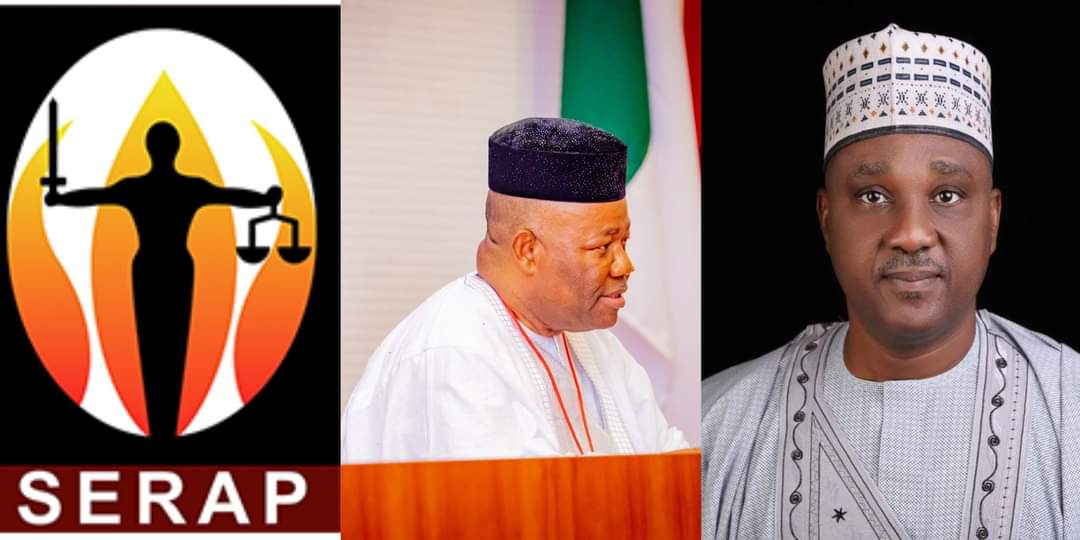
The Socio-Economic Rights and Accountability Project (SERAP) has filed a lawsuit against the Senate President, Godswill Akpabio, and the Speaker of the House of Representatives, Tajudeen Abbas, for allegedly failing to investigate claims that lawmakers pay between ₦1 million and ₦3 million to sponsor or present bills, motions, and petitions in the National Assembly.
Filed under suit number FHC/L/CS/2214/2025 at the Federal High Court, Abuja, the case seeks an order of mandamus compelling Akpabio and Abbas—on behalf of all National Assembly members—to refer the bribery allegations to anti-corruption agencies for proper investigation and prosecution.
The lawsuit was prompted by viral claims from Ibrahim Auyo, a member of the House of Representatives from Jigawa State (APC), who alleged that legislators were required to pay large sums to get their bills or motions considered.
In a video clip recorded in Hausa, Auyo stated:
“Since I was elected in 2015, no individual has given me a bill to pass. Even bills and petitions are paid for. You must pay between ₦1 million and ₦3 million to present them, and after that, you still have to lobby all 360 members to get it approved.”
“Bribery Undermines Democracy” — SERAP
In its filing, SERAP described the alleged practice as “a grave breach of public trust and a violation of lawmakers’ constitutional oath of office.”
“Lawmakers should not be required to pay bribes to present motions or bills in the National Assembly. Bribery must never influence legislative duties or parliamentary processes,” the group stated.
SERAP argued that the alleged conduct violates Section 4 of the 1999 Constitution (as amended), which defines the legislative powers of the National Assembly, and erodes public confidence in democratic governance.
The organisation also asked the court to compel Akpabio and Abbas to protect Ibrahim Auyo as a whistleblower under Article 33 of the United Nations Convention Against Corruption (UNCAC), to which Nigeria is a signatory.
“Mr. Auyo is a whistleblower because of his public interest disclosures on the alleged ₦3m Bribe-for-Bills scandal,” SERAP said.
“Directing Akpabio and Abbas to ensure a transparent investigation would strengthen the rule of law and build trust in democratic institutions.”
Represented by Kolawole Oluwadare, Kehinde Oyewumi, and Andrew Nwankwo, SERAP emphasized that the National Assembly must function as “an accountable institution that upholds transparency and the public interest.”
The statement added:
“These allegations expose how some lawmakers may be abusing their positions to deny Nigerians their constitutional and democratic rights. Investigating and prosecuting those involved will enhance accountability and rebuild public trust in the legislature.”
SERAP Cites Breach of Constitution and UN Convention
SERAP further contended that the alleged bribery scheme breaches Section 15(5) of the Nigerian Constitution, which requires public institutions to “abolish all corrupt practices and abuse of power.”
“Nigeria has also made binding commitments under the UN Convention Against Corruption to prevent and combat bribery. These obligations must be fully respected,” the group argued.
The rights group warned that failure to act would entrench a culture of impunity in the National Assembly and undermine Nigeria’s anti-corruption framework.
The bribery claims surfaced in late October after Rep. Auyo’s video went viral on social media, triggering widespread outrage. In the footage, the lawmaker alleged that bills and motions were being “commercialised” and that legislative business had been reduced to a pay-to-play system.
So far, neither Akpabio nor Abbas has publicly commented on the allegations, and no formal investigation has been announced by the National Assembly.
The case, which seeks to hold the legislative leadership accountable for transparency and ethical conduct, is yet to be assigned a hearing date.







Comments
0 comments