
Latest
State Police Debate Deepens As Former Security Chiefs Clash Over Governors’ Powers

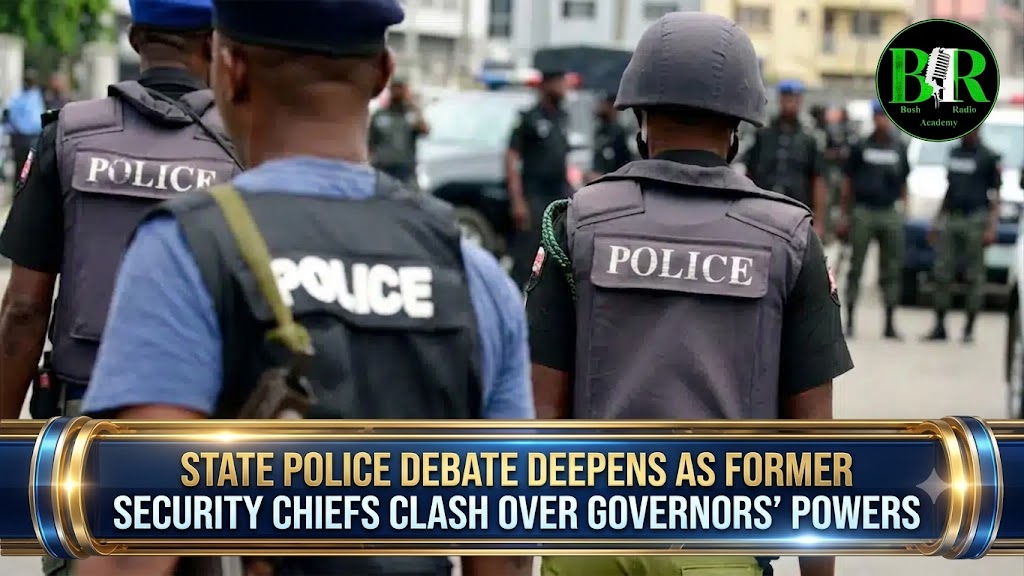
Retired military and police officers have offered differing opinions on the level of authority governors should exercise under the proposed state police framework, with many stressing the need for safeguards to prevent political abuse.....KINDLY READ THE FULL STORY HERE▶
The debate comes amid renewed demands by state governors for greater constitutional control over security operations within their states, as well as guaranteed funding mechanisms for the proposed State Police Services.
The governors’ position emerged from a strategic meeting organised by the Nigeria Governors’ Forum (NGF) Secretariat in Abuja, bringing together state Attorneys-General, legal experts and senior security stakeholders to discuss the future of policing in Nigeria.
The discussions gained further momentum following President Bola Tinubu’s transmission of a Constitution Alteration Bill to the National Assembly seeking the establishment of state police across the country. Senate President, Godswill Akpabio, has urged lawmakers to be present as the upper chamber prepares to debate the proposal.
Speaking on the issue, retired Brigadier-General Peter Aro described state policing as a critical security reform that should be approached as a professional initiative rather than a political project.
According to him, governors should be granted sufficient authority to address local security challenges, but such powers must be clearly defined within constitutional limits. He argued that decentralised policing would only succeed if issues relating to operational control, funding and oversight are properly structured.
Aro maintained that state police should be responsible for internal security functions such as intelligence gathering, investigations and community policing, while matters involving presidential and National Assembly elections should remain under federal control to ensure neutrality.
He also warned against the possibility of politically motivated prosecutions, suggesting the creation of independent judicial and security review mechanisms to scrutinise sensitive cases before prosecution.
Similarly, retired Assistant Inspector-General of Police Ali Amodu supported significant involvement by governors in the administration of state police, noting that state governments would bear responsibility for funding, equipping and maintaining the force.
Amodu argued that since governors are recognised by the Constitution as chief security officers of their states, they should naturally have substantial influence over the operation of state police services.
While acknowledging concerns about potential abuse of power, he stressed that Nigeria’s worsening security challenges require urgent solutions rather than prolonged debates. He suggested that any shortcomings in the system could be addressed through future reforms once implementation begins.
Retired Brigadier-General George Edim also backed the proposal, saying governors should be entrusted with greater security responsibilities as part of the country’s democratic and decentralisation process.
According to him, excessive reliance on the Federal Government for security matters has proven ineffective, and empowering governors could improve responses to local threats such as kidnapping, banditry and communal conflicts.
Edim argued that the potential benefits of state policing outweigh the risks, provided proper institutional structures and accountability mechanisms are established.
However, retired Assistant Inspector-General of Police Wilson Inalegwu expressed reservations about granting governors broader powers, insisting that robust oversight structures must accompany any state police arrangement.
Inalegwu questioned the specific powers being sought by governors and warned against creating a system that could be vulnerable to political interference.
He explained that under the proposed dual-policing structure, the federal police would continue to handle crimes that cut across state boundaries, including cybercrime, kidnapping, banditry, human trafficking and other transnational offences, while state police would focus on local security issues.
According to him, policing powers are too extensive to be placed entirely under the control of political office holders without effective checks and balances.
He pointed to existing institutions such as the Police Service Commission and the National Police Council as examples of oversight mechanisms that help prevent abuse at the federal level and argued that similar structures would be required for state police.
Inalegwu further cautioned that governors could be tempted to use state police for political purposes, including targeting critics or opponents, if adequate safeguards are not put in place.
He maintained that governors already possess considerable influence over security operations in their states and suggested that some of the powers being requested could undermine constitutional principles and due process.
The retired police chief emphasised that law enforcement agencies must remain guided by the rule of law rather than political directives, noting that commissioners of police are obligated to follow legal procedures regardless of pressure from elected officials.
As discussions continue, stakeholders remain divided over the extent of governors’ authority under a future state police system, though there appears to be broad agreement that any decentralised policing structure must be accompanied by strong accountability and oversight measures.


Trump Takes Action: Investigation Begins As Americans Grapple With Higher Fuel Costs

Without Fayose, No Makinde Governorship’ — Isaac Sparks Controversy

Democracy-Era Dispute Erupts As NADECO Challenges Abdulsalami’s Narrative

Nigerians React As Onanuga Questions Scale Of Economic Hardship

State Police Debate Deepens As Former Security Chiefs Clash Over Governors’ Powers

Family Speaks: How General Abubakar Died, Reveals Wife Still In Bandits’ Captivity

Sh*cking Police Shake-Up As Oyigbo DPO Is Removed Over ₦500,000 Bribery Allegation

Dollar To Naira Sh*ck: Fresh Exchange Rate Revealed For June 21, 2026

Etinosa Reacts To Viral Concerns About Her Neck Size, Says She Is Healthy
