
Latest
Democracy-Era Dispute Erupts As NADECO Challenges Abdulsalami’s Narrative

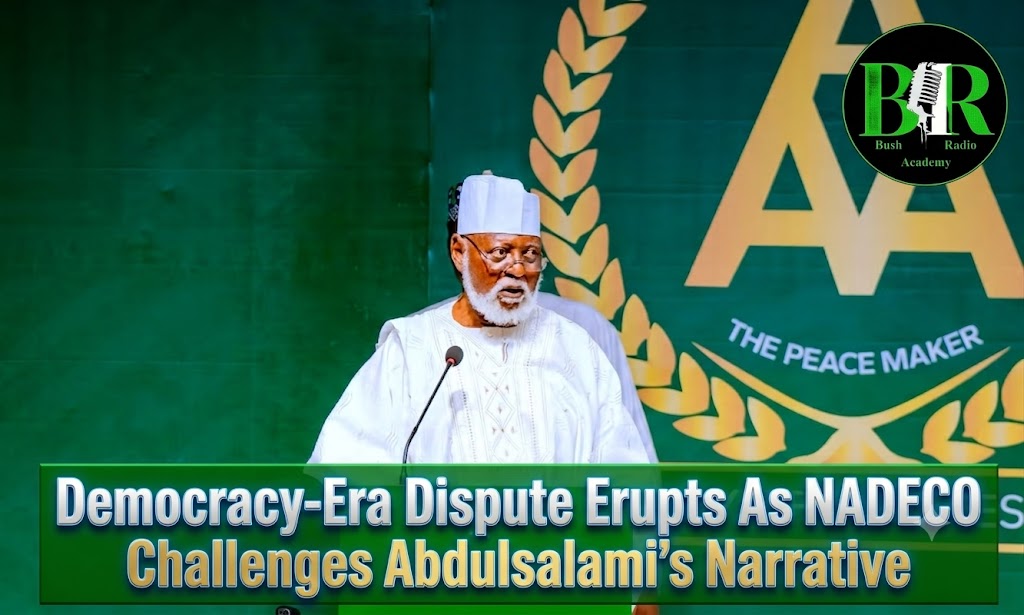
Prominent leaders of the National Democratic Coalition (NADECO), retired Colonel Tony Nyiam and Chief Ayo Opadokun, have strongly disputed claims by former Head of State, General Abdulsalami Abubakar (retd.), that members of the pro-democracy movement urged him to prolong military rule after he assumed office in 1998.....KINDLY READ THE FULL STORY HERE▶
The NADECO chieftains also challenged Abdulsalami’s assertion that the late Chief MKO Abiola, widely regarded as the winner of the annulled June 12, 1993 presidential election, was not poisoned before his death.
In his recently released autobiography, Call of Duty, Abdulsalami stated that some NADECO leaders privately requested an extension of the military transition programme following his emergence as Head of State.
Reacting to the claim, Nyiam said he was unaware of any recognised leader of the coalition who made such a request, insisting that NADECO’s primary objective was to end military rule and restore democratic governance.
According to him, the coalition, under the leadership of the late Chief Anthony Enahoro, consistently advocated a return to civilian rule and the establishment of a democratic framework rooted in the will of the people.
Nyiam recalled that Abdulsalami had sent emissaries to engage NADECO leaders in exile, including President Bola Tinubu, who was based in London at the time. However, he maintained that none of the prominent figures within the movement ever called for an extension of military rule.
He argued that such a request would have contradicted the very struggle NADECO was championing, which was aimed at ending military governance in Nigeria.
Supporting Nyiam’s position, former NADECO General Secretary, Chief Ayo Opadokun, said Abdulsalami may have misunderstood the discussions held with coalition members abroad.
According to Opadokun, what NADECO advocated was the development of a people-oriented constitution that would provide a stable foundation for democratic governance before elections were conducted.
He explained that the coalition’s proposal centred on a government of national unity led by Chief MKO Abiola rather than any extension of military rule.
Nyiam also questioned Abdulsalami’s account of the circumstances surrounding Abiola’s death, expressing doubt over the former military ruler’s assertion that no foul play was involved.
He stated that available accounts and evidence over the years have continued to raise questions about the circumstances leading to Abiola’s death, maintaining that many Nigerians remain unconvinced by official explanations.
According to Nyiam, there is a widely held belief among pro-democracy activists that forces opposed to Abiola’s presidency played a role in preventing him from assuming office, a view he said cannot be easily dismissed.


Trump Takes Action: Investigation Begins As Americans Grapple With Higher Fuel Costs

Without Fayose, No Makinde Governorship’ — Isaac Sparks Controversy

Democracy-Era Dispute Erupts As NADECO Challenges Abdulsalami’s Narrative

Nigerians React As Onanuga Questions Scale Of Economic Hardship

State Police Debate Deepens As Former Security Chiefs Clash Over Governors’ Powers

Family Speaks: How General Abubakar Died, Reveals Wife Still In Bandits’ Captivity

Sh*cking Police Shake-Up As Oyigbo DPO Is Removed Over ₦500,000 Bribery Allegation

Dollar To Naira Sh*ck: Fresh Exchange Rate Revealed For June 21, 2026

Etinosa Reacts To Viral Concerns About Her Neck Size, Says She Is Healthy
