
Latest
2027 Twist: Appeal Court Reserves Judgment In ADC Deregistration Battle

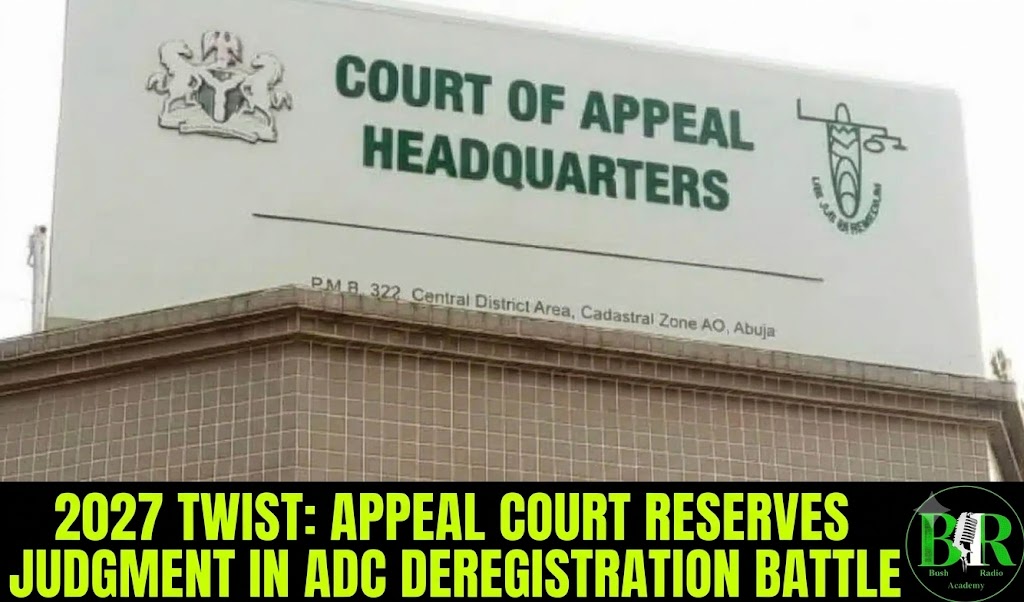
The Court of Appeal in Abuja on Tuesday reserved judgment in the appeals challenging a Federal High Court ruling that directed the Independent National Electoral Commission (INEC) to deregister the African Democratic Congress (ADC) and four other political parties.....KINDLY READ THE FULL STORY HERE▶
A three-member panel headed by Justice Abba Mohammed reserved judgment after counsel representing all parties adopted their final written addresses. The court said the date for delivering its verdict would be communicated to the parties in due course.
The other political parties involved in the appeal are the Action Peoples Party (APP), Action Alliance (AA), Accord Party (AP), and Zenith Labour Party (ZLP).
Earlier, on June 16, the Court of Appeal suspended the execution of the Federal High Court judgment pending the determination of the appeals.
The appellate court also faulted the trial judge, Justice Peter Lifu, for proceeding to deliver judgment despite an earlier directive ordering him to stay further proceedings.
The court noted that it had, on May 22, instructed Justice Lifu to halt all action in the matter pending the resolution of an interlocutory appeal filed by the affected parties.
According to the appellate panel, the lower court was duly notified of the order but went ahead to deliver its judgment regardless.
The justices described the action as “a form of judicial impertinence” and referenced a previous Supreme Court decision which characterised the disregard of a superior court’s order as “judicial rascality” capable of rendering a judge “unfit for the bench.”
High Court Ordered Deregistration of Five Parties
Justice Lifu had ruled that INEC should deregister the ADC, APP, AA, AP, and ZLP after holding that the parties failed to satisfy the constitutional requirements for retaining their registration.
The court also restrained INEC from recognising the affected parties or accepting candidates sponsored by them in future elections, including the 2027 general election.
In addition, the judgment barred officials of the parties from presenting themselves as leaders or representatives of registered political parties.
The ruling followed a lawsuit filed by the National Forum of Former Legislators.
Former Lawmakers Challenge Parties’ Continued Registration
In the suit marked FHC/ABJ/CS/2637/2026, the forum asked the court to determine whether INEC was constitutionally obligated to deregister political parties that failed to meet the electoral performance thresholds stipulated under the law.
The plaintiffs relied on Section 225A of the 1999 Constitution (as amended), relevant provisions of the Electoral Act 2022, and INEC’s regulations.
They argued that political parties are required to secure at least 25 percent of the votes cast in a state during a presidential election or win at least one elective office at the federal, state, or local government level to remain registered.
According to the former lawmakers, the five affected parties failed to meet these constitutional benchmarks during the 2023 general elections and subsequent by-elections.
They further contended that allowing the parties to retain their registration despite their poor electoral performance would undermine the credibility and integrity of Nigeria’s electoral process.


Senate Rejects Makinde’s Call For UN Probe Into Oyo School Abduction

Major Shake-Up: Tinubu Names Suleiman, Teriba, Others To Key Economic Advisory Committee

2027 Twist: Appeal Court Reserves Judgment In ADC Deregistration Battle

Breaking: PFIPC DG Adeniyi Adeyemi Arrested After Court Issues Warrant (Video)

NDC To Makinde: UN Investigation Will Reveal What Really Happened In Oyo School Abduction

Fresh Twist: Leaked Documents Reveal SGF Office’s Role In PFIPC Controversy

BREAKING: Petrol Price Could Crash Below ₦800 As FG, Marketers Reach Key Understanding

Aisha Opens Up: Buhari’s Greatest Legacy Finally Revealed

Iyabo Ojo Reveals Why She Welcomed Her Ex-Husband To Their Daughter’s Wedding
