
Latest
I Deceived Nobody’ — Obasanjo Fires Back At Osoba, Accuses Atiku Of Bankrolling Impeachment Plot

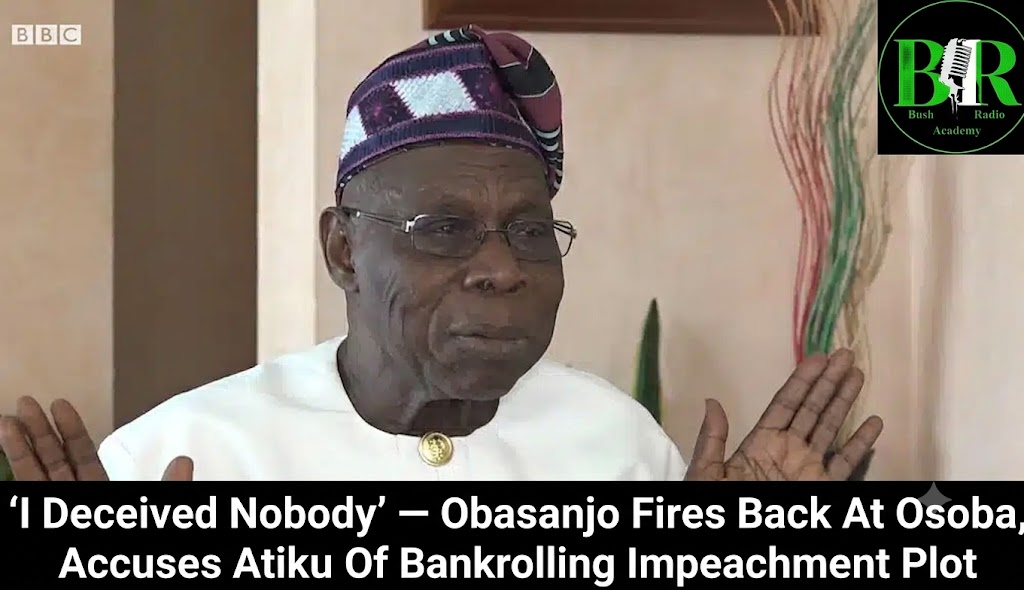
Former President Olusegun Obasanjo has dismissed claims by former Ogun State Governor, Chief Olusegun Osoba, that he deceived the Alliance for Democracy (AD) and Afenifere ahead of the 2003 general elections, insisting he never misled anyone.....KINDLY READ THE FULL STORY HERE▶
Obasanjo also accused former Vice-President Atiku Abubakar of financing an impeachment plot against him during his first term in office and attempting to frustrate his re-election bid through political alliances.
The former president made the allegations in a statement titled “Reply to Your Inaccurate Posture: ‘How Obasanjo Deceived Us in 2003’,” issued in response to an article written by Osoba and published in The Legal Observer on July 20.
Describing Osoba’s account as inaccurate and incomplete, Obasanjo argued that the former governor was not privy to several high-level political discussions that shaped the events leading to the 2003 elections.
“I take strong and serious objection to your calling me a deceiver because I deceived nobody,” Obasanjo said, insisting that he had always presented issues as he understood them without misleading anyone.
He maintained that some negotiations involving senior leaders of Afenifere and the Alliance for Democracy were handled by party elders and were beyond Osoba’s knowledge at the time.
Obasanjo also defended the outcome of the 2003 governorship elections, in which the Peoples Democratic Party (PDP) won five of the six South-West states previously controlled by the AD.
According to him, the election results reflected the will of the people, except in one state where he alleged the figures were manipulated.
“Your loss or defeat in 2003 was genuine in all the six states except the one where the figures were successfully and murderously changed,” he said.
The former president further claimed that Osoba mounted little campaign before the election and later apologised publicly to Ogun residents for what he described as an arrogant public image.
Turning to the impeachment saga during his administration, Obasanjo alleged that Atiku encouraged the then Speaker of the House of Representatives, the late Ghali Na’Abba, to commence impeachment proceedings against him.
He claimed Atiku invited Na’Abba to his office while he was away and handed him ₦5 million to kick-start the process.
“Na’Abba’s impeachment began at the Presidency by the Vice-President… He gave him ₦5 million to begin his impeachment work. It was all noted, recorded and reported to me by my Chief of Staff, a professional intelligence officer,” Obasanjo alleged.
He said he dismissed the impeachment move because he believed he had committed no offence that warranted removal from office.
Obasanjo also alleged that after the impeachment plan failed, Atiku sought political alliances aimed at denying him a second term. According to him, one proposal involved an arrangement with the six AD governors in the South-West under which they would face no serious opposition in the 2003 elections in exchange for backing Atiku’s presidential ambition in 2007.
He claimed the governors accepted the proposal after being told he supported it, insisting that the claim was false.
Reflecting on his return to politics after leaving prison, Obasanjo said he was persuaded by several political leaders from across the country to seek the presidency, adding that he deliberately consulted widely before joining the PDP because he wanted a platform with national appeal rather than one rooted in regional politics.
He reiterated his long-standing opposition to ethnic-based politics, saying he declined invitations to join the Alliance for Democracy because he viewed the party as largely regional in outlook.
Obasanjo also defended his decision to appoint members associated with the AD into his administration after assuming office in 1999, describing the move as part of efforts to promote national unity and reintegrate the South-West into mainstream national politics.
Rejecting Osoba’s claim that his administration depended on the six AD governors for stability, Obasanjo said his government already enjoyed the backing of the PDP, governors from other parties, the National Assembly and the Federal Executive Council.
He argued that it was illogical to suggest that six governors could dictate the direction of a federal administration supported by a much broader political coalition.
While criticising Afenifere for what he described as its failure to move beyond ethnic politics, Obasanjo maintained that political disagreements should never destroy personal relationships.
Despite their differences, he commended Osoba for allocating the land on which the Olusegun Obasanjo Presidential Library in Abeokuta was built, describing it as one of the former governor’s greatest contributions.
He concluded by urging politicians to embrace humility and preserve personal relationships, stressing that political rivalry should never outlive mutual respect.


Petrol Price Hike Sparks Fresh Concerns As Pump Prices Climb Nationwide

Fresh Twist: US Lawmaker Moves Motion Seeking Nnamdi Kanu’s Release

You Can’t Speak For The Southeast’ — Otti Fires Back At Uzodinma Over Tinubu’s 2027 Bid

Dangote Refinery Secures Massive $2.5 Billion In Landmark Private Equity Deal

Political Shake-Up: El-Rufai’s Associate Wins Fierce ADC Governorship Ticket Contest In Ogun

Mystery Deepens: New Details Surface In Mary Habila Death Investigation

Edo Governor Makes Major Shake-Up, Approves 20 Fresh Appointments

Oshiomhole Breaks Ranks, Opposes Fasina’s Confirmation Over Sexual Harassment Allegations

The Truth Must Be Told!’ – Full Text Of Umahi’s Explosive Remarks On Mary Habila’s Controversial Death
