
Latest
VAR Shake-Up! UEFA Refereeing Chiefs Tighten Rules On Match-Changing Reviews

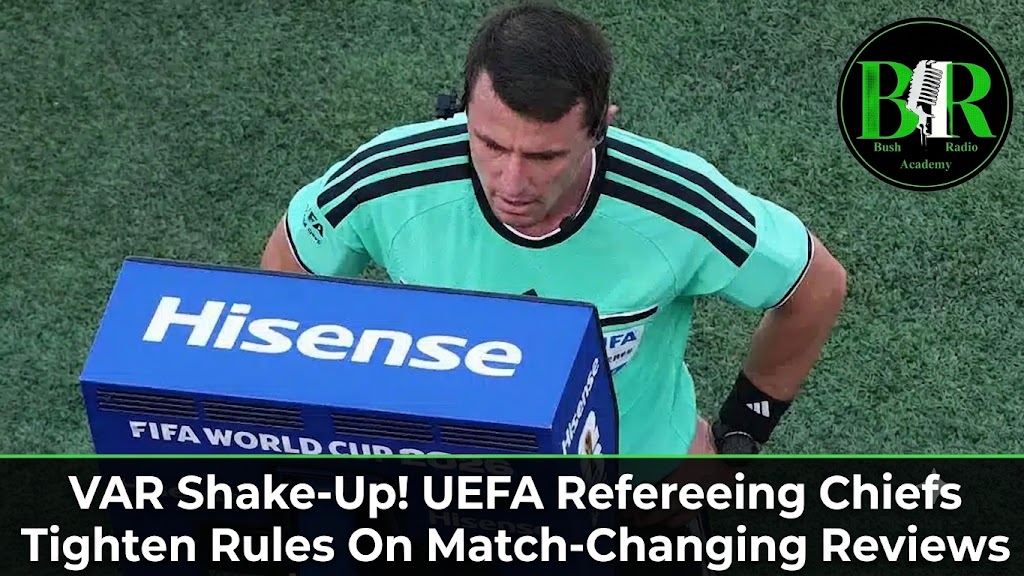
Europe’s top football refereeing officials have urged a return to the original purpose of the Video Assistant Referee (VAR), stressing that the technology should only be used to overturn “blatantly incorrect” decisions or correct obvious missed incidents.
The position was reached during a meeting involving chief refereeing officers from all 55 UEFA member associations, UEFA’s refereeing committee, and a representative of the International Football Association Board (IFAB).
The officials reviewed recent changes to the Laws of the Game and expressed concern that VAR has increasingly been used beyond the role it was originally designed to perform.
Introduced into football’s laws by IFAB in 2018, VAR was built around the principle of “minimum interference, maximum benefit,” with the aim of correcting clear mistakes involving goals, penalties, straight red cards and cases of mistaken identity.
However, refereeing chiefs believe the system has gradually evolved into a tool for lengthy reviews of marginal incidents that do not meet the threshold for intervention.
In a statement, UEFA said: “It was reiterated that, in accordance with protocol, VAR must only intervene in situations of ‘clear and obvious’ error — when a referee’s decision is blatantly incorrect or when a clear incident has been missed.
“VAR is not intended to re-referee matches. It exists to support referees, who must remain at the centre of the decision-making process.
“Lengthy and microscopic reviews often indicate that the original decision was not clearly or obviously wrong, and such interventions should therefore be kept to a minimum.”
The meeting also addressed IFAB’s recent clarification on the revised mistaken identity rule introduced ahead of this summer’s World Cup.
Under the updated interpretation, VAR may intervene when disciplinary action is mistakenly taken against the wrong player following an incident.
Switzerland striker Breel Embolo became the first player affected by the revised rule after being controversially sent off for a second yellow card for simulation during a match against Argentina, following VAR intervention after Leandro Paredes had initially been cautioned.
IFAB later clarified that VAR’s role in such situations is limited to identifying the correct player responsible for the offence and cannot be used to review or change the nature of the offence itself.
Refereeing officials also unanimously endorsed recently introduced measures aimed at reducing time-wasting and improving match flow. These include stricter limits for goal-kicks, throw-ins and substitutions, as well as new regulations governing on-field injuries and goalkeeper tactical delays.


VAR Shake-Up! UEFA Refereeing Chiefs Tighten Rules On Match-Changing Reviews

Real Madrid Make Final Push To Keep Vinicius As Arsenal Circle

BREAKING: Rimin-Gado Draws Battle Line, Tells Politicians ‘Don’t Ask Me To Free Thugs

Kebbi 2027 Twist: Court Speaks On Move To Remove Malami As ADC Governorship Candidate

Makinde Unveils Two High-Tech Surveillance Aircraft Worth ₦7.76 Billion

Fear Grips Kidnappers, Bandits as Okpebholo Deploys 497 Forest Guards Across Edo

Fresh Details Emerge On Operation That Led To PFIPC ‘Fake DG’ Adeyemi’s Arrest

El-Rufai’s Medical Report Sparks Fresh Crisis As MDCAN Probes Doctor, ICPC Files Charges

Why Is It Not Implemented?’—Lawmaker Blasts FG Over 2025 Budget Delay
