
Latest
State Police Debate: Senate Reveals Why FCT Was Excluded

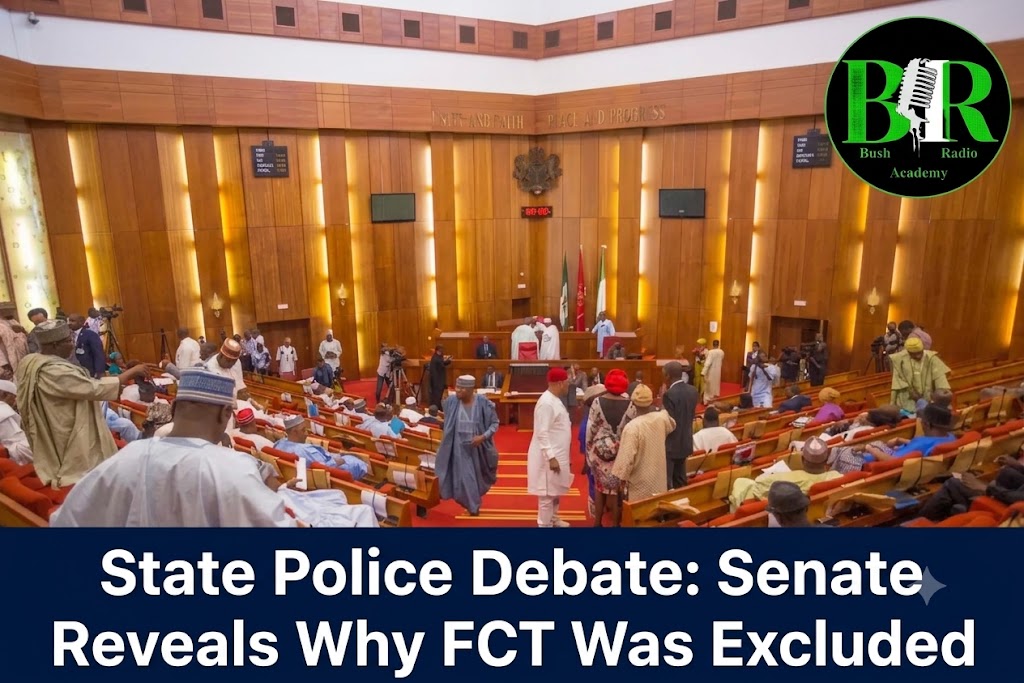
The Senate has explained that the Federal Capital Territory (FCT) was excluded from the proposed state police framework because it does not have the constitutional structures associated with a state, such as an elected governor and House of Assembly.
The Chairman of the Senate Committee on Media and Publicity, Yemi Adaramodu, gave the explanation on Friday while responding to questions about the omission of the FCT from the emerging framework for decentralised policing.
According to Adaramodu, the FCT remains under the direct administration of the Federal Government and is constitutionally distinct from Nigeria’s 36 states.
“I have heard many people raise a lot of questions on why the Federal Capital Territory is not among the plan for state police. The FCT issue is different. It is under the Federal Government,” he said.
The Ekiti State lawmaker explained that the territory is administered by a minister who operates under the Federal Executive Council, unlike the states, which are headed by elected governors.
“Again, the FCT does not have a governor. It is run by a minister who subscribes to the Federal Executive Council. It is from this FEC that the FCT takes directives and its administrative relevance,” Adaramodu stated.
He also noted that legislative authority over the FCT rests with the National Assembly because the territory does not have its own legislative assembly.
“So, the federal capital does not have an assembly. It is the National Assembly that legislates for the FCT. This is why it can’t be different from what the Federal Government does. Therefore, the federal police are in charge,” he said.
The clarification comes as the Federal Government advances plans to introduce a new policing structure following sustained calls for greater decentralisation of the Nigeria Police Force (NPF).
The Presidency had announced that President Bola Tinubu was expected to receive the draft Executive National Policing Bill on September 3 as part of efforts to reform the country’s policing architecture.
The Chief of Staff to the President and Chairman of the Presidential Working Group on the National Policing Bill, Femi Gbajabiamila, disclosed this after a meeting of the group at the Presidential Villa in Abuja.
Gbajabiamila also unveiled a public information portal through which Nigerians can submit memoranda and position papers on the proposed legislation.
While the proposed constitutional amendment is expected to provide the legal basis for the establishment of state police, the Executive Bill would define the operational framework for the new policing system.
Under the proposed arrangement, state Houses of Assembly would have authority to legislate on the establishment, administration, funding and oversight of state police formations.
State governments would bear the primary responsibility for financing their police forces, although federal grants or other forms of assistance could also be made available.
A proposed Section 216A provides that the Federal Government may provide grants or assistance to state police based on the recommendation of the National Police Council and subject to approval by the National Assembly.
However, the provision does not specify a fixed federal contribution, funding formula or guaranteed revenue allocation for state police.
FCT Remains Under Federal Policing
Under the proposed framework, state governments would largely finance their police formations, while access to federal support would depend on recommendations from the National Police Council and approval by the National Assembly.
The council is chaired by the President and comprises senior federal and state officials.
Adaramodu, however, maintained that the FCT would remain outside the state police arrangement because its administrative and legislative functions continue to be exercised at the federal level.


PFIPC Probe Deepens As Police Reveal Details Of Adeyemi’s Alleged ₦400m Spending

Five Govt Officials Fingered in PFIPC Scandal — Police Reveal

State Police Debate: Senate Reveals Why FCT Was Excluded

Fresh Twist In P-Square Feud As Henry Reveals Alleged Architect Of Family Division

EFCC Has Three Days To Freeze Account’ — Tietie Explains Commission’s Powers

Explosive Details Surface As Full List Of Alleged Sylva Coup Fund Beneficiaries Emerges

This Is Why He Was Arrested’ — Osun Speaker Breaks Silence On SSG Saga

Army Gets New Leadership Boost As COAS Shaibu Appoints Commanders For Tinubu’s New Divisions

She Should Resign!’ — Reuben Abati Fires At Head Of Civil Service Over PFIPC Controversy
