
Full List: Meet All Democratically Elected Governors Who Have Ruled Adamawa State
 Follow us on Google News
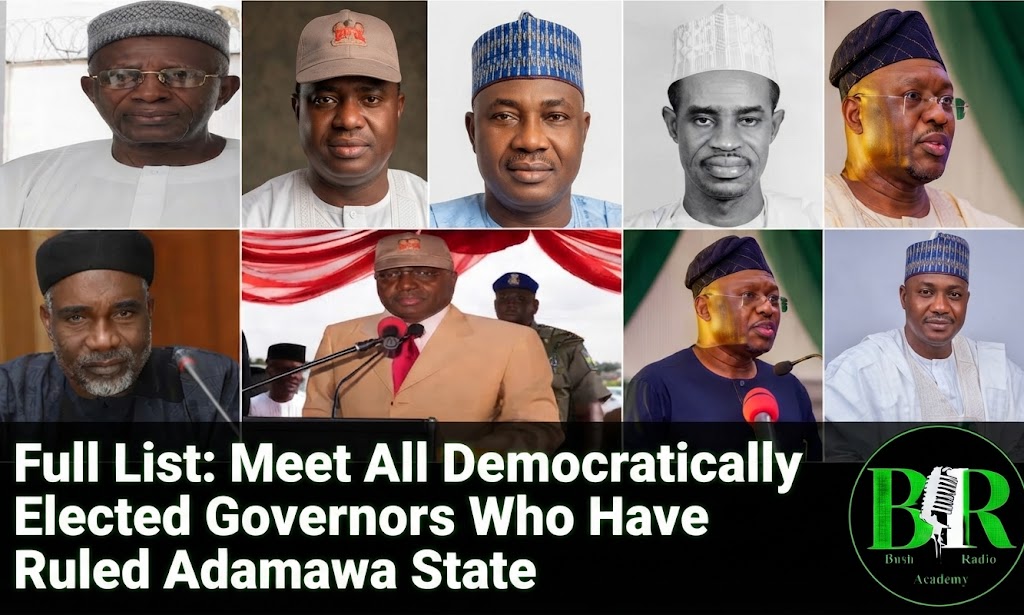
Adamawa State has experienced both military and civilian administrations since its creation in 1991, with democratic rule interrupted during periods of military intervention before the return of uninterrupted democracy in 1999.
According to Bush Radio Academy, Adamawa State was created on August 27, 1991, after the former Gongola State was divided into Adamawa and Taraba states. Since then, the Government House in Yola has been occupied by military administrators, acting governors and politicians who emerged through democratic elections.
However, only a number of politicians have secured the mandate to govern the state through democratic elections.
They include Abubakar Saleh Michika, Boni Haruna, Murtala Nyako, Mohammed Umaru Jibrilla Bindow and Ahmadu Umaru Fintiri.
Bala James Ngilari also served as a substantive governor during the democratic era, although he did not win a governorship election. He assumed office after a court ruling determined that, as deputy governor, he was constitutionally entitled to succeed Murtala Nyako following his impeachment.
Abubakar Saleh Michika became the first democratically elected governor of Adamawa State. He contested the 1991 governorship election on the platform of the National Republican Convention (NRC) and emerged victorious during Nigeria’s transition to the Third Republic.
The governorship election was held on December 14, 1991, while Michika and his deputy, Lynn Nathan, were inaugurated on January 2, 1992.
His administration was cut short when the military returned to power on November 17, 1993, bringing an end to the Third Republic. Michika therefore spent less than two years in office. He died on March 10, 2018.
Following Nigeria’s return to democratic rule in 1999, Boni Haruna became governor of Adamawa State under the Peoples Democratic Party (PDP).
Haruna’s emergence followed a unique political development involving former Vice President Atiku Abubakar, who had initially won the governorship election with Haruna as his running mate. Atiku was later selected as the running mate to PDP presidential candidate Olusegun Obasanjo, paving the way for Haruna to assume the governorship.
Haruna was sworn in on May 29, 1999, and later contested the governorship in his own right. He won re-election in 2003 and remained in office until May 29, 2007, completing eight years as governor.
Although an election tribunal initially nullified his 2003 victory, the Court of Appeal later overturned the decision.
Murtala Nyako succeeded Haruna in 2007 after winning the governorship election on the PDP platform. He was sworn in on May 29, 2007.
Nyako’s initial election was later annulled, leading to another governorship election in 2008, which he won. Following further legal developments surrounding gubernatorial tenures, another election was conducted in Adamawa in February 2012, with Nyako again emerging victorious on the PDP platform.
He later defected from the PDP to the All Progressives Congress (APC).
Nyako’s administration came to an abrupt end on July 15, 2014, when the Adamawa State House of Assembly impeached him over allegations of gross misconduct.
Although the Court of Appeal later declared his impeachment unconstitutional in 2016, Nyako could not return to office because his tenure had already elapsed.
His impeachment triggered a complicated succession process in the state. The then Speaker of the Adamawa State House of Assembly, Ahmadu Umaru Fintiri, initially became acting governor.
However, Nyako’s deputy, Bala James Ngilari, challenged the circumstances surrounding his purported resignation. A court subsequently ruled that Ngilari’s resignation had not been properly executed and determined that he was constitutionally entitled to succeed Nyako.
Ngilari consequently became substantive governor and served from October 2014 until May 29, 2015. Although he was not elected directly as governor, he remains part of Adamawa’s history of civilian administrations.
Mohammed Umaru Jibrilla, popularly known as Bindow Jibrilla, became governor following the 2015 general election.
Bindow contested under the APC and defeated his major opponents to emerge governor. He had previously represented Adamawa North Senatorial District in the National Assembly from 2011 to 2015.
He was sworn in on May 29, 2015, succeeding Ngilari.
Bindow sought re-election in 2019 but was defeated by PDP candidate Ahmadu Umaru Fintiri. Official results released by the Independent National Electoral Commission showed Fintiri polling 376,552 votes against Bindow’s 336,386, while Abdul-Azeez Nyako of the African Democratic Congress secured 113,237 votes.
Bindow left office on May 29, 2019, after serving one term.
Ahmadu Umaru Fintiri is the incumbent governor of Adamawa State and one of the state’s democratically elected leaders.
Before winning the governorship election, Fintiri had briefly served as acting governor following Nyako’s impeachment and the subsequent political and legal developments.
He later contested the 2019 governorship election on the PDP platform. The election proceeded to a supplementary poll before Fintiri was declared winner with 376,552 votes, defeating incumbent Bindow Jibrilla.
Fintiri was sworn in on May 29, 2019.
He sought a second term in 2023 and faced a strong challenge from APC candidate Senator Aishatu Dahiru Ahmed, popularly known as Binani.
Following the main election and supplementary poll, INEC declared Fintiri the winner with 430,861 votes, while Binani received 398,788 votes.
The outcome was challenged in court, with the dispute eventually reaching the Supreme Court, which upheld Fintiri’s victory and allowed him to continue serving as governor of Adamawa State.

Comments
0 comments