
Latest
Cooking Gas Price Shock: See How Prices Have Changed In Nigeria From 2002 Till Date

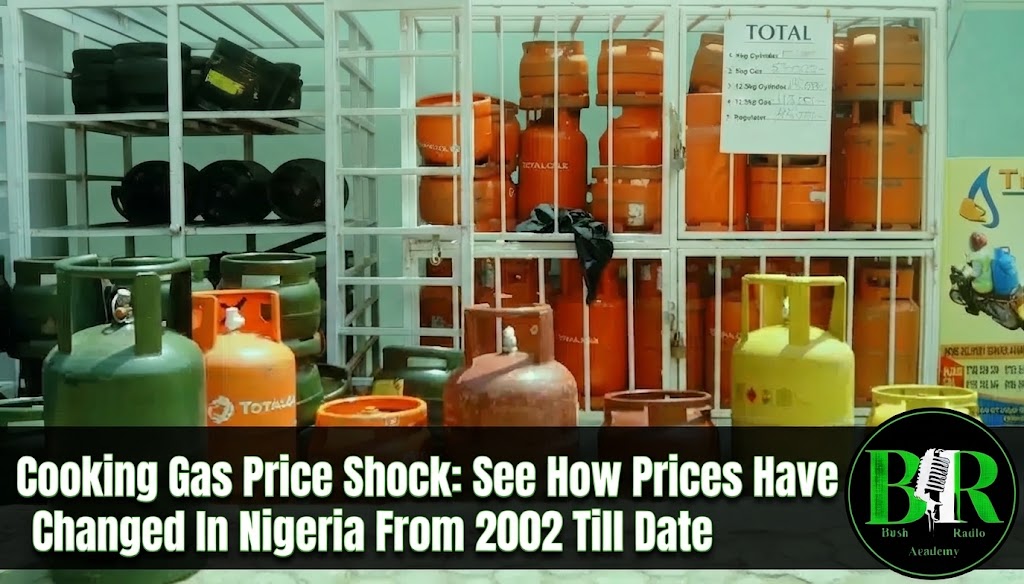
The price of Liquefied Petroleum Gas (LPG), popularly known as cooking gas, has risen dramatically in Nigeria over the past two decades, moving from about ₦100 per kilogramme in the early 2000s to between ₦1,250 and ₦1,650 per kilogramme in some parts of the country by August and September 2026.
According to Bush Radio Academy, the sharp increase reflects a combination of factors, including changes in domestic LPG production, import dependence, foreign exchange fluctuations, transportation costs, inflation, depot prices and periodic supply shortages.
Reliable nationwide retail data for the early years of the Fourth Republic are limited. However, historical records indicate that cooking gas could be purchased for roughly ₦100 per kilogramme in parts of Nigeria during the early 2000s.
A World Bank study on Nigeria’s LPG sector found that a 12.5kg cylinder in Lagos was generally sold for between ₦1,200 and ₦1,300 at the time. That translated to approximately ₦96 to ₦104 per kilogramme. During periods of scarcity, however, prices reportedly climbed as high as ₦1,800 to ₦2,000 for 12.5kg, equivalent to about ₦144 to ₦160 per kilogramme.
By 2004 and 2005, LPG prices had become more volatile, with reports indicating that a 12.5kg refill could sell for around ₦1,700 under normal conditions, translating to approximately ₦136 per kilogramme. Severe shortages, however, reportedly pushed the price as high as ₦5,500 for 12.5kg, equivalent to about ₦440 per kilogramme.
The upward trend continued into 2006, when a 12.5kg refill was reported to have reached approximately ₦2,600, putting the equivalent price at about ₦208 per kilogramme.
In 2007, consumers reportedly paid between ₦2,200 and ₦3,000 to refill a 12.5kg cylinder, translating to roughly ₦176 to ₦240 per kilogramme. The period was also notable for efforts to increase domestic LPG supply, including initiatives by Nigeria LNG to make more cooking gas available to the local market.
Between 2008 and 2010, available historical reports suggested that a 12.5kg refill generally sold for between ₦2,000 and ₦3,000 under normal market conditions. This placed the approximate cost at ₦160 to ₦240 per kilogramme, although prices varied depending on location and supply conditions.
Another notable increase occurred around late 2010 and early 2011, when LPG shortages reportedly pushed the price of a 12.5kg cylinder to between ₦3,000 and ₦3,500. On a per-kilogramme basis, this represented approximately ₦240 to ₦280.
Similar prices were reported in 2012, with a 12.5kg refill selling for around ₦3,000 to ₦3,500 in parts of Lagos and Ogun States. During periods of scarcity, prices were significantly higher in some locations.
In 2013, the price reportedly moderated to about ₦2,500 to ₦3,000 for a 12.5kg cylinder in some areas, equivalent to approximately ₦200 to ₦240 per kilogramme. However, supply disruptions once again caused prices to surge, with some consumers reportedly paying between ₦4,000 and ₦5,000 for the same quantity.
The historical figures show that cooking gas prices have not followed a steady upward path, but have instead been affected by repeated periods of scarcity and market disruptions. Nevertheless, the long-term trend has been a substantial increase in the cost of LPG for Nigerian households.
More recent National Bureau of Statistics data illustrate the acceleration in prices. The average cost of a 12.5kg cylinder rose from ₦4,154.28 in December 2020 to ₦7,332.04 in December 2021, representing a 76.49 per cent increase.
By 2026, the pressure on consumers had intensified further. NBS data placed the average price of LPG at ₦1,572.23 per kilogramme in March and ₦1,790.58 per kilogramme in April. Later data from the Nigerian Midstream and Downstream Petroleum Regulatory Authority showed prices of around ₦1,325 per kilogramme in Lagos and ₦1,575 per kilogramme in Sokoto in July.
In some areas, prices reportedly crossed ₦2,000 per kilogramme during periods of acute scarcity in 2026, placing additional pressure on households already dealing with rising food, transportation and energy costs.
From approximately ₦100 per kilogramme in the early 2000s to well above ₦1,000 per kilogramme in 2026, the cost of cooking gas has increased several-fold, highlighting the dramatic changes in Nigeria’s energy market over the past 24 years.


I Made Over ₦10 Million Monthly Selling Akara And Bread — Governor Umo Eno Reveals

10 Years Later, Man Recalls Embarrassing Incident At GTBank

Falconets Ready For Tough Spain Clash, Coach Aduku Declares

Lagos Govt Issues Strong Warning To Husbands Over Forceful Sex With Wives

NDC Rejects INEC List, Says We Did Not Submit These Names

WHY OKPEBHOLO KNOWS WHAT HE IS SAYING ABOUT TINUBU’S 2.5 MILLION VOTES

Fake Agency Scandal: ICPC Recommends Punishment for 13 Officials — See Full List

Cement Hits ₦15,000: FCCPC Demands Answers From Dangote, BUA, Other Producers

Was The Sacrifice Worth It?” – El-Rufai’s Son Reveals What Father Told Him In Detention
