
Electricity Reform: Shettima Challenges States To Build Their Own Power Markets And Attract Investors
 Follow us on Google News
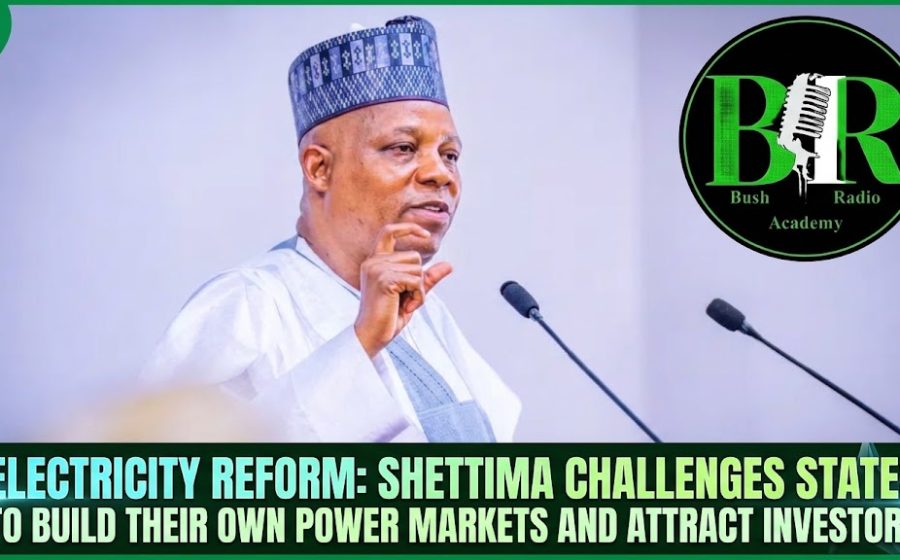
Vice President Kashim Shettima has called on state governments across Nigeria to stop relying exclusively on the Federal Government to address electricity challenges and instead establish functional power markets capable of attracting private-sector investment.
Shettima said reliable electricity remained essential to Nigeria’s ambition of building a strong industrial economy, stressing that businesses, households, hospitals and schools needed consistent power supply to operate effectively.
He made the call on Wednesday while declaring open a national stakeholders’ workshop on the implementation of the Electricity Act 2023 at the Presidential Villa in Abuja. He was represented at the event by the Deputy Chief of Staff to the President, Senator Ibrahim Hassan Hadejia.
The workshop brought together government agencies, electricity regulators and other stakeholders to review the implementation of the law and explore measures to improve power supply across the country.
According to Bush Radio Academy, Shettima said the Electricity Act 2023 had created opportunities for states to regulate electricity markets within their jurisdictions and develop solutions that reflect their available resources and economic priorities.
“Our states must shed the habit of waiting for Abuja to provide every answer,” the Vice President said.
He emphasised that improving electricity supply required a collective effort involving the Federal Government, state governments and private investors, rather than leaving the responsibility to the federal authorities alone.
Shettima urged states to harness their individual energy resources to develop viable electricity projects and stimulate economic growth. He identified the solar energy potential of Sokoto, Borno and Katsina states, the gas resources of Delta, Rivers and Bayelsa, as well as hydropower opportunities in Niger and Kebbi states.
According to him, effectively utilising these resources could strengthen agriculture, manufacturing, healthcare and education while expanding access to reliable electricity.
However, the Vice President cautioned that the passage of the Electricity Act alone would not resolve Nigeria’s power challenges. He said states must establish credible regulatory institutions and create an enabling environment that gives private investors confidence to commit resources to the sector.
He therefore urged states that had yet to establish their electricity regulatory bodies to begin the process without further delay.
Shettima also proposed a voluntary National Electricity Reform Peer Review and Implementation Framework involving the Nigerian Electricity Regulatory Commission (NERC), the Federal Ministry of Power, the Nigeria Governors’ Forum and state electricity regulators.
He explained that the proposed framework would enable states to exchange experiences, assess their progress in developing electricity markets, attract investment, protect consumers and expand access to power.
Earlier, the Permanent Secretary of the Ministry of Power, Mahmuda Mamman, said the success of the Electricity Act depended on states establishing credible regulatory institutions and commercially viable electricity markets.
Similarly, the Director-General of the Nigeria Governors’ Forum, Dr Abdulateef Shittu, said the organisation was working to strengthen cooperation between federal and state institutions in implementing electricity reforms.
Shittu also disclosed that efforts were underway to develop a standard tariff framework designed to protect consumers while encouraging private-sector investment in the electricity industry.
Meanwhile, NERC’s Deputy General Manager and Head of Compliance, Hauwa Yakubu, revealed that the commission had transferred regulatory responsibilities to 17 states, with Akwa Ibom emerging as the latest to receive the transfer.
The development represents another step towards decentralising electricity regulation and allowing states to play a more active role in improving power supply under the Electricity Act 2023.






Comments
0 comments