
Fresh Blow For Nigerian Students As UK Universities Tighten Admissions Over Visa Crisis
 Follow us on Google News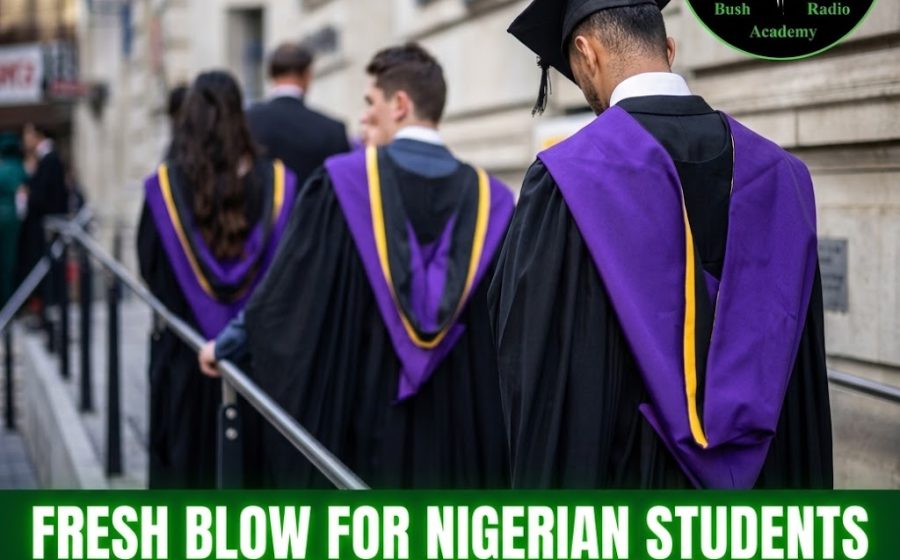
Universities across the United Kingdom are withdrawing admission offers to international students, including Nigerians and Pakistanis, amid a sharp increase in study visa refusals and concerns that institutions could lose the right to recruit students from overseas.
According to Bush Radio Academy, an analysis of UK Home Office data revealed that 22.7 per cent of Nigerian study visa applications were withdrawn in the first half of 2026, compared with 4.5 per cent during the corresponding period in 2025.
The figures also showed a significant increase among applicants from other countries. Pakistan’s withdrawal rate rose from three per cent to 40.9 per cent, while Bangladesh recorded an increase from 7.1 per cent to 23.5 per cent. For Indian applicants, the rate climbed from 1.2 per cent to 5.2 per cent.
Overall, 10.5 per cent of study visa applications were withdrawn between January and June 2026, compared with 2.3 per cent during the same period in 2025 and just 0.4 per cent in 2023.
International students generally need to secure admission from a university before applying for a study visa. When an institution subsequently withdraws its admission offer, the associated visa application is also withdrawn. Although applications can be withdrawn for several reasons, universities reportedly said the recent increase was largely linked to institutions revoking offers to avoid breaching stricter immigration compliance requirements.
Under the revised rules, universities risk losing permission to sponsor international students if more than five per cent of applicants offered admission are subsequently refused visas. The previous threshold was 10 per cent. The restrictions have placed additional pressure on institutions, particularly as visa refusals have reportedly increased among nationalities suspected by the government of using the student visa route to seek asylum.
Reports indicate that about 15 UK universities have suspended recruitment from Pakistan entirely this year. Data from visa-processing company Enroly also suggest that refusal rates at nearly half of universities exceed the new five per cent threshold.
University of Sunderland Vice-Chancellor, Sir David Bell, said some institutions had taken precautionary measures in response to the unexpected increase in visa refusals, including reducing recruitment from countries where visa applications were facing greater scrutiny.
Jamie Arrowsmith, director of Universities UK International, acknowledged the importance of maintaining public confidence in the immigration system but expressed concern about the unpredictability of visa processing.
He argued that some refusals appeared to be based on inconsistent and subjective assessments, leaving universities with little choice but to withdraw admission offers to remain within the permitted compliance limits.
University leaders have warned that the situation could worsen the financial challenges facing the higher education sector. International students provide a significant source of income for many UK institutions, and a decline in overseas enrolment could lead to staff reductions, course cancellations and campus closures.
Vanessa Wilson, chief executive of University Alliance, which represents 20 professional and technical universities, warned that the financial consequences could trigger institutional restructuring and job losses.
Some universities have reportedly raised concerns about the reasons given for visa refusals, citing cases in which applicants were rejected after previously considering studying in other countries. In another case, a PhD applicant was reportedly asked to identify course modules despite applying for a research degree that did not have conventional modules.
Professor Steven McGuire, deputy vice-chancellor of the University of East Anglia, said his institution began withdrawing offers from applicants in certain countries late last year after experiencing a sharp increase in visa refusals.
He described some of the decisions as arbitrary and poorly informed, recounting an instance in which an applicant was reportedly rejected after an interviewer appeared not to understand that the university was located in Norwich.
The developments have raised concerns among international applicants, including Nigerians hoping to study in Britain, as universities adjust their recruitment strategies to comply with tighter visa sponsorship rules and reduce the risk of losing their authorisation to admit overseas students.





Comments
0 comments