
IFEKANMA NNEWI AT 80: THE MAN, THE MIND, THE EXTRAORDINARY STORY
 Follow us on Google News
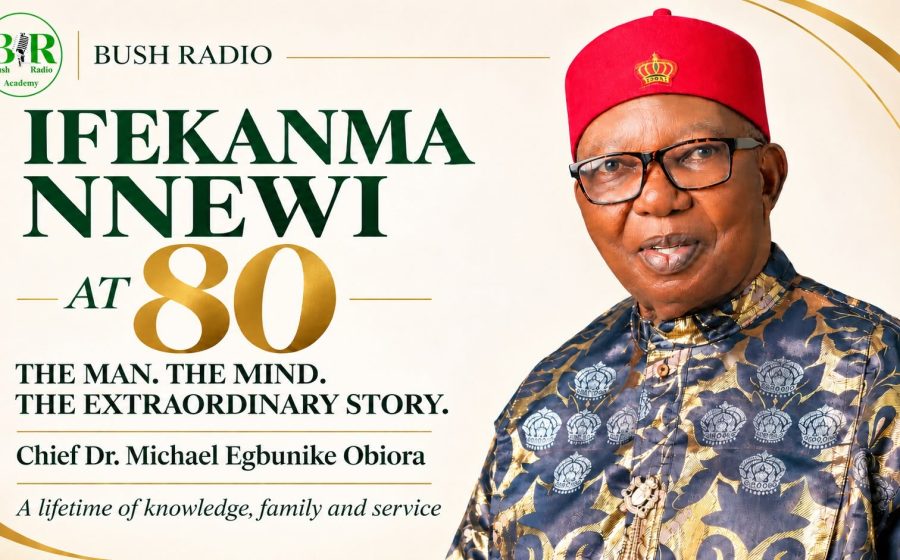
IFEKANMA NNEWI AT 80: THE MAN, THE MIND, THE EXTRAORDINARY STORY
Some lives invite celebration because of how long they have lasted. Others command attention because of what they have made possible. As Chief Dr. Michael Egbunike Obiora approaches his 80th birthday, his story offers compelling reasons for both.
There is something intriguing about a man who devoted his professional life to understanding the human mind while building his own life around a clear conviction: enlightenment is better than darkness.
That conviction finds expression in his title, Ifekanma Nnewi. It also provides a lens through which to understand a journey spanning education, clinical psychology, community service, marriage and fatherhood across two continents.
This December, Chief Dr. Michael Egbunike Obiora turns 80. The approaching milestone invites us beyond the familiar outline of a distinguished biography into the choices, relationships and convictions that gave it substance.
What makes a young man hold firmly to education when other paths appear more familiar? What sustains the determination to begin again in another country? And how does a life of professional accomplishment remain anchored in family and ancestral belonging?
The answers begin far from the birthday spotlight.
Born in 1946 on the Jos Plateau, Michael was the firstborn child of Chief Luke Obiora Maduike and Mercy Adiza Maduike. His father, a foreman in the tin mines, possessed the practical abilities of a man accustomed to building, repairing and providing. His mother came from Gombe, giving their son a family heritage that crossed regional boundaries.
As the firstborn, Michael encountered responsibility early. His progress would carry meaning for others, and the expectations placed upon him helped develop the discipline that became central to his outlook.
Education gave that discipline a direction.
While many young men around him looked towards commerce, he was drawn to the classroom. The influence of Dr. Nwafor Orizu strengthened that ambition, leaving him with a principle he would carry through life: once committed to a worthwhile purpose, keep moving forward.
That resolve would be tested. Having completed secondary school, he served during the Nigerian Civil War. Afterwards, he returned to the pursuit of learning, bringing to it the discipline of military experience and an undiminished desire to advance.
He earned his Bachelor of Science in Psychology from the University of Lagos in 1976, his Master of Science in Clinical Psychology from the University of Benin in 1983, and his doctorate in Clinical Psychology from the University of Lagos in 1991.
Behind those qualifications lay a consequential choice: to make the human mind his life’s work.
At the University of Benin Teaching Hospital and the University of Benin School of Medicine, he combined clinical responsibilities with teaching, contributing to the education of future healthcare professionals. His involvement in drug abuse training also reflected a sustained interest in people whose difficulties required understanding, skilled care and patience.
Further training in Cardiff broadened his clinical perspective. His move to the United States in 1993 opened another demanding chapter, with responsibilities in mental health services, addiction treatment and residential care in metropolitan Detroit.
Across these settings, a consistent purpose emerges: helping people whose circumstances could leave them misunderstood, overlooked or struggling to regain stability.
Yet an account built solely around academic qualifications and professional appointments would leave much of the man undiscovered.
One of the most revealing chapters began with a visit to a family in Zaria that had welcomed him years earlier. Seated in their reception room, he encountered a young woman named Theresa Nkemdilim.
That meeting became the beginning of a marriage now spanning 48 years.
Together, they raised five children and welcomed seven grandchildren. Theresa would also earn a master’s degree from the University of Benin after raising their children. She credits her husband’s encouragement; he credits her contribution to their shared journey.
Their story gives practical meaning to one of his strongest beliefs: marriage should be grounded in character, shared purpose and the willingness to help another person grow.
His understanding of education follows the same principle. Learning carries its fullest value when it expands another person’s possibilities. That belief connects his academic career with his support for his wife’s advancement, his community service and his commitment to younger generations.
His attachment to Nnewi adds another dimension. Through his involvement in community life and his December returns to his ancestral home, he has maintained a relationship with the traditions and people from whom part of his identity derives.
At 80, these strands come together: the firstborn’s sense of duty, the scholar’s persistence, the clinician’s concern for human wellbeing, the husband’s partnership and the community leader’s attachment to home.
The approaching celebration offers an opportunity to explore how those commitments were formed—and what they can teach those coming behind him.
There are stories still to hear, memories still to share and defining moments deserving a fuller telling. As the countdown begins, the portrait of Ifekanma Nnewi comes gradually into view.
Chief Dr. Michael Egbunike Obiora at 80: a life shaped by purpose, sustained by discipline and illuminated by the conviction that enlightenment is better than darkness.
@Bush Radio Academy.




Comments
0 comments