
Inside The Green Chamber: Full List Of 37 Constitutional Amendment Bills Put To Vote
 Follow us on Google News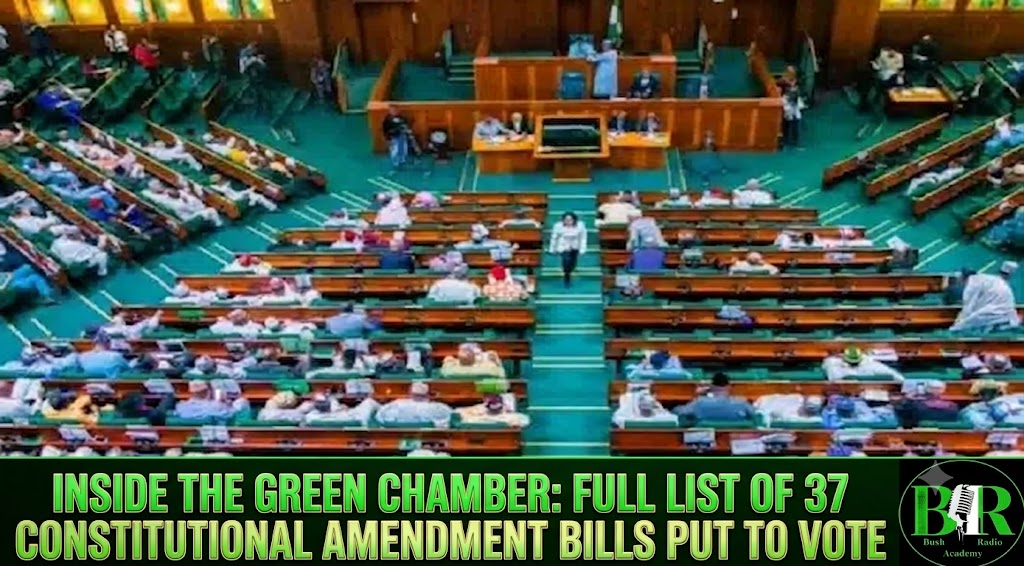
The House of Representatives is scheduled to vote today, Thursday, June 11, 2026, on 37 constitutional amendment bills covering key governance, electoral, security, and institutional reforms.
Lawmakers will also consider a high-profile proposal seeking the establishment of State Police across Nigeria.
The bills are grouped into thematic areas, including electoral reforms, judicial reforms, security and policing, local government administration, legislative procedures, devolution of powers, human rights protections, fiscal accountability, and traditional institutions.
Electoral Reform Bills (1–3)
The electoral reform proposals include provisions for independent candidacy in presidential, governorship, legislative, and local government elections, subject to signature requirements verified by INEC and SIEC.
Other proposals seek to strengthen State Independent Electoral Commissions by expanding their powers and setting stricter criteria for appointment, including non-partisanship and integrity standards.
A separate bill proposes the establishment of an Electoral Offences Commission to investigate and prosecute electoral crimes as an independent federal body.
Judicial Reform Bills (4–6)
The judicial reform package aims to reduce the workload of the Supreme Court by limiting appeals requiring leave and repositioning it as a court of policy, except in presidential and vice-presidential election disputes.
Another proposal seeks to enforce timelines for the resolution of appeals, mandating disposal within 360 days.
A further bill allows judges elevated to higher courts to conclude part-heard criminal cases before completing their transition.
Security and Policing (7–8)
A major proposal in this category is the bill establishing State Police, which would amend constitutional references to enable subnational policing structures.
Another bill proposes placing funding for the Armed Forces on a first-line charge to ensure financial independence.
Local Government and Governance (9–17)
Reforms in this section aim to strengthen local government autonomy, including proposals to recognise local councils as a formal tier of government.
Additional bills propose the creation of independent State Auditors-General for local governments and area councils, enhancing financial oversight.
Citizenship and Rights (18–20)
Proposed amendments include gender-neutral citizenship rights for foreign spouses after a five-year residency period and provisions for citizenship by investment.
Another bill seeks to create additional reserved seats for women in the National Assembly and state legislatures to improve gender representation.
Legislative Reforms (21–25)
These bills focus on improving parliamentary operations, including institutionalising legislative bureaucracy, regulating budget timelines, and refining procedures for inaugurating lawmakers.
Other proposals address the removal of transitional law-making powers from the executive and introduce safeguards for removing presiding officers in state assemblies.
Devolution, Human Rights and Institutions (26–37)
The final cluster includes proposals to move tourism to the Concurrent Legislative List and strengthen protections for children and unborn children under sentencing provisions.
Other bills aim to elevate environmental rights, mandate public disclosure of Auditor-General reports, improve financial accountability of public agencies, and expand representation in federal institutions.
Additional proposals include reforms to civil service representation, local government representation in state assemblies, and adjustments to executive succession rules.
The package also includes bills establishing State Councils of Traditional Rulers and providing statutory funding for traditional institutions through local government allocations.







Comments
0 comments