
National Assembly In Hot Seat As SERAP Drags Akpabio, Abbas To Court For Missing Billions
 Follow us on Google News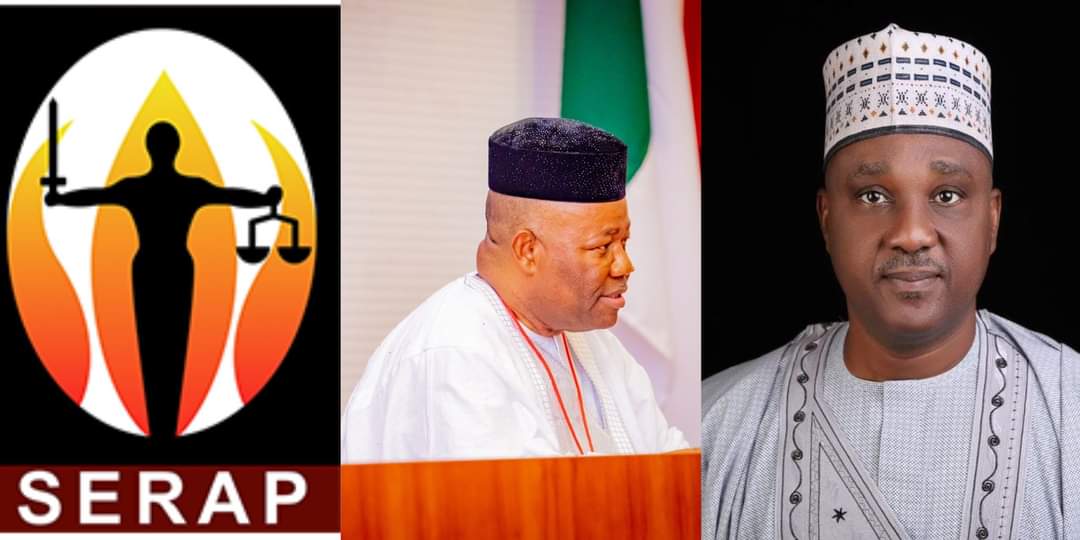
The Socio-Economic Rights and Accountability Project (SERAP) has filed a lawsuit against Senate President Godswill Akpabio and Speaker of the House of Representatives Tajudeen Abbas over the alleged mismanagement of ₦18.6 billion allocated for the construction of the National Assembly Service Commission (NASC) Office Complex in Abuja.
Akpabio and Abbas were sued in their personal capacities and on behalf of all National Assembly members. The NASC was also listed as a respondent.
The suit follows revelations in the 2022 Annual Report of the Auditor-General of the Federation, released on September 9, 2025, which questioned the spending and flagged the funds as unaccounted for.
Filed at the Federal High Court, Abuja (Suit No. FHC/ABJ/CS/2457/2025), SERAP is seeking a mandamus order compelling Akpabio, Abbas, and the NASC to explain the whereabouts of the ₦18.6 billion earmarked for the office complex project.
SERAP is also requesting an order compelling the officials to disclose the identity of the alleged “fictitious construction company” that received the funds, as well as to release all project-related documents, including assessment reports, bid advertisements, contractor quotations, contract agreements, Tender Board minutes, and Federal Executive Council (FEC) approvals.
In its argument, SERAP stated that the alleged misappropriation or diversion of the funds constitutes a serious breach of public trust, the Nigerian Constitution, and global anti-corruption standards. The organisation insists Nigerians have a right to know what happened to the money and who received it.
SERAP argued that compelling the National Assembly leadership to account for the funds would strengthen public confidence in democratic institutions and reinforce the rule of law. It added that the National Assembly must uphold its constitutional duties by promoting transparency, accountability, and integrity in public finance management.
The suit highlighted findings from the Auditor-General’s report, which revealed that the NASC paid over ₦11.6 billion to an “unknown construction company” on August 11, 2020, for the construction of its office complex. The report further indicated that the contract was allegedly inflated by ₦6.9 billion, with another payment made on November 29, 2023, purportedly for converting a roof garden into office space.
According to the report, the contracts were awarded without a Bill of Quantity (BOQ), needs assessment, public bidding, contract agreements, competitive quotations, or FEC approval. The Bureau of Public Procurement (BPP) did not issue a Certificate of No Objection either.
The Auditor-General warned that the entire ₦18.6 billion may have been diverted, misused, or stolen.
SERAP argued that the alleged violations reflect a persistent failure by the National Assembly and its commission to uphold transparency and accountability. It insisted that granting the requested orders would help bring offenders to justice and aid in recovering any stolen public funds.
The organisation stressed that corruption continues to impose severe economic and social burdens on poor and vulnerable Nigerians, undermining development and eroding trust in public institutions.
SERAP pointed to constitutional provisions—particularly Sections 13, 15(5), 16(1), and 16(2)—which mandate public institutions, including the National Assembly, to prevent corruption, manage resources responsibly, and prioritise the welfare of citizens. It also cited Nigeria’s obligations under the UN Convention Against Corruption, which requires transparency in the management of public funds.
The suit was filed by SERAP’s legal team: Kolawole Oluwadare, Kehinde Oyewumi, and Andrew Nwankwo.






Comments
0 comments