
Obasanjo vs. Buhari: Conflicting Testimonies Rock ICC Over $6 Billion Mambilla Power Scandal
 Follow us on Google News
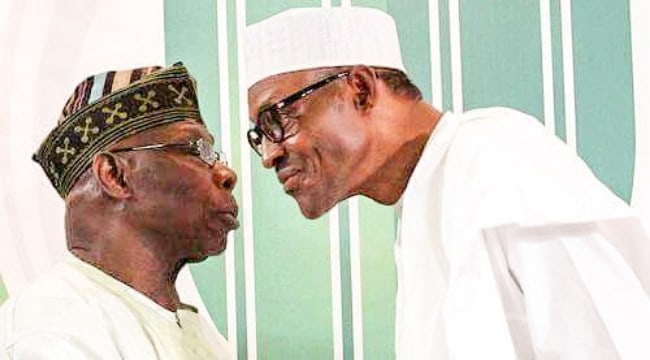
Former Nigerian Presidents Olusegun Obasanjo and Muhammadu Buhari reportedly presented conflicting testimonies before the International Chamber of Commerce (ICC) Court of Arbitration in Paris, France, over the disputed $6 billion Mambilla Power Project awarded to Sunrise Power and Transmission Company of Nigeria in 2003.
The prolonged legal battle, spanning nearly two decades, revolves around Sunrise Power and its Chairman, Chief Leno Adesanya, who is demanding $2.3 billion in compensation from the Nigerian government for an alleged breach of contract.
Testifying on January 22, 2025, Obasanjo discredited the validity of the 2003 contract, insisting that it was unlawfully approved by then-Minister of Power, Olu Agunloye, just a day after the Federal Executive Council (FEC) had rejected it. He argued that a minister lacked the authority to unilaterally approve such a massive contract, especially against FEC’s decision.
“The agreement cited by Sunrise Power was never legitimate. A minister cannot approve a contract that FEC had already dismissed,” Obasanjo stated.
Buhari Contradicts Obasanjo, Admits Nigeria Awarded The Contract
However, in his testimony a day later, on January 23, 2025, former President Muhammadu Buhari presented a different account, acknowledging that Nigeria had indeed awarded the contract to Sunrise Power.
According to witness transcripts obtained by SaharaReporters, Buhari claimed he could not recall several key details but admitted that his administration had engaged in negotiations with the company.
“I directed the Attorney General, Abubakar Malami (SAN), and the Minister of Works and Power, Babatunde Fashola (SAN), to negotiate with Sunrise Power,” Buhari reportedly told the arbitration panel.
His testimony appeared to weaken Nigeria’s defense, with some interpreting his statements as an implicit admission of the government’s liability. Buhari also controversially suggested that Nigeria—not Sunrise Power—was behaving like the “extortionist” in the dispute, further damaging the federal government’s stance against the compensation claim.


Comments
0 comments