
Latest
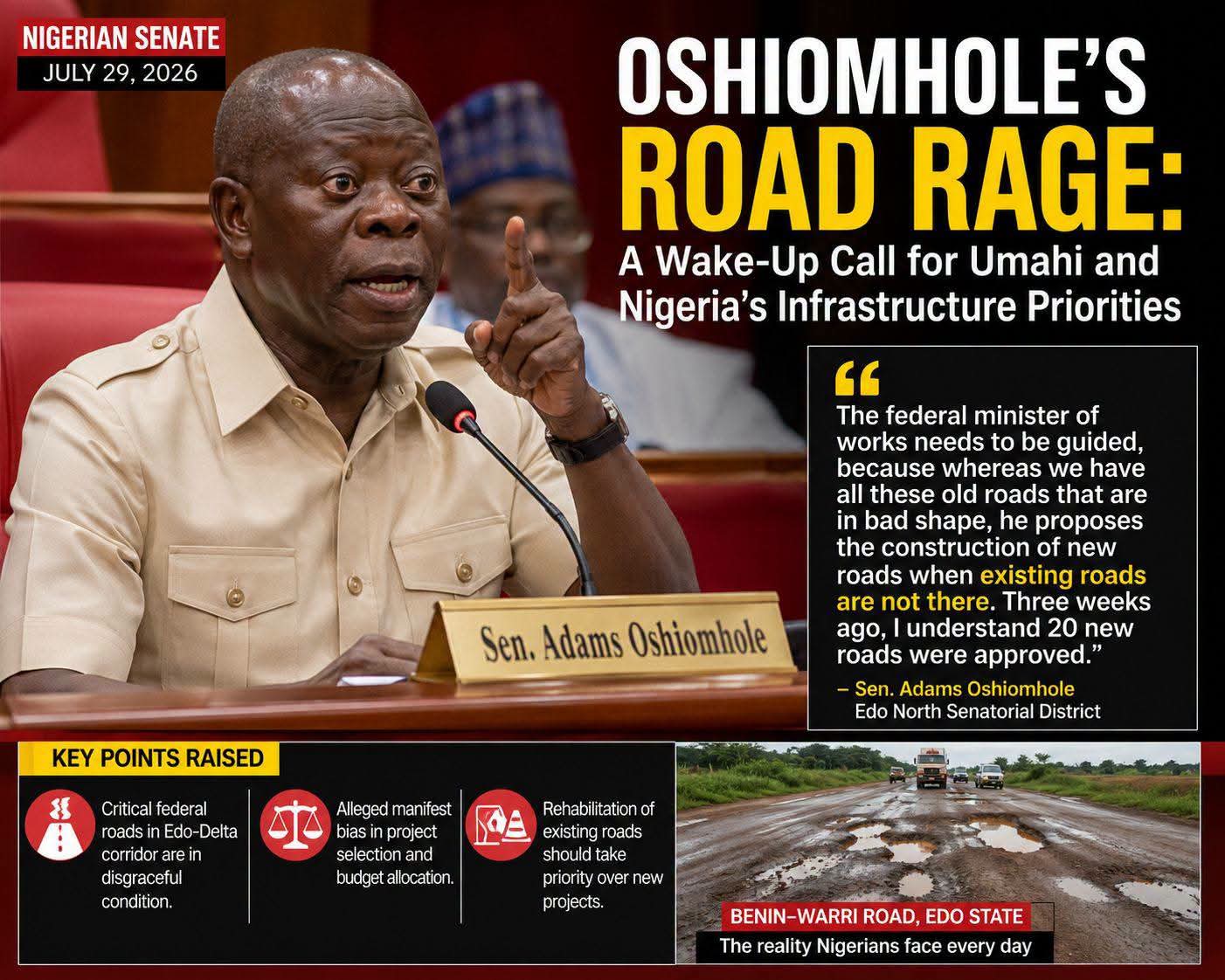
Oshiomhole’s Road Rage: A Wake-Up Call For Umahi And Nigeria’s Infrastructure Priorities

By Osigwe Omo-Ikirodah
During Senate proceedings , Senator Adams Oshiomhole delivered a blunt message to the Minister of Works, David Umahi.
His concern was straightforward.
While many of Nigeria’s major federal highways remain in terrible condition, the Federal Government continues approving new road projects.
According to Oshiomhole, the priority should be fixing the roads Nigerians already depend on before embarking on additional mega projects.
Using the Edo-Delta corridor as an example, he argued that critical federal routes linking Benin to Warri, Asaba, Auchi and Okene have deteriorated to unacceptable levels.
He maintained that despite previous Senate resolutions and presidential interventions through tax-credit arrangements, the Edo-Delta section has repeatedly been left out of federal budget allocations.
His appeal was not for confrontation but for a more balanced national approach to infrastructure planning.
Oshiomhole’s position deserves serious consideration.
Road infrastructure is the backbone of Nigeria’s economy.
Every day, farmers, transporters, manufacturers and ordinary commuters rely on these highways to move goods and people.
When major roads collapse, transport costs increase, food prices rise, businesses lose productivity and insecurity worsens as criminals exploit abandoned and impassable routes.
In a period of limited public resources, rehabilitating existing economic corridors often delivers faster and broader economic benefits than launching entirely new projects.
This does not diminish the significant infrastructure programmes already being pursued by the Ministry of Works under the Renewed Hope Agenda.
Oshiomhole’s intervention is therefore less about opposing new construction and more about achieving the right balance between expansion and maintenance.
If this advice is embraced, the benefits could be substantial.
Restoring key federal highways would reduce logistics costs, improve interstate commerce, support agricultural distribution, strengthen security operations and ease pressure on inflation.
It would also reinforce public confidence that infrastructure decisions are based on national priorities rather than regional considerations.
Ultimately, Oshiomhole’s submission goes beyond politics.
It is a reminder that governance is measured not only by the number of new projects announced, but also by the condition of the roads Nigerians use every day.
Building new highways is important.
Keeping existing ones functional is indispensable.
That is the balance Nigeria must strive to achieve.
Osigwe Omo-Ikirodah is the Principal and CEO of Bush Radio Academy


Oshiomhole’s Road Rage: A Wake-Up Call For Umahi And Nigeria’s Infrastructure Priorities

Lake Chad Erupts In Violence As Boko Haram, ISWAP Engage In Deadly Gun Battle

Fear In Osun! Ooni Expresses Deep Concern Over Escalating Political Tension, Calls For Peace

Army Gets New Leadership Boost As COAS Shaibu Appoints Commanders For Tinubu’s New Divisions

Tinubu Approves ₦46 Billion For Second Runway At Kano Airport

Fear Grips Kidnappers, Bandits as Okpebholo Deploys 497 Forest Guards Across Edo

El-Rufai’s Medical Report Sparks Fresh Crisis As MDCAN Probes Doctor, ICPC Files Charges

Aliko Dangote’s Daughter Reveals Sh*cking Condition In Billionaire’s Will

Aisha Yesufu Unleashes Scathing Reaction To Peter Obi’s Channels TV Interview
