
Pastor Kingsley Okonkwo Sparks Debate, Declares Tattoos Are Not A Sin
 Follow us on Google News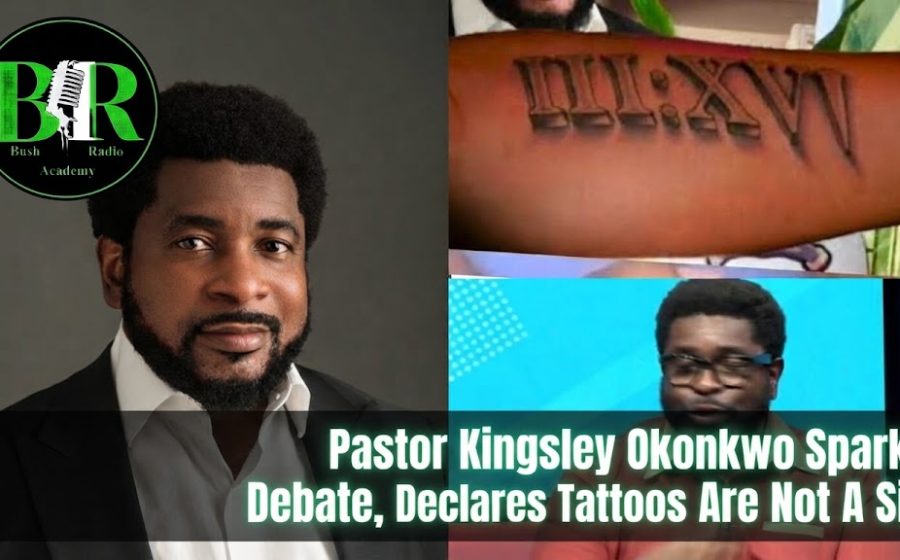
Pastor Kingsley Okonkwo has defended the practice of tattooing, arguing that tattoos and other forms of body markings have existed across different cultures for centuries and that, in his interpretation, there is no biblical scripture that explicitly declares tattoos to be a sin.
According to Bush Radio Academy, Okonkwo made the remarks while discussing the longstanding debate among Christians over whether getting tattoos is compatible with the Christian faith. His comments have since sparked renewed conversations about tattoos, biblical teachings and cultural practices.
The pastor argued that tattoos are not peculiar to Nigeria, noting that various societies around the world have historically used tattoos, tribal marks and other forms of body inscriptions.
He recalled growing up in Lagos and seeing older people with traditional body markings, arguing that such practices have been part of human culture across different societies.
Okonkwo also referred to biblical imagery involving inscriptions on the body. He pointed to a passage describing God as having inscribed His people on His hand, arguing that the imagery would have been understandable to people familiar with the practice of using markings as a way of remembering someone.
He further cited Revelation 19:16, which describes a name written on the thigh of Christ in the biblical account. The passage states that the name is “King of kings and Lord of lords.”
Okonkwo maintained that tattoos should not automatically be regarded as sinful and questioned the way some Christians interpret the Old Testament passage commonly referenced in discussions about tattooing.
He argued that Leviticus 19:28 should be understood within its historical and cultural context, particularly its reference to markings associated with mourning for the dead. However, several mainstream Bible translations do explicitly use the word “tattoo” in that verse, meaning Christians and biblical scholars may interpret its relevance to modern tattoos differently.
The pastor also drew attention to cosmetic procedures such as microblading, describing the practice as a form of tattooing. He questioned why some people accept such cosmetic procedures while condemning tattoos as sinful.
Okonkwo said his experience preaching in multiracial churches had exposed him to people from different cultural backgrounds and personal circumstances. He gave an example of someone who had reportedly received a tattoo to commemorate a significant period in his life, arguing that it would be difficult to simply label such a person’s tattoo sinful without considering the circumstances.
He further compared the tattoo debate with past disagreements among Christians over practices such as makeup, wearing trousers and jeans, using television, wearing wigs and perfumes. According to him, some practices that were previously rejected by certain Christian communities later became more widely accepted.
Okonkwo’s comments have therefore added another perspective to the ongoing Christian debate over tattoos, with his position focusing on cultural context, biblical interpretation and the circumstances surrounding why an individual chooses to have body markings.







Comments
0 comments