Revised Timetable For 2027 Elections, Voter Registration Updates: Details From INEC-RECs Meeting Leak Out
 Follow us on Google News
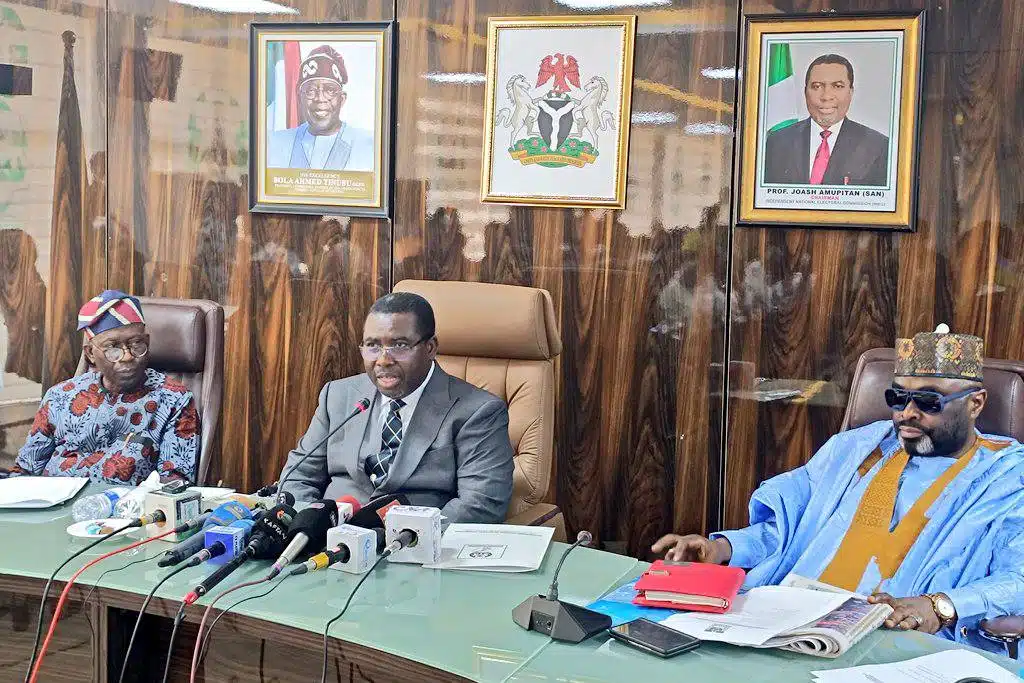
The Chairman of the Independent National Electoral Commission (INEC), Prof. Joash O. Amupitan, on Wednesday convened a high-level meeting with Resident Electoral Commissioners (RECs) from all 36 states and the Federal Capital Territory (FCT).
According to an official statement from INEC, the session at the Commission’s Abuja headquarters served as a critical review of the recently concluded FCT Area Council and state constituency elections, while also setting the agenda for the forthcoming Ekiti and Osun governorship elections and the 2027 general elections.
Prof. Amupitan emphasized the commission’s commitment to excellence, stating, “Excellence is not optional; it is mandatory.” While acknowledging successes, he issued firm directives and cautioned RECs about shortcomings observed in the FCT, Kano, and Rivers State elections.
During the review, the INEC chairman highlighted voter apathy as an ongoing challenge. He reported that over 93% of polling unit results had been uploaded to the INEC Result Viewing (IReV) Portal by 2:00 pm on Sunday, a figure that has since risen to an average of 97%.
Amupitan also dispelled rumors of “voter migration” in 2026, clarifying that the adjustments were part of the 2022 Polling Unit expansion initiative. “As part of that exercise, 6.7 million voters were redistributed nationwide from 12,000 congested units to 17,000 new ones. In the FCT alone, 580,000 voters were moved to 1,156 new polling units to ease congestion,” he said.
He directed RECs to intensify continuous voter education and urged citizens to verify their polling units using the online portal.
On the issue of delayed polling, Prof. Amupitan expressed strong dissatisfaction. Only 45% of polling units in the FCT opened by the mandated 8:30 am time, though all were operational by 10:00 am. He called the delay “unacceptable” and warned that staff responsible in Kuje and Kabusa wards had been queried, while the transporter causing delays in Kwali Area Council would be blacklisted.
New safeguards in the result management system were also introduced. Presiding Officers are now required to manually enter scores into the BVAS, which performs automatic validation to prevent over-voting and mathematical errors.
Addressing allegations of result padding at Kuroko Health Centre in Kwali Area Council, where a party was incorrectly reported to have scored 1,219 votes against 345 registered voters, Amupitan clarified that the discrepancy resulted from a counting error, which was transparently corrected.
He placed full responsibility on RECs, stating, “You are the Commission in your states. The buck stops with you.” He warned that absenteeism or dereliction of duty at local government offices would attract sanctions.
Revised 2027 Election Timetable
Prof. Amupitan informed RECs that the new Electoral Act, 2026, had been passed, and a revised timetable for the 2027 general election would be issued shortly.
CVR Exercise
Preparations for the 2027 election include the ongoing second phase of the Continuous Voter Registration (CVR), which runs until April 17, 2026, and concludes nationwide on August 30, 2026.
Enugu REC Sworn In
Prof. Amupitan formally swore in Dr. Chukwu Chukwuemeka Joseph as REC for Enugu State, representing Abia State. He congratulated him on his reappointment and urged strict adherence to integrity and professionalism.
FOSIECON Partnership
The Chairman also received a delegation from the Forum of State Independent Electoral Commissions of Nigeria (FOSIECON), led by National Chairman Mamman Nda Eri. Eri congratulated Prof. Amupitan and praised INEC’s role in electoral administration and institutional innovation.
The FOSIECON delegation presented a five-point proposal for collaboration, including joint capacity building, technology sharing (such as BVAS), policy dialogue, and coordinated voter education initiatives.
Prof. Amupitan welcomed the partnership, stating, “Your presence underscores our shared commitment to the integrity and progress of electoral processes across Nigeria. Collaboration and open dialogue are vital to upholding democratic principles.”