
Wike’s ₦10m Ward Promise Sparks Legal Warning Over Possible Electoral Inducement
 Follow us on Google News
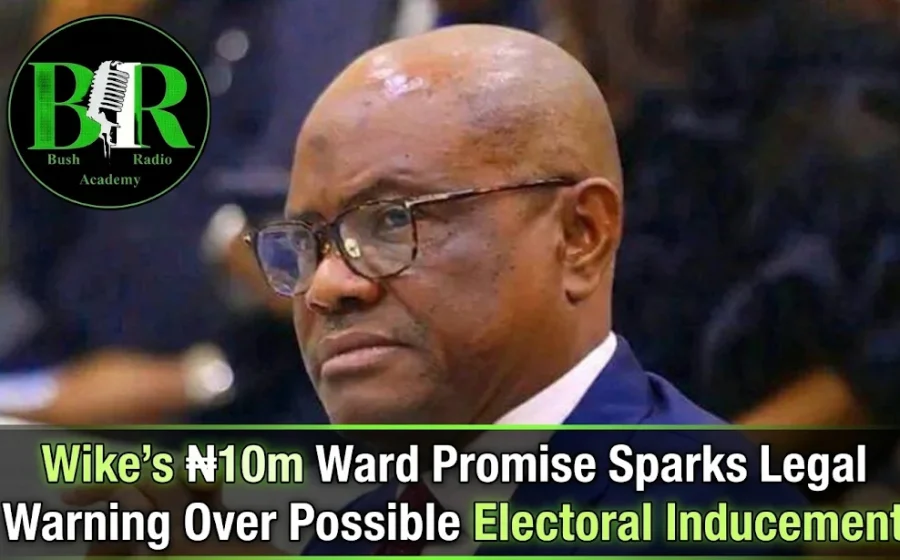
A constitutional lawyer and public affairs commentator, Justice Osai Ahiakwo, has cautioned the Minister of the Federal Capital Territory, Nyesom Wike, and other political figures against making financial promises that could compromise the credibility of Nigeria’s electoral process ahead of the 2027 general elections.
Ahiakwo made the remarks while reacting to reports that Wike had promised to give each councillor ₦10 million for ensuring that their respective wards support President Bola Tinubu in the 2027 elections.
Wike had reportedly defended the proposed payments as rewards for political mobilisation rather than an attempt to influence voters through financial inducement.
However, the lawyer argued that describing such payments as mobilisation incentives did not automatically place them outside the reach of electoral laws. He maintained that the purpose, circumstances and intended use of the money must be carefully examined to determine whether any legal provisions had been violated.
In a statement issued in Calabar, Ahiakwo referred to Section 125(1)(a) of the Electoral Act 2026, which prohibits corrupt gifts, offers, promises or agreements intended to influence someone to procure or attempt to procure an electoral outcome.
He explained that legitimate campaign mobilisation and payments for genuine services were not necessarily unlawful. However, he stressed that the necessary elements of corrupt intention must be established before criminal liability could arise.
Questioning the idea of elected councillors being expected to deliver their wards to political benefactors, Ahiakwo insisted that votes belong to the electorate and not to politicians or their associates.
He maintained that no political figure, regardless of influence or position in government, has ownership rights over the electoral decisions of citizens.
The commentator described the controversy as a reflection of a wider challenge facing Nigeria’s democracy, arguing that some political actors appear willing to disregard established rules whenever those rules conflict with their political interests.
According to him, the country’s major problem is not necessarily the absence of laws but the unwillingness of certain politicians to submit themselves to the discipline and requirements of those laws.
Ahiakwo called on the Independent National Electoral Commission (INEC) to provide clearer guidelines distinguishing legitimate political mobilisation from prohibited electoral inducement. He also urged the commission to establish accessible channels through which citizens can report suspected electoral violations and ensure that credible complaints receive prompt attention.
He further appealed to political parties to strengthen internal discipline and called on the National Assembly to improve oversight of campaign financing, electoral compliance and the use of public resources for partisan activities.
The lawyer also urged law-enforcement agencies to investigate suspected electoral offences without fear or favour, regardless of the political influence or status of those involved, and prosecute individuals where sufficient evidence is established.
Ahiakwo encouraged citizens and civil society organisations to document and report suspected electoral violations, while advocating increased political education to discourage the practice of treating votes as commodities.
He warned that the 2027 general elections must not become another opportunity for politicians to test the limits of the country’s electoral laws without facing consequences.
According to Bush Radio Academy, Ahiakwo maintained that Nigeria needs political leaders who recognise that electoral victories must be achieved within constitutional and legal boundaries, warning that although political power is temporary, the damage caused by weakening democratic institutions could have lasting consequences.






Comments
0 comments