
Latest
Senate Sparks National Outrage With Controversial Electoral Act Decision

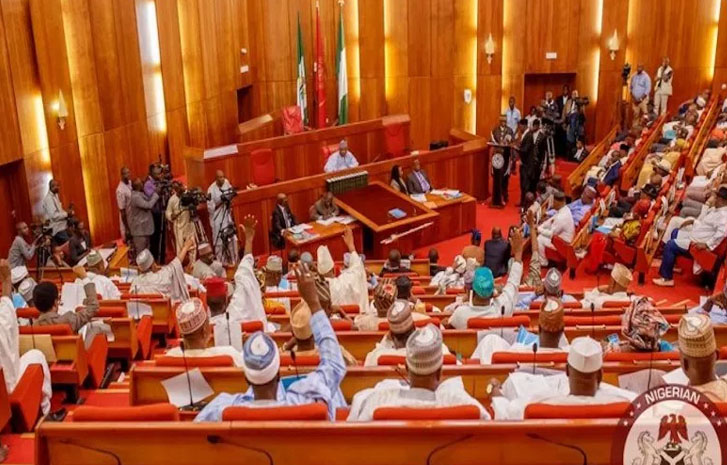
The Senate’s passage of the Electoral Act Amendment Bill on Thursday has drawn sharp criticism from experts, who argue that the rejection of real-time transmission of election results threatens to undermine public confidence in Nigeria’s electoral process.....KINDLY READ THE FULL STORY HERE▶
Mahdi Shehu, a public affairs analyst, condemned the National Assembly’s decision, describing it as a serious blow to Nigeria’s democracy.
In an exclusive interview with DAILY POST, Shehu said lawmakers’ refusal to approve critical electoral reforms signals a deliberate effort to diminish the value of citizens’ votes.
“This is one assault too many. The Senators have abandoned the very mandate Nigerians entrusted them with and continue to take the people for granted,” he said.
Shehu warned that by rejecting reforms such as mandatory electronic transmission of results, the Senate is sending a dangerous signal that citizens’ votes may no longer count.
“When votes no longer count, there is little point in voting,” he stated.
He likened the Senate’s actions to a combination of deadly global disasters, adding that the impact on democracy could be long-lasting.
Shehu further accused the political system of failing to provide adequate checks and balances, claiming that the executive, legislature, and judiciary are no longer holding each other accountable.
“When the executive, legislature, and judiciary, who are supposed to check one another, collude instead, meaningful reforms become nothing more than a mirage,” he said.
He also alleged that the Independent National Electoral Commission (INEC) has been compromised, asserting that the commission has become a tool for ensuring the president’s victory.
“INEC is now expected to ensure the president wins, regardless of the actual votes,” he claimed.
Shehu warned that continued weakening of democratic institutions could push Nigerians to question the future of the country.
“Less than two million people are shaping the lives, livelihoods, and commerce of over 250 million Nigerians,” he said.
Electoral Act Amendment: A Strategic Move for 2027 – NNPP
The New Nigeria Peoples Party (NNPP) in Kano State also condemned the Senate’s decision, describing the recent amendment to the Electoral Act as a calculated political maneuver by the ruling party to secure an advantage in the 2027 general elections.
In an exclusive interview with DAILY POST, NNPP Kano State Publicity Secretary, Engr. Ibrahim Karaye, said the Senate’s action was intentional, aimed at manipulating future elections.
“I see this as a deliberate political strategy by the ruling party. The 2023 election was one of the closest in Nigeria’s history, with very slim margins between contestants,” Karaye said.
He noted that President Bola Ahmed Tinubu won the presidency with minority votes, a situation that has reportedly made the ruling party uneasy about free and fair elections going forward.
“President Tinubu is the only president in this democratic dispensation to have won with minority votes. The ruling party is now taking steps to influence the outcome of the 2027 election in its favor,” Karaye said.
According to him, rejecting key reforms, including mandatory electronic transmission of results, is aimed at reducing transparency and accountability in the electoral process.
Despite these concerns, Karaye said Nigerians remain determined to participate actively in upcoming elections.
“This decision will not discourage voter participation. Nigerians are politically aware and understand the stakes ahead of the 2027 polls,” he said.
He added that for the first time in Nigeria’s history, resources that should be directed to citizens’ welfare are being diverted toward political preparation for 2027.
Karaye urged Nigerians to remain vigilant, defend their electoral rights, and participate fully in the process to prevent rigging and manipulation.
“Protecting our democracy requires collective effort. Citizens must not allow their votes to be taken for granted,” he concluded.


Trump Takes Action: Investigation Begins As Americans Grapple With Higher Fuel Costs

Without Fayose, No Makinde Governorship’ — Isaac Sparks Controversy

Democracy-Era Dispute Erupts As NADECO Challenges Abdulsalami’s Narrative

Nigerians React As Onanuga Questions Scale Of Economic Hardship

State Police Debate Deepens As Former Security Chiefs Clash Over Governors’ Powers

Family Speaks: How General Abubakar Died, Reveals Wife Still In Bandits’ Captivity

Sh*cking Police Shake-Up As Oyigbo DPO Is Removed Over ₦500,000 Bribery Allegation

Dollar To Naira Sh*ck: Fresh Exchange Rate Revealed For June 21, 2026

Etinosa Reacts To Viral Concerns About Her Neck Size, Says She Is Healthy
