
Fanny Amun Breaks Silence, Reveals Why He Quit NFF Fact-Finding Committee
 Follow us on Google News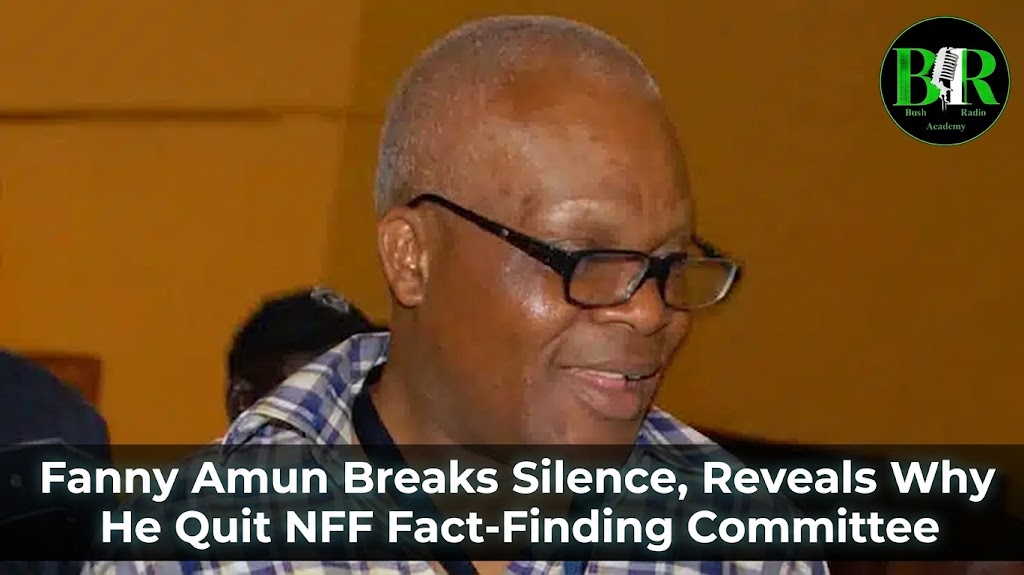
Former Nigeria Football Federation (NFF) General Secretary, Fanny Amun, has explained that he resigned as chairman of the federation’s fact-finding committee immediately after submitting its report to safeguard the independence and integrity of its findings.
Amun made this known at a press conference held at the National Stadium, Surulere, Lagos, on Tuesday, August 25, 2026.
He said he deliberately completed the assignment in less than a week, despite being given two weeks by the NFF, because he wanted to submit the report before there was any opportunity for external influence.
According to Amun, he did not want anyone to interfere with the committee’s findings before the report was submitted to the federation, prompting his decision to step down immediately after handing it over.
The NFF inaugurated the committee on August 17, 2026, following a series of disappointing performances by Nigeria’s national teams, particularly the failure of the Super Falcons to qualify for the 2027 FIFA Women’s World Cup.
The Super Falcons, defending African champions and 10-time Women’s Africa Cup of Nations (WAFCON) winners, were eliminated in the quarter-finals before suffering a 2-1 defeat to South Africa in the World Cup play-off.
The result means Nigeria will miss the global women’s tournament for the first time since its inaugural edition in 1991.
Amun said the committee was given a two-week mandate but disclosed that he had always intended to conclude the assignment much earlier.
He explained that he told members of the committee that the process would take two weeks, although he expected to complete it within seven days, in order to prevent anyone from influencing its work.
The committee was mandated by NFF President Ibrahim Musa Gusau to investigate both the immediate and underlying causes of the poor performances of Nigeria’s national teams. Its responsibilities also included consulting stakeholders, receiving submissions from the public and making recommendations on how to address the challenges facing Nigerian football.
Members of the committee included former Nigeria U-20 coach Ladan Bosso, former Super Falcons player Desire Oparanozie, ex-Super Eagles midfielder Mutiu Adepoju and Alex Mana, while Nasiru Jibril served as secretary.
Despite the recent setbacks, Amun maintained that Nigerian football had not completely collapsed, pointing out that the country’s national teams had continued to qualify for major competitions despite administrative difficulties.
However, he criticised aspects of the NFF electoral statutes, particularly the provision that exempts serving board members from the anti-corruption screening required of other contestants.
He described the provision as unacceptable and called for a review of the rules to ensure that all candidates, including incumbent board members, are subjected to the same scrutiny.
Amun proposed that contestants should undergo screening by the NFF Ethics Committee and relevant financial crime agencies while also declaring their assets.
He further advocated limiting elected football administrators to a maximum of two terms in office.
The former NFF General Secretary also raised concerns about the welfare of players, coaches and federation workers. He alleged that board members receive full allowances during foreign trips while players and coaches are sometimes inadequately compensated.
He also expressed concern about federation employees who, according to him, have remained on temporary contracts for several years.
Amun subsequently announced his resignation from both the fact-finding committee and the NFF Ethics Committee, while thanking NFF President Ibrahim Gusau, the General Secretary and other members of the federation’s board for giving him the opportunity to serve.
He confirmed that he had submitted the report on behalf of himself and the other committee members and had resigned as chairman with immediate effect.
Amun added that he remained available to provide further clarification if required.
He also disclosed that copies of the report had been made available to the NFF, FIFA, CAF, the National Sports Commission (NSC) and security agencies.
However, the NFF had not publicly released the contents of the committee’s report as of the time of filing the report.






Comments
0 comments