
Oluku Market: Okpebholo Moves From Promise To Rebuilding, Restoring Hope For Traders
 Follow us on Google News
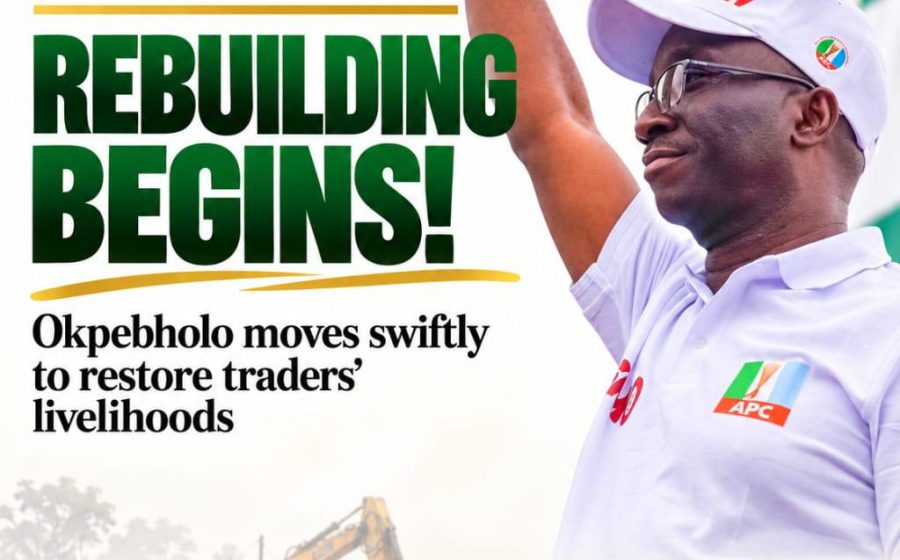
For the traders whose livelihoods were devastated by last week’s tanker explosion at Oluku Market, the commencement of rebuilding offers something urgently needed: a visible path back to business.
Governor Monday Okpebholo’s response has moved beyond his visit to the scene and his assurance that affected traders would receive government support. With rebuilding now underway, that promise is taking physical shape.
The significance lies in the speed: a disaster struck, the governor responded, and the work of restoration has begun.
The fire occurred on Thursday, October 15, along the Benin–Lagos Road in Ovia North-East Local Government Area. By the following day, Okpebholo was at the market, assessing the destruction, listening to traders and pledging to rebuild. He also visited injured victims at the University of Benin Teaching Hospital, extending his response from the scene of economic devastation to the bedside of those receiving treatment.
Now, the commencement of reconstruction gives affected families a stronger reason to look ahead.
For someone whose shop has just been destroyed, time carries a heavy cost. Rent, school fees, feeding expenses and loan obligations continue even when trading stops. Every additional week without income can deepen the damage and make recovery more difficult.
That is why the urgency at Oluku matters. Getting rebuilding underway creates the conditions for traders to recover their working spaces and begin the journey towards earning again.
A market may be built with blocks, roofing sheets and concrete, but its real value is measured in the households it sustains.
Behind every stall is a network of people: the farmer supplying produce, the driver delivering goods, the apprentice learning a trade, the porter earning a daily wage and the parent depending on sales to keep a child in school. Restoring the market helps reconnect that chain of economic activity.
The intervention also draws credibility from an earlier example in Ekpoma.
After fire destroyed the Police Officers’ Wives Association shopping complex in January 2026, Okpebholo visited the affected traders and promised to rebuild. In April, he commissioned the reconstructed complex and announced ₦200 million in support for traders whose goods had been destroyed. That response addressed both the trading environment and the need to help businesses recover.
For Oluku traders, Ekpoma provides a practical reference: a devastated commercial space was rebuilt, and government committed additional support towards restoring livelihoods.
Jattu forms another part of this wider effort. Following the January 2025 market fire, the administration pledged assistance to victims. By September 2026, Jattu Modern Market was among the commercial facilities reported to be undergoing extensive reconstruction under the administration’s market renewal programme.
From Ekpoma to Jattu and now Oluku, the common concern is the survival of local enterprise. These markets serve different communities, but the people who depend on them share the same basic aspiration: a secure place to work and a fair opportunity to earn.
The administration’s wider redevelopment programme offers relevant lessons. Plans for the redesigned Oba Market included a mini fire station, a sick bay and other welfare facilities, demonstrating how market infrastructure can incorporate protection for the people and investments within it.
This is where Okpebholo’s commitment to a progressive Edo State meets everyday reality. Progress becomes meaningful when government protects the foundations of ordinary people’s independence—the shop, the stall, the tools and the opportunities through which families sustain themselves.
His swift response at Oluku, followed by the commencement of rebuilding, sends an important message about that responsibility. It shows the value of responding while the needs are urgent and carrying an assurance into action.
The work must now maintain that momentum until traders can return, reopen and rebuild their income.
For the people of Oluku, the strongest expression of hope will be the sound of business returning to a place where fire brought everything to a halt. The rebuilding already underway is the first concrete step towards that recovery.
Osigwe Omo-Ikirodah is the Principal and CEO of Bush Radio Academy





Comments
0 comments