
40 Years After Dele Giwa’s K!ll!ng, Ray Ekpu Laments Failure To Get Justice
 Follow us on Google News
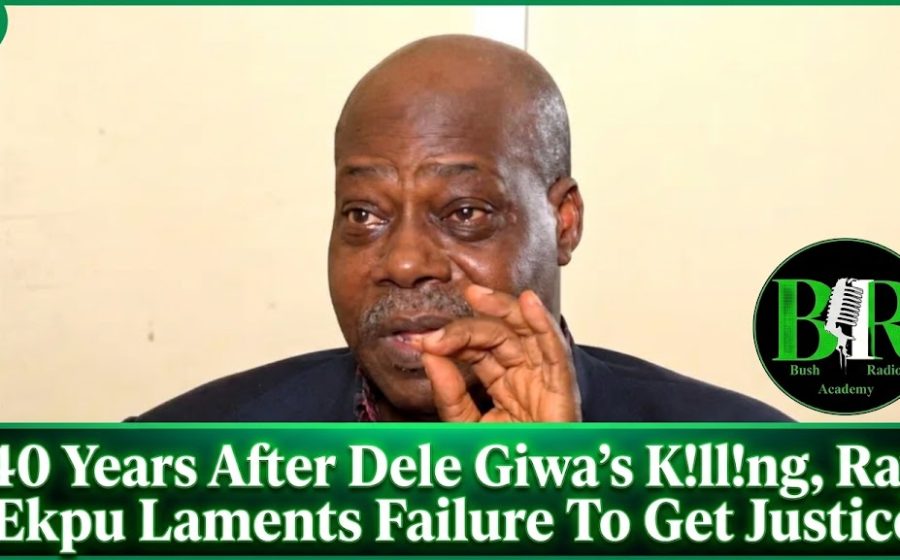
Veteran journalist and co-founder of Newswatch magazine, Ray Ekpu, has recounted how the assassination of the publication’s founding Editor-in-Chief, Dele Giwa, prompted his five-year-old son to abandon his ambition of becoming a journalist.
According to Bush Radio Academy, Ekpu shared the experience on Monday during the presentation of a book titled Dele Giwa’s Granite Journalism at the Nigerian Institute of Journalism in Lagos. The book features a collection of Giwa’s writings published in the Daily Times, Sunday Concord and Newswatch.
Giwa was killed on October 19, 1986, when a parcel bomb delivered to his residence in Ikeja, Lagos, exploded. His assassination occurred during the military administration of Ibrahim Babangida, who ruled Nigeria from 1985 to 1993.
Reflecting on his relationship with the late journalist, Ekpu explained that their families lived in the same duplex in Ikeja and maintained a close relationship.
He recalled that his young son had admired Giwa and often expressed his desire to follow in his footsteps by becoming a journalist. However, the child changed his mind just days after the assassination.
Ekpu said his son approached him and announced that he no longer wanted to pursue journalism. When asked why, the boy reportedly explained that he feared suffering the same fate as Giwa.
“My five-year-old son used to tell me that he would like to be a journalist like Daddy Uncle Dele. But a few days after Dele’s assassination, my son came to me and said, ‘Daddy, I have changed my mind.’
“I asked him, ‘You changed your mind about what?’ He said, ‘I don’t want to be a journalist anymore.’ I asked him, ‘Why?’ And he said, ‘I don’t want to be killed like Uncle Dele,’” Ekpu recalled.
The veteran journalist said the incident demonstrated how Giwa’s killing had affected even a young child, who had already begun to associate journalism with the risk of losing one’s life.
He disclosed that his son eventually pursued a different career far removed from the media industry.
“Today, the guy works in a different profession far away from journalism,” he said.
Ekpu also expressed disappointment over the failure to secure justice for Giwa, noting that four decades had passed since the journalist’s death without a resolution that brought those responsible to justice.
He explained that members of the Newswatch team had made sustained efforts to pursue the case, working alongside their lawyer and friend, the late human rights activist Gani Fawehinmi.
According to Ekpu, those efforts were frustrated by what he described as “the forces of oppression,” leaving the media community without the justice it had sought for their slain colleague.
“So, at this point, all we can do is to leave the criminals who assassinated our partner, friend and brother in the able hands of God Almighty because the good Lord says vengeance is mine,” he said.
Ekpu’s account has renewed attention to the enduring impact of Giwa’s assassination on Nigeria’s media community and the unresolved questions surrounding the killing, which remains a significant episode in the country’s journalistic history.





Comments
0 comments