
Ebola Scare: Nigerian Senate Orders Mandatory Screening For All Travellers, Demands ₦10bn
 Follow us on Google News
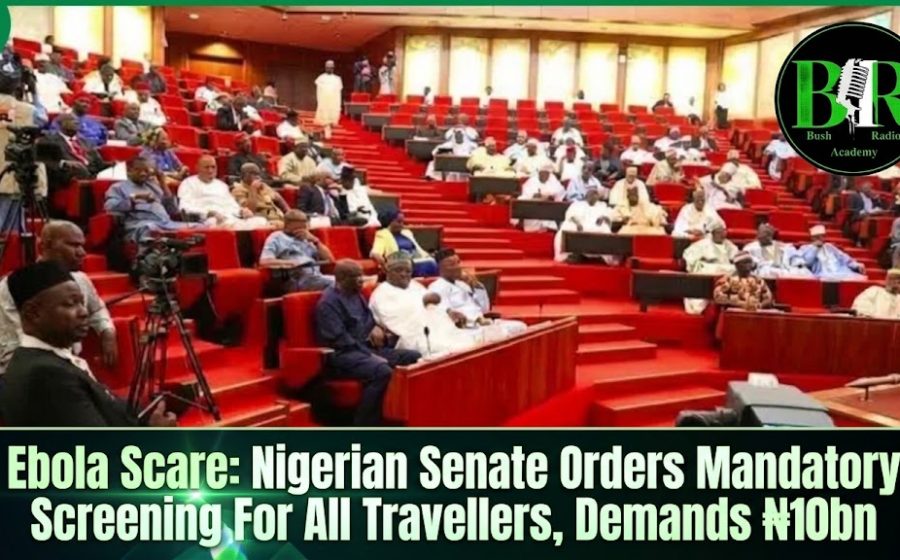
The Nigerian Senate has directed that all international travellers entering the country undergo compulsory health screening at airports, seaports and designated land borders amid concerns over a reported Ebola case involving a traveller who arrived from Kenya.
According to Bush Radio Academy, the lawmakers reached the resolution on Wednesday following an urgent debate on Nigeria’s preparedness to contain the disease. The Senate also called for the immediate release of ₦10 billion in emergency funding for Ebola control and urged the government to replace the country’s century-old Quarantine Act of 1926 with modern public health legislation.
Senate President Godswill Akpabio raised concerns during the debate, disclosing that he had received information that a traveller from Kenya who tested positive for Ebola entered Nigeria without undergoing health screening.
“There was no temperature check or any form of screening, and the traveller himself was worried,” Akpabio said.
He suggested that the case might have been detected only after the traveller arrived at a hospital, raising questions about the effectiveness of screening procedures at the country’s entry points.
Akpabio recalled Nigeria’s experience during the 2014 Ebola outbreak, when the virus was introduced into the country by a Liberian patient and a doctor who treated him subsequently died. He warned that the situation could become more dangerous if the infection spread beyond individuals already identified through contact tracing.
“With 44 contacts already traced in 24 hours, and each of those potentially in contact with at least three more people, we are looking at a dangerous chain reaction. This is a major wake-up call,” he said.
Following the deliberations, senators unanimously called for mandatory screening of every international passenger arriving in Nigeria, regardless of their country of origin. The proposed measures include health declaration forms, temperature checks and screening for symptoms associated with Ebola.
The lawmakers also called for enhanced monitoring of travellers who had visited or transited through affected areas within the preceding 21 days.
Senator Ali Ndume, representing Borno South, argued that screening should not be limited to passengers arriving from countries officially identified as affected by the outbreak. He maintained that the reported case involving a traveller from Kenya demonstrated the need for a comprehensive approach.
“You don’t know where a person contracted Ebola. Screening must be mandatory for every traveller coming into this country at every airport, regardless of origin,” Ndume said.
The Senate further urged the Federal Ministry of Health and Social Welfare, the Federal Airports Authority of Nigeria and the Nigeria Immigration Service to ensure that entry points were adequately equipped with trained Port Health officers, thermal scanners, personal protective equipment and isolation facilities.
It also called for the readiness of isolation and treatment centres across all 36 states and the Federal Capital Territory to strengthen the country’s response capacity.
On the legal framework governing disease control, the lawmakers expressed concern that the Quarantine Act of 1926 was no longer adequate for managing modern public health emergencies.
Senator Mohammed Tahir Monguno, representing Borno North, described the legislation as outdated and called for its repeal and replacement with a law that reflects contemporary public health needs and incorporates modern technology.
Akpabio directed the Senate Committee on Judiciary to work with relevant health authorities and the executive arm of government to begin the necessary legislative process without waiting for a bill from the Federal Government.
Senator Sadiq Suleiman Umar of Kwara North also called for a coordinated national response involving relevant agencies, stronger border controls and sufficient funding. Senator Adamu Aliero of Kebbi Central described the motion as timely and stressed the need for urgent measures to prevent further transmission.
The question of funding also featured prominently during the debate. Ndume told the Senate that President Bola Ahmed Tinubu had already approved ₦10 billion for Ebola control and demanded that the money be released without delay, with proper accountability for its use.
Senator Ireti Kingibe, who represents the FCT, also called for the funds to support the procurement of vaccines and other essential interventions, particularly in Abuja, where the case was reportedly detected.
The motion was sponsored by Senator Francis Faduyile, a professor of medicine and specialist pathologist, who warned lawmakers about the risks posed by the outbreak and weaknesses in Nigeria’s preparedness.
Faduyile told the Senate that the Bundibugyo Ebola outbreak in the Democratic Republic of Congo, which he said was declared in May 2026, had recorded thousands of cases and deaths. He also raised concerns about the reported spread of the virus to Uganda and Kenya before the case linked to Nigeria.
According to figures presented during the debate, contact tracing connected to the Abuja case had identified approximately 44 people for quarantine and observation.
The senator criticised Nigeria’s existing screening arrangements, arguing that restrictions introduced on September 22, 2026, focused on selected countries and did not include Kenya at the time. He also warned that some airports, seaports and land borders lacked sufficient health personnel, scanning equipment and isolation facilities.
Faduyile further noted that Nigeria was already managing other public health threats, including Lassa fever, cholera and diphtheria, and warned that the country could not afford to allow another major outbreak to escalate.
The Senate’s resolutions underscore growing concerns about border surveillance, emergency funding and the need to strengthen Nigeria’s public health system. The effectiveness of the response will depend on the implementation of the screening measures, availability of resources and coordination among the relevant government agencies.







Comments
0 comments