
Certificate Forgery Trial: ICPC Investigator Admits Team Could Not Trace Where Documents Were Allegedly Forged
 Follow us on Google News
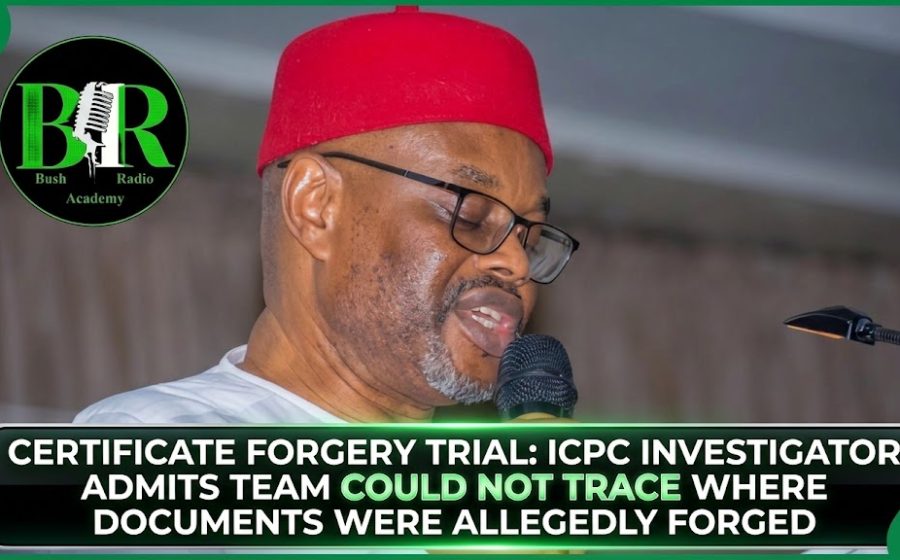
An investigator with the Independent Corrupt Practices and Other Related Offences Commission (ICPC), Superintendent of Police Yakubu Ibrahim, has told a Federal High Court in Abuja that the University of Nigeria, Nsukka (UNN) and the National Youth Service Corps (NYSC) denied issuing certificates allegedly presented by former Minister of Innovation, Science and Technology, Uche Nnaji.
Ibrahim made the disclosure on Monday, October 26, 2026, while testifying as the first prosecution witness in the ongoing trial of the former minister, who is facing six counts relating to alleged corruption, fraud, conferring corrupt advantage and providing false information over the disputed academic and NYSC documents.
According to Bush Radio Academy, the investigator said the ICPC launched an investigation after receiving two separate petitions accusing Nnaji of certificate forgery. He explained that the commission’s Special Task Force chairman subsequently directed the team to investigate the allegations.
Ibrahim told the court that investigators requested relevant records from the National Assembly, the Office of the Secretary to the Government of the Federation, UNN and the NYSC as part of their inquiries.
He said the commission contacted UNN to verify a Bachelor of Science certificate in Microbiology and Biochemistry allegedly presented by Nnaji during his ministerial screening before the Senate in 2023. According to the witness, the university responded that it had not issued the certificate attributed to the former minister.
The investigator also stated that the NYSC denied issuing a discharge certificate dated May 15, 1986, allegedly presented by Nnaji.
He further told the court that UNN supplied the commission with academic records relating to the former minister, including a withdrawal notice connected to his performance in a course.
When the prosecution sought to tender correspondence between the ICPC and the two institutions, defence counsel Wole Olanipekun, a Senior Advocate of Nigeria, said he would not object to their admission at that stage but reserved the right to challenge them subsequently.
Ibrahim also explained how the commission attempted to invite Nnaji for questioning. He said investigators initially encountered difficulties locating his address, prompting the head of his section to send an invitation dated May 5, 2026, to the former minister’s email address and WhatsApp number.
According to the witness, after Nnaji failed to honour the invitation, the ICPC sought assistance from the Economic and Financial Crimes Commission (EFCC) in locating and arresting him. He told the court that the arrest took place on July 1, after which Nnaji was questioned and made statements dated July 1 and 2.
However, during cross-examination, Ibrahim acknowledged that he did not personally visit UNN during the investigation and could not identify the faculty to which Nnaji had been admitted. He maintained that members of the investigative team interviewed the university’s registrar.
The witness also admitted that investigators had not established where the disputed certificates were allegedly forged.
When questioned about whether the team investigated where Nnaji completed his national service, Ibrahim said it did not pursue that line of inquiry because the NYSC had already denied issuing the discharge certificate.
The court also heard evidence concerning a UNN withdrawal notice dated November 7, 1984, which Ibrahim identified as an exhibit. He said the university explained its academic requirements for students to qualify for graduation, including the consequences of repeatedly failing a course.
According to the investigator, the records indicated that Nnaji failed at two stages and did not sit for an examination at a third stage for medical reasons. He added that the former minister subsequently took a supplementary examination for which he had not registered.
During cross-examination, Olanipekun suggested that a later letter dated March 18, 1985, had reversed the earlier withdrawal notice. Ibrahim agreed with the suggestion and clarified that the notice concerned a course in General Microbiology.
The investigator further acknowledged that the team had not established the expected duration of a Microbiology degree programme at the university. He also told the court that Nnaji did not comment on the allegations when questioned by investigators.
Following the conclusion of cross-examination, the prosecution asked no further questions, and Justice Joyce Abdulmalik discharged the witness.
The judge adjourned the case until November 3, 2026, for further hearing.
The allegations remain subject to judicial determination. The evidence presented by the prosecution, including the institutions’ reported responses and the investigator’s admissions during cross-examination, does not by itself amount to a conviction of the former minister.



Comments
0 comments