
Federal Workers Express Outrage Over Selective Implementation Of ₦70,000 Minimum Wage
 Follow us on Google News
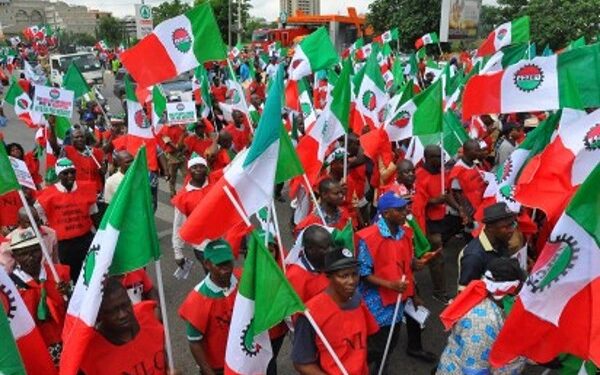
Federal Workers Express Outrage Over Selective Implementation Of ₦70,000 Minimum Wage
The Federal Government’s selective implementation of the new ₦70,000 minimum wage has sparked significant unrest among public sector workers, many of whom have yet to receive any pay increase. Employees from various Ministries, Departments, and Agencies (MDAs), including those at federal universities, have criticized the government for what they perceive as a blatant insensitivity, pointing to policies that have exacerbated hardship and hunger across the nation…….CONTINUE READING
Since the minimum wage was signed into law by President Bola Tinubu on July 18, 2024, following extensive negotiations with the tripartite committee involving government representatives, the Organised Private Sector (OPS), and labor unions like the Nigeria Labour Congress (NLC) and the Trade Union Congress (TUC), numerous workers have expressed their frustration over the lack of payment.
Conflicting reports from the Accountant-General’s Office and the Budget Office have only added to the confusion. The Accountant-General’s office stated that the new minimum wage was implemented alongside the September salary payments. However, the Budget Office asserted that a flat amount of ₦40,000 was paid across the board to all federal workers, a claim that has been disputed by many employees.
An anonymous MDA staff member expressed their discontent, saying, “We are fed up with the whole system. We do not know what the government wants us to do. It’s bad enough that the government removed the fuel subsidy, inflicting unbearable suffering and hardship on workers and Nigerians alike. To add insult to injury, the new minimum wage, signed into law for months, has still not been implemented.”
The worker also noted that some employees in the core civil service had received a salary increase, raising questions about the fairness of this selective payment. “It is pure discrimination and salary slavery designed to keep some of us in perpetual bondage,” they added. Many workers have been forced to sleep in their offices or trek long distances to work due to financial constraints, while others struggle to provide for their families and pay school fees for their children.
Another source in the Accountant-General’s office insisted that the new minimum wage was indeed applied in the September salary. However, a source from the Office of Budget and National Planning indicated that a flat ₦40,000 payment was made to all federal workers rather than the new minimum wage. The intention was to transition workers previously earning ₦30,000 to the new ₦70,000 minimum wage by providing an additional ₦40,000.
While some federal workers reported receiving the extra ₦40,000 in their September salaries, an explanatory note obtained by Vanguard clarified that this amount was a temporary measure before the official minimum wage template was finalized. The note stated that the ₦40,000 was a flat rate applied to all civil servants, pending the release of the official minimum wage template, which was expected to come into effect in October.
Benjamin Anthony, President of the Amalgamated Union of Public Corporation, Civil Service Technical and Recreational Services Employees (AUPCTRE), condemned the selective payment of the new minimum wage. He stated, “An insignificant number of workers has received an addition to their monthly pay, but the majority have not received anything. This means nobody has truly been paid the new minimum wage.”
Similarly, Ibeji Nwokoma, President of the National Association of Academic Technologists (NAAT), expressed concern over the delay, highlighting the increasing hardship faced by his members. “People are suffering, parking their cars, and unable to send their children to school,” he lamented, calling for the urgent implementation of the new wage to alleviate the financial strain on public servants.
Mohammed Ibrahim, President of the Senior Staff Association of Nigerian Universities (SSANU), echoed these sentiments, stating that the delay is causing significant economic distress for university workers, many of whom face long commutes. “We urge the government to commence the payment immediately to help alleviate the high cost of living,” he urged.
For more information on this article and other related posts from Bushradiogist, please join our WhatsApp channel by clicking this link https://whatsapp.com/channel/0029VaUumOODTkK7AZL1Fw3o. For advertisement inquiries only, kindly send a message to 090 1907 0863 on WhatsApp.







Comments
0 comments