
Five Election Gods — Fayemi Reveals What Every Politician Must Satisfy To Win
 Follow us on Google News
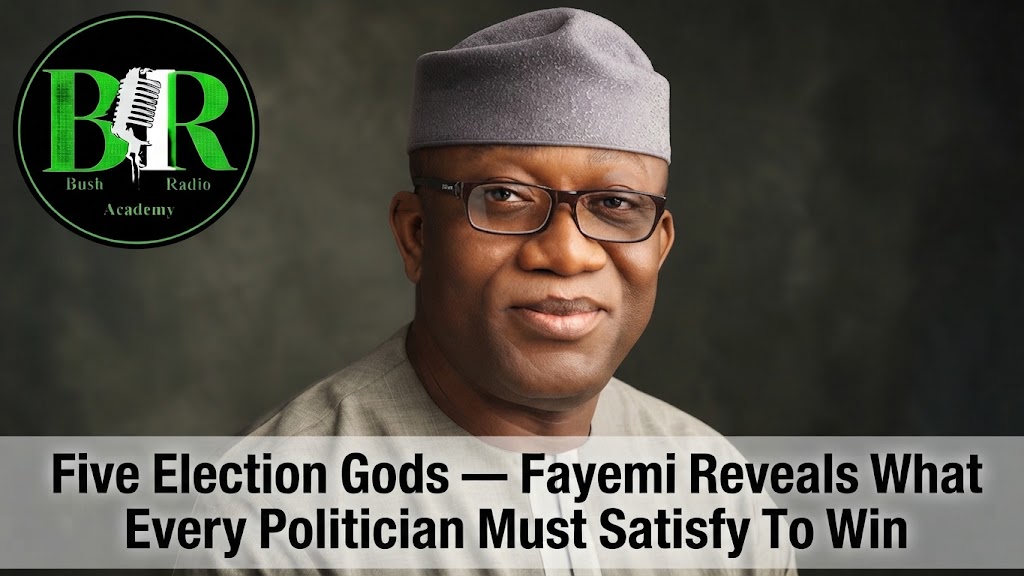
Former Ekiti State Governor, Kayode Fayemi, has identified five major forces that politicians must take into account if they hope to win elections in Nigeria, describing them as the “five election gods.”
Fayemi identified the Independent National Electoral Commission (INEC), security agencies, the judiciary, non-state security actors and financial resources as critical factors that can significantly influence the outcome and aftermath of elections.
According to Bush Radio Academy, the former governor made the remarks in media entrepreneur Seun Oloketuyi’s book, How To Win Elections in Nigeria, where he reflected on his experiences in Nigerian politics and the strategies he believes are necessary for electoral success.
Fayemi explained that winning elections goes beyond having a popular candidate or a strong campaign structure, stressing the importance of understanding the political environment and building relationships with influential figures at both the elite and grassroots levels.
He recalled his early political experiences in Ekiti, where he faced a challenging political environment and opponents who portrayed him as an outsider. According to him, strong convictions, external networks, grassroots mobilisation and a clear policy agenda helped strengthen his political campaign.
The former governor also emphasised the importance of maintaining effective communication with different groups within the electorate. He said politicians must constantly engage intellectual and political elites, social media audiences and grassroots communities rather than assuming that their achievements will automatically speak for them.
Fayemi further stressed the importance of engaging smaller political parties and other stakeholders during elections. He argued that candidates should establish relationships with smaller parties and their agents, while also maintaining links with independent observers who could play important roles if disputes arise after an election.
He noted that politicians must also be prepared to manage their public narrative, particularly during periods of controversy or electoral disputes. In his view, candidates who fail to communicate their own version of events risk allowing opponents to define the narrative surrounding their political campaigns.
The former governor’s comments highlight the complex nature of electoral politics in Nigeria, where candidates must navigate electoral institutions, security structures, legal processes, political networks and financial demands while simultaneously maintaining strong connections with voters.
Fayemi’s reflections also suggest that successful political campaigns require more than conventional mobilisation, with candidates needing to understand the institutions and influential actors that shape the electoral process before, during and after voting.






Comments
0 comments