
Fresh Details Surface After Ribadu’s Strategic Talks With US Vice President Vance
 Follow us on Google News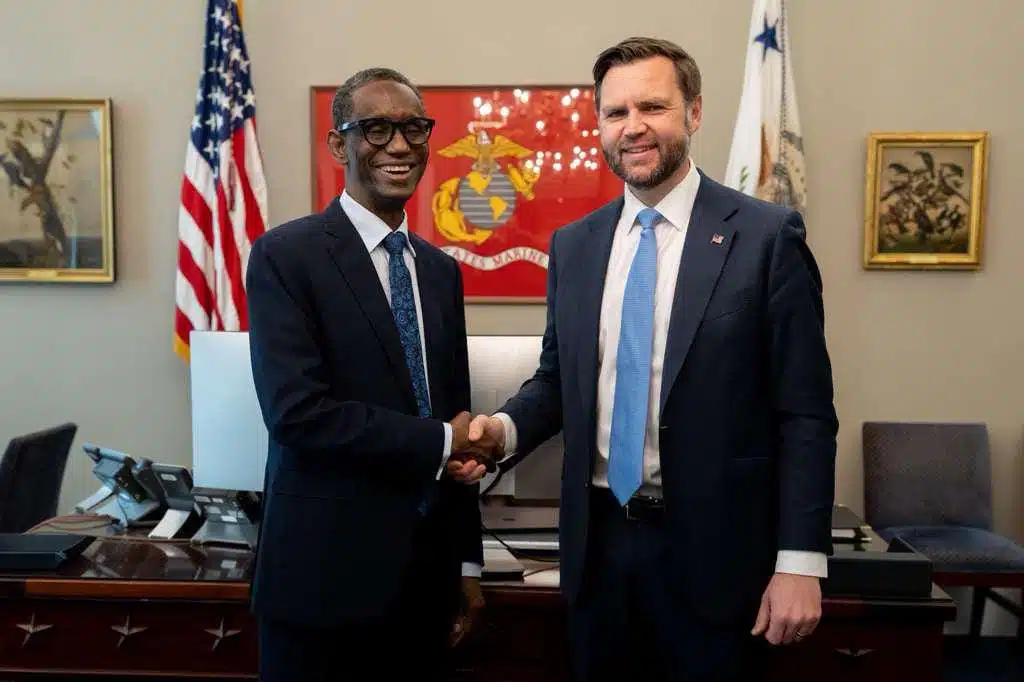
The Presidency has provided details of discussions held by Nigeria’s National Security Adviser, Nuhu Ribadu, during his three-day official visit to the United States.
Ribadu was in the U.S. from May 4 to May 6, where he held meetings with top American government officials.
The development was disclosed in a statement issued by the Special Adviser to the President on Information and Strategy, Bayo Onanuga.
During the trip, Ribadu met with U.S. Vice President J.D. Vance, Acting National Security Adviser and Secretary of State Marco Rubio, Undersecretary for Political Affairs Allison Hooker, and Assistant Secretary of War Daniel Zimmerim.
According to the Presidency, the discussions centered on strengthening diplomatic and security cooperation between Nigeria and the United States. Both countries reportedly agreed to deepen bilateral relations through sustained diplomatic engagement and improved collaboration in defence and security matters.
Onanuga explained that the talks reviewed the current state of Nigeria–U.S. relations, with particular attention on counterterrorism operations, intelligence sharing, regional security, defence cooperation, economic resilience, and democratic governance.
Ribadu highlighted the need for continued international collaboration in tackling emerging threats across West Africa and the Sahel region, including terrorism, violent extremism, organised crime, and cyber-related threats.
He also reaffirmed Nigeria’s commitment to promoting peace, stability, democratic governance, and economic growth across Africa, while emphasizing the country’s leadership role in counterterrorism efforts within the Lake Chad Basin and the wider West African region.
The discussions further addressed the evolving security challenges in the Sahel and the importance of stronger regional partnerships and institutional capacity to manage complex security threats effectively.
During his meeting with Allison Hooker at the U.S. Department of State, Ribadu expressed appreciation to the American government for its continued support in areas such as intelligence cooperation, defence training, humanitarian assistance, and counterterrorism operations.
He also reiterated Nigeria’s commitment to implementing agreements under the Nigeria–U.S. Joint Working Group, established to strengthen structured bilateral cooperation on strategic and security-related matters.
Both sides reportedly reviewed progress made under the framework and discussed additional steps to improve intelligence exchange, military cooperation, border security, strategic communications, and institutional capacity building for Nigerian security agencies.
Ribadu also briefed U.S. officials on reforms and operational measures being introduced by the Nigerian government to improve national security, stabilize affected communities, and address the root causes of insecurity.
He explained that the government’s strategy combines military operations with non-military approaches such as community engagement, economic development, deradicalisation programmes, and regional partnerships.
According to the Presidency, U.S. officials commended Nigeria’s leadership role in promoting regional peace and security and described the country as an important strategic partner of the United States in Africa.
Both countries reaffirmed their commitment to democratic values, regional stability, economic cooperation, and the promotion of sustainable peace and security across West Africa and the Sahel, while expressing optimism about the future of their strategic partnership.


Comments
0 comments