
Fresh Tension In Rivers As Groups Fault Fubara’s Five-Member Cabinet
 Follow us on Google News
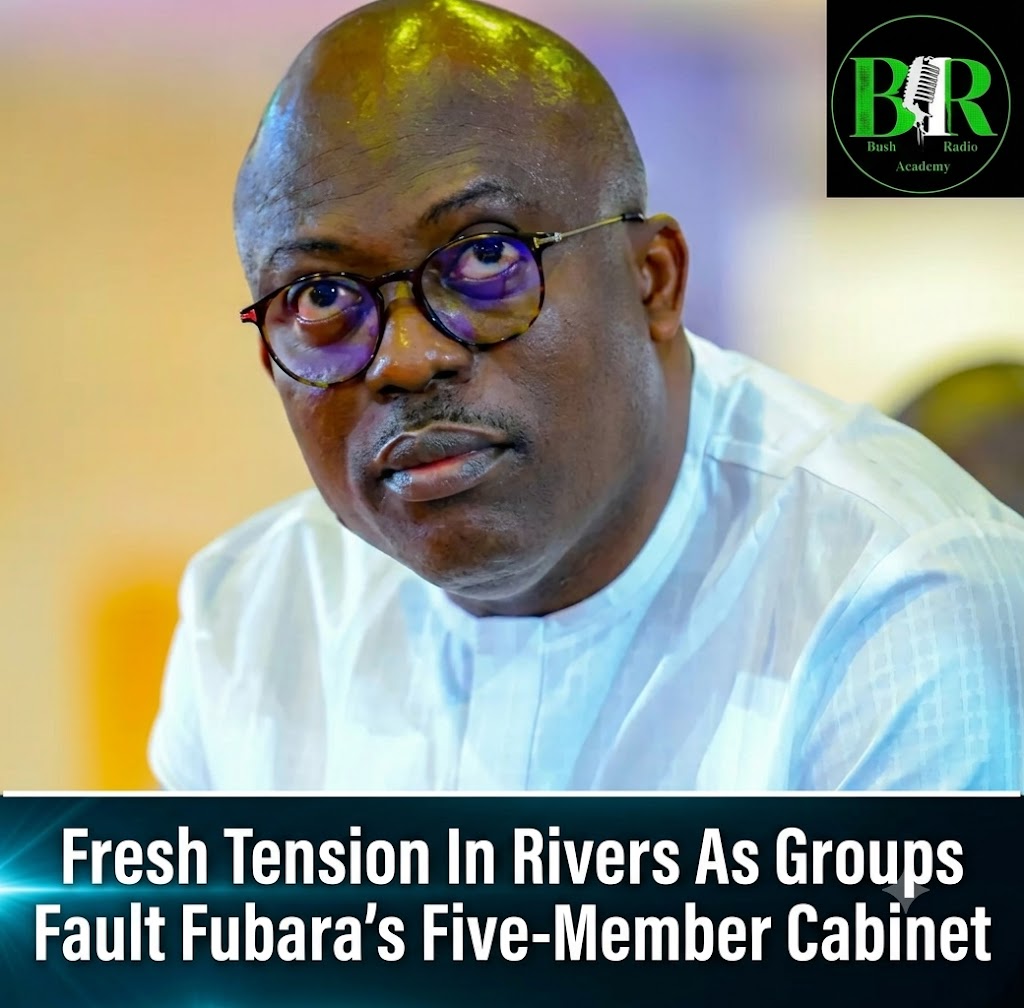
Rivers State Governor, Siminalayi Fubara, is still running the state with only five commissioners, leaving several key ministries without substantive political heads months after the state’s political crisis was reportedly resolved.
The affected ministries include Health, Justice, Works, Environment, Sports, and Information and Communications.
Fubara had submitted nine commissioner-nominees to the Martin Amaewhule-led Rivers State House of Assembly, with the nominees screened on March 9, 2026. However, lawmakers rejected four of them over alleged poor performance during screening and petitions against one of the nominees.
The five nominees who secured approval were subsequently sworn in and assigned portfolios.
The situation has left the state without a substantive Attorney-General and an official government spokesperson, while permanent secretaries, including some serving in acting capacities, continue to oversee the affected ministries.
The governor also recently inaugurated 13 new permanent secretaries.
Cabinet Dissolved After Reconciliation
Fubara dissolved the State Executive Council and removed his special advisers on February 12, 2026, following a reconciliation agreement reached with his predecessor and political ally, Nyesom Wike, the Minister of the Federal Capital Territory.
The dissolution was followed by the submission of nine commissioner-nominees to the House of Assembly, but only five were confirmed.
Concerns over the incomplete cabinet have grown as the state proceeds with its 2026 budget process. Fubara presented the 2026 Appropriation Bill to the House on July 10.
Stakeholders have argued that the absence of commissioners in critical ministries could affect budget defence, policy coordination and effective implementation of government programmes.
Youth Group Demands Full Cabinet
The South-South Youths Initiative (SSYI) welcomed the reported political reconciliation but expressed concern that it had not translated into a fully functional government.
Its National President, Saviour Imeabe, said operating with only five commissioners was unacceptable, particularly with the 2026 budget process underway.
He questioned how five commissioners could effectively supervise ministries, departments and agencies and coordinate programmes across the state’s 23 local government areas.
Imeabe urged the governor to submit fresh nominees and called on the House of Assembly to expedite their screening and confirmation.
He warned that the absence of political leadership in critical sectors such as Health, Education, Works, Agriculture, Youth and Women Affairs could place additional pressure on the governor and civil servants while slowing service delivery.
CLO Raises Accountability Concerns
The Rivers State branch of the Civil Liberties Organisation also criticised the continued operation of what it described as a skeletal cabinet.
The branch spokesman, Emmanuel Obe, said the political crisis could no longer justify the vacancies, following the reported reconciliation between the executive and legislative arms.
He expressed concern about the absence of substantive commissioners in ministries including Justice, Health, Agriculture, Environment, Works, and Information and Communications.
According to Obe, the situation could also affect the budget process because commissioners are traditionally expected to defend their ministries’ proposals before lawmakers.
The CLO therefore called on Fubara to forward fresh commissioner-nominees to the Assembly for screening and confirmation without further delay.
Rivers Peace Initiative Calls for Action
The Rivers Peace Initiative also welcomed the improved relationship between the executive and legislature but urged both arms of government to ensure that the reconciliation produces tangible governance benefits.
Its convener, Obinna Ebogidi, said a fully constituted cabinet would demonstrate the sincerity of the peace process and enable the government to focus on development.
He urged Fubara to submit fresh nominees while calling on the Assembly to consider them fairly and promptly.
Ebogidi said Rivers residents expected more than an end to political hostilities, stressing that the ultimate test of reconciliation would be improved governance and better outcomes for the people.
The groups maintained that the resolution of the political crisis should now pave the way for a fully constituted executive council capable of providing effective leadership and delivering the state’s development agenda.





Comments
0 comments