
Latest
He Betrayed Nigerians’ — Ex-Guards Brigade Officer Unleashes Scathing Attack On IBB

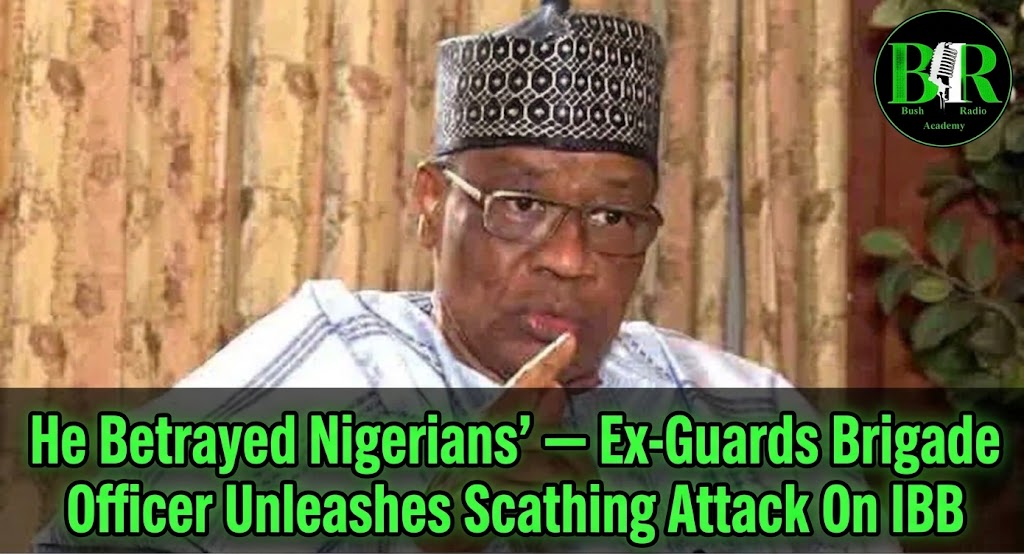
A former Guards Brigade officer has accused former military Head of State, Gen. Ibrahim Badamasi Babangida (retd.), of attempting to distance himself from some of the most controversial decisions taken during his administration.
The former officer, who spoke with Sahara Reporters, specifically cited the annulment of the June 12, 1993 presidential election and the execution of Maj. Gen. Mamman Vatsa.
According to him, Babangida, as Head of State and Commander-in-Chief at the time, should accept responsibility for decisions made by his military government, regardless of the involvement of other senior officers.
The former lieutenant, who served in the Guards Brigade during Babangida’s administration, said his distrust of the former military ruler intensified after the annulment of the June 12 election, which was widely believed to have been won by the late businessman and politician, Moshood Kashimawo Olawale Abiola.
He recalled an incident during a Ramadan Iftar at the Presidential Villa in March or April 1993, which he said raised suspicions in his mind about Abiola’s political future.
“IBB is completely evil. Satanic, really. I was in the Guards Brigade as a lieutenant when the June 12 election annulment occurred.
“I hated him from that time, especially when he later blamed others, especially Abacha, for the decision.”
Iftar Remark Raised Suspicions
The former officer said he and two other officers from the 7 Guards Battalion were invited to break their Ramadan fast with Babangida at the Presidential Villa.
He recalled that the late Abdulrahman Okene, whom he later learned had taught Babangida in secondary school, was also present.
According to him, television news was being watched during the Iftar when a report showed Abiola campaigning in a northern state, speaking in Hausa and promising to improve infrastructure and living conditions if elected.
The former officer claimed Babangida reacted to the report in Hausa, saying:
“Za mu ga wanda zai bar shi ya yi ayyukan nan.”
He translated the statement to mean:
“Let’s see who will allow him to do such things.”
The former officer said he interpreted the comment as an indication that powerful forces might prevent Abiola from implementing his campaign promises.
“I was not surprised when the election was annulled in June 1993,” he said.
He, however, acknowledged that the alleged statement alone did not constitute conclusive proof that Babangida knew beforehand that the election would be annulled.
“I am not implying categorically that he, IBB, may not have known beforehand that the election was going to be annulled, but the words that he uttered on the dining table during the Iftar suggest something untoward.”
Babangida’s Account of June 12
In his 2025 autobiography, A Journey in Service, Babangida acknowledged that Abiola won the June 12 election with 8,128,720 votes, compared with 5,848,247 votes recorded by Bashir Tofa.
He also acknowledged that Abiola secured the required geographical spread.
However, Babangida attributed part of the crisis surrounding the election to forces opposed to the poll, allegedly led by his then Chief of Defence Staff, Gen. Sani Abacha, while he was away in Katsina.
The former military ruler also cited security concerns, legal disputes surrounding the election and opposition within the military to the return to civilian rule.
Babangida maintained that there were fears Abiola could be assassinated by powerful military interests, potentially plunging the country into another civil war.
At the public presentation of his autobiography in Abuja, Babangida nevertheless accepted overall responsibility for events that occurred under his administration and described the annulment as a regrettable accident of history.
The former Guards Brigade officer, however, rejected attempts to place primary responsibility for the annulment on Abacha and other senior military officers.
“For IBB to later insinuate that Abacha and some other generals were responsible is arrant nonsense.”
Abacha subsequently became military Head of State after the short-lived Interim National Government headed by Chief Ernest Shonekan, following Babangida’s resignation in August 1993.
Officer Challenges IBB’s Account of Vatsa’s Execution
The former officer also criticised Babangida’s explanation of the execution of Maj. Gen. Mamman Vatsa, his childhood friend and former Minister of the Federal Capital Territory.
Vatsa and several other military officers were executed in March 1986 after being convicted by a special military tribunal for allegedly participating in a coup plot against Babangida’s government.
Babangida had previously said he was “shocked, devastated and deeply disappointed” by the development but maintained that his “hands were tied” by military law.
The former Guards Brigade officer dismissed the explanation, arguing that Babangida, as President and Commander-in-Chief, had authority over military tribunals and could confirm, commute or otherwise act on sentences.
“What a nonsense talk.
“Thus, IBB was the President and Commander-in-Chief and had such powers to convene, confirm, commute, etc.”
He also referred to comments attributed to former Defence Minister Gen. Domkat Bali concerning the relationship between Babangida and Vatsa.
According to the officer, Bali described the relationship between the two men as being marked by rivalry and said he could not understand the level of hostility between them.
The former officer said Bali’s account led him to conclude that Babangida was responsible for the decision to execute Vatsa and the other convicted officers.
“From Gen. Bali’s statement, I deduced that the decision to execute Vatsa and the other convicted coup plotters was made by IBB.”
He added that Babangida did not publicly challenge Bali’s account while the former Defence Minister was alive.
‘The Buck Stops With the Leader’
The former Guards Brigade officer said the June 12 annulment and Vatsa’s execution significantly influenced his assessment of Babangida’s years in power.
He accused the former military ruler of refusing to take responsibility for decisions made under his authority.
“In the two instances narrated above, IBB showed that he is a coward. He does not own up to things as he blames others for things which he should take responsibility for.”
He argued that leaders and commanders must ultimately accept responsibility for decisions taken under their authority, even when such decisions are made collectively.
“There is a saying that as a leader or commander, the buck stops at your table; it doesn’t go any further.”
The former officer further accused Babangida of abandoning responsibility for decisions involving his colleagues and subordinates.
“IBB is a betrayer. Even if a decision was taken collectively, he, as the head, should take responsibility, especially if it didn’t go right.


Bella-Sheggz Saga: BBNaija Star Breaks Silence, Reveals What Really Happened In Their Relationship

Burna Boy Reveals Secret Group Chat With Vinícius, Jaylen Brown, Teases Nigeria Visit

Osun Election: Fayose Reveals How Accord Party Allegedly Spent ₦40bn In Campaign Spending

Nollywood Actor Reveals Chilling Details Of Alleged Meeting With Witches [Video]

Jonathan Raises Alarm Over Govs’ Interference In Off-Cycle Elections: ‘This Must Be Stopped

OKPEBHOLO DECLARES WAR ON REVENUE LEAKAGES, SECRET ACCOUNTS AND ILLEGAL TAX COLLECTION IN EDO

2Baba Makes Bold Move Amid Growing Tension In Marriage To Natasha

BREAKING: US Ends Temporary Protection For 12 Countries — See Full List

Peter Obi Can’t Be President” — Dino Melaye Reveals His Reason!
