
Latest
THE 18,439-VOTE MISSION WHY WADADA COULD BE TINUBU’S NASARAWA GAME CHANGER

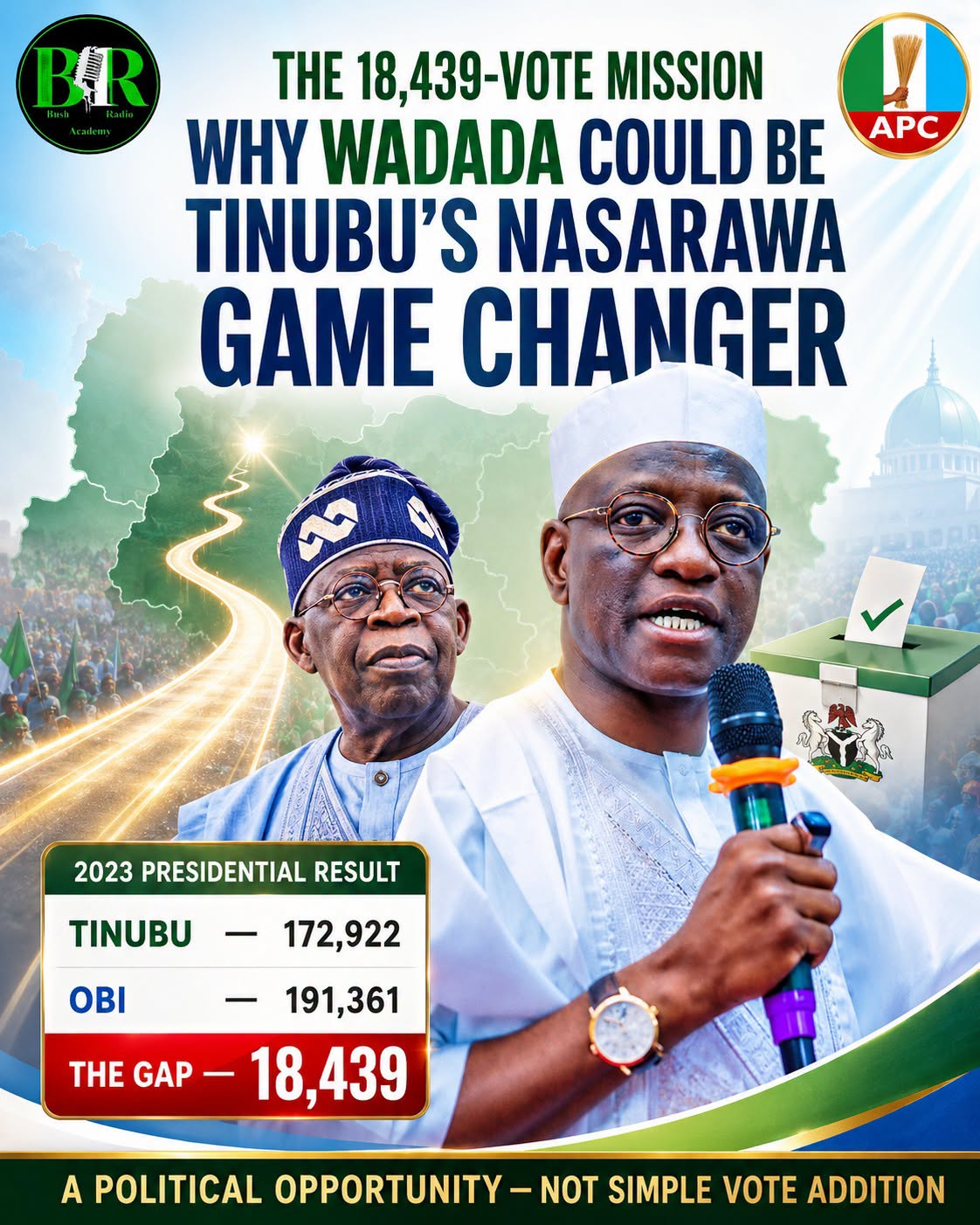
THE 18,439-VOTE MISSION
WHY WADADA COULD BE TINUBU’S NASARAWA GAME CHANGER
Political elections are sometimes transformed by enormous national movements.
At other times, the difference is simply finding the right local candidate capable of closing a narrow gap.
In Nasarawa State, that gap is 18,439 votes.
During the 2023 presidential election, Peter Obi received 191,361 votes, while Bola Ahmed Tinubu secured 172,922 votes. Tinubu therefore finished second in the state by 18,439 votes.
It was not an overwhelming rejection of the APC.
It was a close political contest decided by a margin that a stronger coalition, improved mobilisation and a compelling local candidate could potentially reverse.
That is where Senator Ahmed Aliyu Wadada becomes strategically important.
In that same 2023 election cycle, Wadada contested for the Nasarawa West senatorial seat under the Social Democratic Party.
He polled 96,488 votes, defeating the APC candidate, who received 47,717 votes, and the PDP candidate, who secured 46,820 votes.
Those Senate votes cannot simply be added to Tinubu’s presidential total. They came from a different contest, involving different candidates and voter considerations.
But they revealed something politically significant:
Wadada possessed electoral influence beyond the APC structure.
He left the ruling party, contested under a smaller platform and still defeated candidates representing Nigeria’s two largest political parties.
Today, the political equation has changed.
Wadada’s personal following and the APC’s established machinery are no longer standing on opposite sides.
They are now operating within the same political platform.
That creates an opportunity for the APC—but it does not automatically guarantee victory.
THE FIRST ASSIGNMENT IS POLITICAL RECONCILIATION
Wadada must unite the competing interests that emerged during the APC governorship contest.
Winning a party ticket produces a candidate.
Reconciliation produces a campaign.
If influential aspirants, local leaders, elected officials and grassroots organisers genuinely work together, the APC enters the election with a broader mobilisation network.
But if reconciliation exists only in photographs and public declarations, unresolved divisions could weaken the party from within.
THE SECOND ASSIGNMENT IS RECOVERING HIS CROSS-PARTY VOTE
Thousands of people supported Wadada when he stood outside the APC.
The critical question is whether they supported the SDP—or whether they supported Wadada himself.
If that loyalty was personal, he could bring voters who previously opposed the APC into a new coalition.
However, he must convince them that returning to the ruling party has not disconnected him from the independence and grassroots accessibility that originally attracted their support.
That may be his most delicate political task.
THE THIRD ASSIGNMENT IS GIVING TINUBU’S CAMPAIGN A LOCAL FACE
Presidential elections are not won through national messaging alone.
Voters frequently respond to the political leaders they know, the candidates they trust and the local consequences they can understand.
Wadada could translate the APC’s national campaign into a distinctly Nasarawa conversation—connecting federal policy with jobs, agriculture, infrastructure, mineral development, security and opportunities for young people.
His governorship campaign could provide the local energy needed to strengthen Tinubu’s presidential mobilisation.
But the campaign must also confront economic hardship honestly.
It cannot rely entirely on party loyalty or assume that voters have forgotten their daily struggles.
It must explain what has changed, acknowledge what remains difficult and present a credible case for what Nasarawa stands to gain.
That is the real importance of the 18,439-vote gap.
It is small enough to be overturned—but large enough to punish complacency.
Wadada’s assignment is therefore bigger than securing Nasarawa Government House.
He must unite the APC.
He must retain his personal following.
He must reach voters outside the ruling party.
And he must help transform Tinubu’s second-place finish in Nasarawa into a winning coalition.
The votes cannot simply be added together.
The people must be persuaded.
The structures must be united.
And the political opportunity must be converted.
THAT IS THE 18,439-VOTE MISSION.
Osigwe Omo-Ikirodah is the Principal and CEO of Bush Radio Academy.


THE 18,439-VOTE MISSION WHY WADADA COULD BE TINUBU’S NASARAWA GAME CHANGER

SALIU MUSTAPHA: YOU CAN DENY HIM A PARTY TICKET—BUT YOU CANNOT CONFISCATE THE GRASSROOTS

Transfer Boost: Kingsley Ehizibue Joins Genoa As Victor Orakpo Moves To Turkey

EPL Showdown: Arsenal, Chelsea Clash In Battle For London Supremacy

Continental Glory: Ikpeme Backs Edo Queens, Rangers, Others To Make Nigeria Proud

WHY OKPEBHOLO KNOWS WHAT HE IS SAYING ABOUT TINUBU’S 2.5 MILLION VOTES

Fake Agency Scandal: ICPC Recommends Punishment for 13 Officials — See Full List

Cement Hits ₦15,000: FCCPC Demands Answers From Dangote, BUA, Other Producers

Was The Sacrifice Worth It?” – El-Rufai’s Son Reveals What Father Told Him In Detention
