
The North Has Lost Its Values’ – Ango Abdullahi Laments Region’s Decline
 Follow us on Google News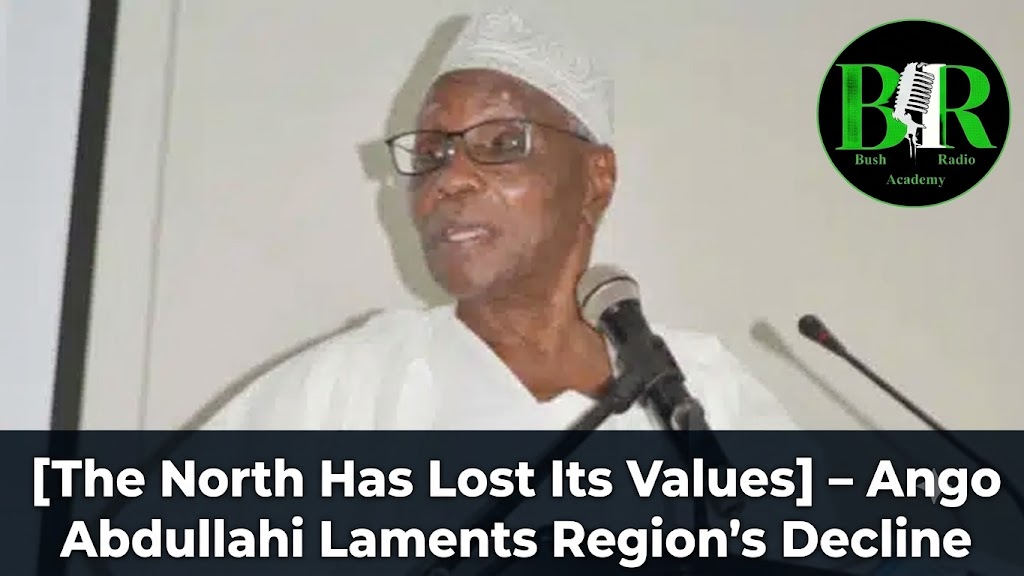
Elder statesman and former Vice-Chancellor of Ahmadu Bello University (ABU), Prof. Ango Abdullahi, has expressed concern over what he described as the decline of values and leadership in Northern Nigeria, blaming many of the region’s current challenges on the abandonment of the principles upheld by its founding leaders.
Abdullahi made the remarks on Saturday at the third edition of the Late Gen. Hassan Usman Katsina Memorial Conference held at Arewa House in Kaduna.
The annual event, organised to honour the legacy of the late Gen. Hassan Usman Katsina, also serves as a platform for discussions on leadership, governance and the future of Northern Nigeria.
The conference was themed, “From Sacrifice to Strategy: Rekindling Gen. Hassan Usman Katsina’s Vision for a Prosperous Northern Nigeria.”
The former ABU Vice-Chancellor said the North had drifted away from the values inherited from its forebears and pioneer leaders, arguing that the region’s stagnation stemmed more from a decline in moral standards and leadership than from a lack of infrastructure.
‘The North Has Lost Its Values’
According to Abdullahi, the erosion of virtues such as discipline, honesty, sacrifice and selfless leadership has played a major role in the region’s current difficulties.
“The North has lost its values. You may not want to hear this, but that is the case today. If we have not lost the values we inherited from our parents and pioneer leaders, the North would not be where it is today,” he said.
He acknowledged that many northern cities have experienced physical growth but argued that the moral principles that once distinguished the region have steadily faded.
Abdullahi stressed that infrastructure alone cannot solve the North’s challenges if its people continue to neglect the ideals that shaped previous generations of leaders.
“The North is in a pathetic situation. For me, that is the major reason the region has stagnated. Forget the buildings you see; the real issue is the loss of our values,” he stated.
He urged today’s leaders to study and emulate the life of the late Gen. Hassan Usman Katsina, describing him as a symbol of integrity, accountability and selfless service.
“If we can return to those values, particularly by remembering those who lived by them, I have no doubt the North would be in a far better position today,” he added.
Bugaje Raises Concerns Over North’s Challenges
In his keynote address, former presidential candidate and political commentator, Dr. Usman Bugaje, said Northern Nigeria continues to grapple with worsening economic conditions, insecurity and institutional decline.
He attributed much of the situation to a departure from the leadership principles exemplified by the late Gen. Hassan Katsina and other leaders of his era.
Bugaje painted a bleak picture of the region, citing declining agricultural production, widespread displacement, rising poverty and the deterioration of education and healthcare services.
“The troubles of the North are many and varied. Food production is declining daily, hundreds of thousands have been displaced from their homes, the economy has continued to shrink, poverty has nearly tripled, education and healthcare have deteriorated, and our human capital has been depleted,” he said.
He noted that persistent insecurity has disrupted farming, commerce and everyday life across the region.
Bugaje also questioned whether the current generation of leaders possesses the vision and resolve needed to confront the North’s mounting challenges.
“It is time to ask how much of the North still remains. More importantly, how much of the sanity of the elite, especially those in government, still remains? Who is there to turn to today? Where are the General Hassans? Where is the leadership? Where is the direction?” he asked.
The political commentator criticised sections of the Northern elite for merely lamenting the region’s problems without taking concrete steps to address them.
“It has become fashionable for the elite to sit comfortably in their homes and declare that the North is in trouble. Some even claim the North is finished. Such remarks only reflect the complacency—or even complicity—of the northern elite,” he said.
Bugaje also recalled a personal encounter with the late Gen. Hassan Katsina, whom he praised for encouraging him to continue expressing his views despite external pressure.
He recounted how the then American ambassador travelled to Kaduna to complain about an article he wrote criticising Western imperialism.
According to Bugaje, rather than discouraging him, Hassan Katsina read the article and urged him to continue writing.
“The American ambassador came all the way to Kaduna to complain about the article. General Hassan read it himself and called me. Instead of asking me to stop, he encouraged me to write more. That was the kind of leader he was. When he believed something was right, he stood by it,” he said.
Bugaje described leaders of Hassan Katsina’s generation as individuals who combined modern education with discipline, modesty, justice and a deep commitment to public service.
He urged present-day leaders to embrace those same values, arguing that doing so would help Northern Nigeria confront its economic, security and social challenges while restoring hope to the region.







Comments
0 comments