
Tinubu Fights Release Of FBI, DEA Records, Gives Reasons To US Court
 Follow us on Google News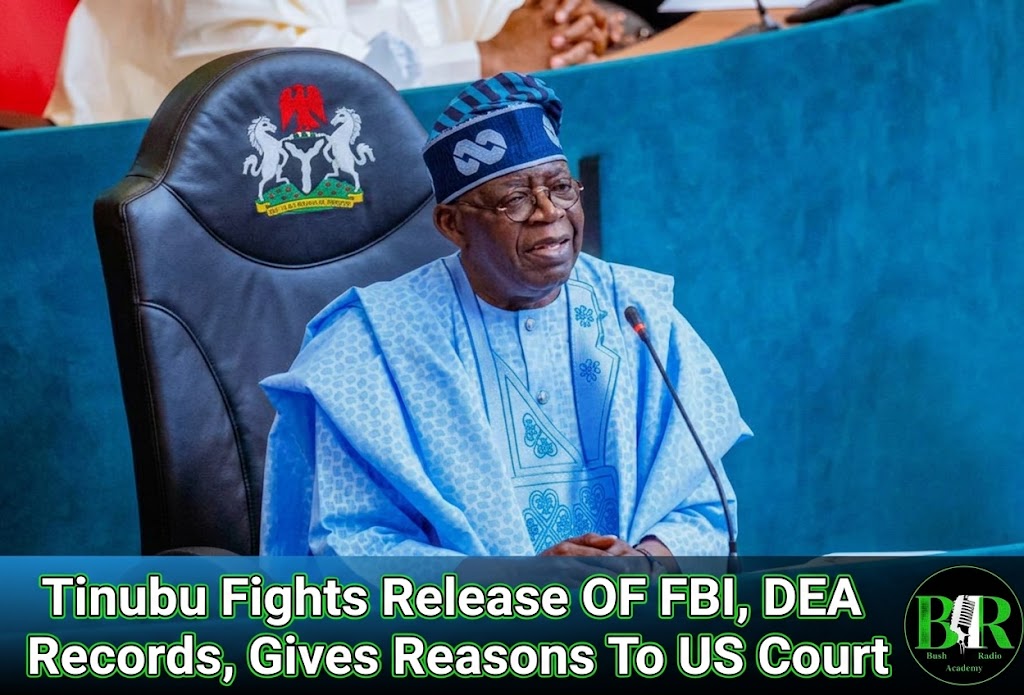
President Bola Tinubu has presented four reasons to the United States District Court for the District of Columbia as to why his records held by the Federal Bureau of Investigation (FBI) and Drug Enforcement Administration (DEA) should remain undisclosed.
The President’s position was contained in court filings submitted by his legal team, comprising Christopher Carmichael, Victor Henderson and Oluwole Afolabi.
Tinubu’s lawyers argued that disclosure of the records was barred by provisions of the US Freedom of Information Act (FOIA) and the Privacy Act, while insisting that the request did not meet the threshold of public interest under American law.
They further maintained that there was no legitimate public interest requiring the records to be disclosed and alleged that the plaintiff had ulterior political motives for seeking documents bearing Tinubu’s name.
The legal submission followed a request by American transparency activist Aaron Greenspan, who petitioned for the release of the records under the US Freedom of Information Act.
Greenspan had argued that his request was justified because it involved the “sitting President of Nigeria” and a country of more than 230 million people whose lives, he said, are directly affected by Tinubu’s decisions.
However, Tinubu’s lawyers urged the US District Court to dismiss the request, arguing that it was an attempt to obtain private information for political purposes in Nigeria.
The legal team acknowledged that the request touched on matters involving government activities but rejected the argument that public interest in Tinubu’s personal background amounted to a form of public interest recognised under US FOIA law.
The lawyers also dismissed claims relating to Tinubu’s fitness for office, arguing that such considerations were outside the scope of interests protected by FOIA.
They stated that “the asserted ‘public interest in Tinubu’s own fitness for office’ is not an interest FOIA recognises or one that needs to be balanced.”
Tinubu’s lawyers further argued that the requested records were protected by privacy exemptions under both the FOIA and the US Privacy Act.
“The redacted information sought by the plaintiff is exempt from disclosure,” they argued, citing FOIA Exemption 7(C), which protects personal information contained in law-enforcement records where disclosure could constitute an unwarranted invasion of privacy.
The President’s legal team also relied on the 1989 US Supreme Court ruling in Department of Justice v. Reporters Committee for Freedom of the Press.
According to the lawyers, the landmark decision established that FOIA is primarily intended to enable the public to understand “what the government is up to,” rather than provide access to personal information about private individuals contained in government files.
They argued that Greenspan’s request amounted to seeking the “disclosure of information about private citizens that is accumulated in various governmental files,” which, in their view, “reveals little or nothing about an agency’s own conduct.”
Tinubu’s legal team therefore maintained that the requested FBI and DEA records should remain protected from disclosure under applicable US privacy and freedom-of-information laws.







Comments
0 comments