
Tinubu’s Alleged Letter To US President Lands Facebook User In Court As DSS Files Three Charges
 Follow us on Google News
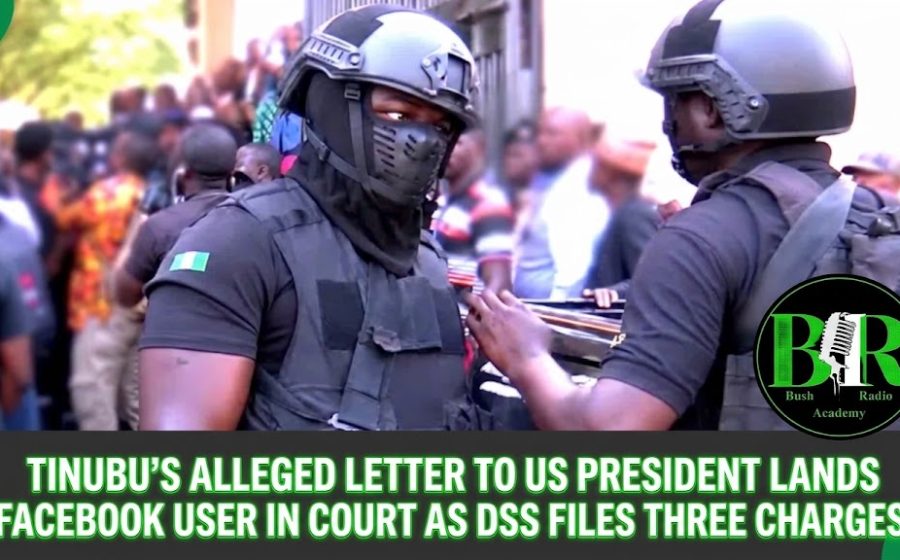
The Department of State Services (DSS) has filed three counts of alleged cybercrime and defamation against a Facebook user, Mubarak Abdullahi, popularly known as Sardaunan Samari, over the alleged circulation of a forged letter purportedly written by President Bola Tinubu to the President of the United States.
President Tinubu’s Special Adviser on Information and Strategy, Bayo Onanuga, disclosed the development in a post on X on Monday night, stating that the suspect had been accused of sharing the document on Facebook.
According to Bush Radio Academy, Onanuga said Abdullahi was arrested on September 28 after allegedly posting the document with the caption, “ATIKU IS COMING.”
The presidential aide claimed that Abdullahi admitted to investigators that he shared the document and expressed regret over his actions. However, Onanuga maintained that the suspect’s apology did not prevent the authorities from pursuing the case.
“Mubarak admitted to investigators that he shared the fake document and apologised for his actions. The contrition was not enough,” Onanuga stated.
The presidential aide further explained that the DSS initially arraigned Abdullahi before Chief Magistrate Court No. 10 in Kabala Doki, Kaduna State, where an order was made for his remand at the Nigerian Correctional Centre in Kaduna.
He added that the DSS had also filed three charges against the suspect at the Federal High Court in Kaduna, although a date for his arraignment before the court had not been fixed at the time of his statement.
Onanuga said the development demonstrated the DSS’s ability to identify individuals allegedly involved in spreading misleading information through online platforms.
However, the arrest has attracted criticism from human rights activist and former presidential candidate Omoyele Sowore, who accused the Tinubu administration of using the secret police to suppress dissenting voices.
In a post on X on Tuesday, Sowore condemned the arrest, arguing that a national security agency should not be deployed to intimidate citizens over their online activities.
He described the action as shameful and warned that those responsible would eventually be held accountable for their conduct.
The case has reignited debate over the government’s handling of alleged online misinformation, the enforcement of cybercrime laws and the need to balance national security concerns with freedom of expression.
Abdullahi’s case remains subject to judicial proceedings, and the allegations against him have yet to be determined by the courts.







Comments
0 comments