
Who Is Afraid of Saliu Mustapha? The Falsehoods, Manipulations and Politics of Desperation
 Follow us on Google News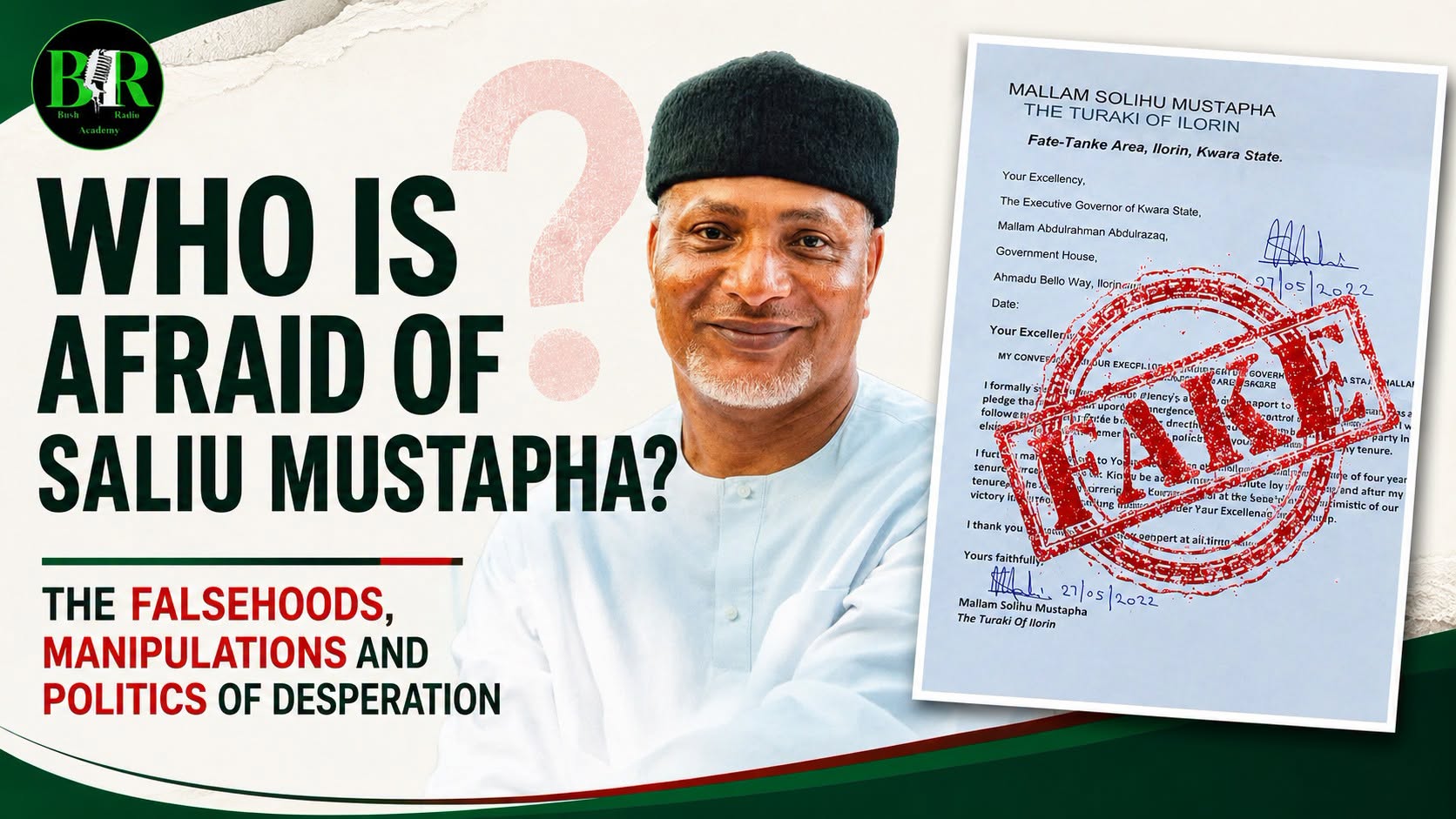
Who Is Afraid of Saliu Mustapha? The Falsehoods, Manipulations and Politics of Desperation
In politics, the strength of a candidate is sometimes measured not only by the size of his support but also by the intensity of the campaign mounted to discredit him.
That is why the controversy surrounding Senator Saliu Mustapha’s resignation from the All Progressives Congress deserves serious examination.
On the day Mustapha announced his departure from the APC, a purported 2022 letter gained widespread circulation on social media. It claimed that he had pledged loyalty to Governor AbdulRahman AbdulRazaq, agreed to follow the governor’s directives and promised to serve only one term as senator representing Kwara Central.
Within hours, the document became the foundation of a political narrative: Mustapha had allegedly made a promise, benefited from it and was now attempting to violate it.
But Mustapha has rejected the viral document as fake.
Speaking on Channels Television’s Politics Today, he said the document was not what he signed and drew attention to the misspelling of his name.
Mustapha acknowledged writing a different letter in 2022 but maintained that its contents were not the same as those of the viral document. According to him, the original reflected his political plan at the time: he intended to spend one term in the Senate and then seek a higher office—the governorship of Kwara State.
His subsequent decision to contest the APC governorship primary was therefore consistent with the ambition he says the authentic letter contained. He denied pledging personal loyalty to AbdulRazaq or signing the purported agreement now being circulated.
The issue is not whether Mustapha ever wrote a letter. It is whether this particular document being presented as evidence of a political pact is authentic.
What Does the Viral Document Show?
The document carries no conventional, branded or independently traceable letterhead.
What appears at the top is simply a typed name and title:
“Mallam Solihu Mustapha, The Turaki of Ilorin.”
Below it is the vague location, “Fate-Tanke Area, Ilorin, Kwara State.”
There is no street name, building number, office address, telephone number or email address through which its origin can be independently traced.
The space marked “Date” inside the letter is also blank. Handwritten dates appear beside the purported signatures, but the formal date field was never completed.
These defects may not individually prove fabrication, but they raise legitimate questions about a document supposedly containing such a consequential political commitment.
His Name Was Misspelt Twice
The alleged author’s name is written as “Solihu Mustapha.”
That spelling appears twice—once in the heading and again beneath the bottom signature.
But the senator’s name is Saliu Mustapha.
This is not a single typographical error hidden inside the body of the letter. The wrong name appears in the two places specifically intended to identify its supposed author.
Are Nigerians expected to believe that Saliu Mustapha prepared and signed such an important undertaking without noticing that his own name had been incorrectly written twice?
That inconsistency becomes even more significant because Mustapha himself cited the misspelling while rejecting the viral document.
Why Was It Signed Twice?
Another irregularity is the presence of what appears to be the same purported signature of Mustapha in two different places.
One appears at the bottom, where the author of a formal letter would ordinarily sign. Another strikingly similar signature appears near the upper right-hand corner. Both carry the same handwritten date.
Why would Mustapha sign the same letter twice on the same day?
Nothing identifies the upper signature as belonging to a receiving officer. There is no name, designation, Government House receipt stamp or official acknowledgement explaining its presence.
If it was intended to confirm receipt, who signed it? What was that person’s position? Why does it resemble the signature attributed to Mustapha?
Repeated circulation cannot answer these questions.
Why Did It Not Appear During the Governorship Contest?
Timing is central to understanding political propaganda.
Mustapha did not hide his governorship ambition. He entered the APC contest and challenged the candidate reportedly preferred by Governor AbdulRazaq.
If the purported agreement was genuine and politically important, why was it not produced when Mustapha contested the governorship primary against the governor’s preferred candidate?
That would have been the most logical time to invoke any agreement allegedly defining Mustapha’s political future.
Why was it not presented through the APC’s internal mechanisms? Why was Mustapha not publicly confronted with it while he remained inside the party?
Why did the document gain widespread circulation only after he resigned from the APC and became positioned to challenge AbdulRazaq for the Kwara Central senatorial seat?
Its sudden circulation appears less like an attempt to enforce an old agreement and more like an effort to portray Mustapha as dishonest before he can present his record to the electorate.
Those presenting the document as genuine carry the responsibility of proving its authenticity.
Where is the original?
Who delivered it?
Who received it at Government House?
Was it entered into an official correspondence register?
Can its text and purported signatures withstand independent forensic examination?
Until the original is produced and properly authenticated, the photographed copy remains a disputed political document—not conclusive evidence of a binding agreement.
This Is About Political Power
Governor AbdulRazaq is completing his constitutionally permitted second term and is positioned for the Kwara Central senatorial contest. Mustapha is the incumbent senator with an established structure, grassroots visibility and a record of interventions across the district.
Through the Alubarika empowerment programme and other initiatives, thousands of farmers, traders, artisans, students, women and young people have reportedly received support.
Critics may legitimately examine the reach and sustainability of these interventions. But presenting a disputed document as established fact is not democratic scrutiny. It is partisan convenience.
Political camps rarely invest this much energy in people they consider harmless.
Let the People Decide
Governor AbdulRazaq has the right to seek election to the Senate. Mustapha equally has the right to pursue re-election on another platform.
The proper place to settle the contest is the ballot box—not anonymous social-media accounts, disputed documents or organised character assassination.
Those promoting the purported letter must produce the original and establish its authenticity.
Until then, one question remains:
If Saliu Mustapha is truly as politically insignificant as his opponents claim, why circulate a disputed letter at the precise moment he becomes their most formidable electoral challenger?
Who, exactly, is afraid of Saliu Mustapha?
Osigwe Omo-Ikirodah is the Principal and CEO of Bush Radio Academy.






Comments
0 comments