
22 Buildings Collapse In Nigeria, Resulting In 33 Deaths Over 7-Month Period
 Follow us on Google News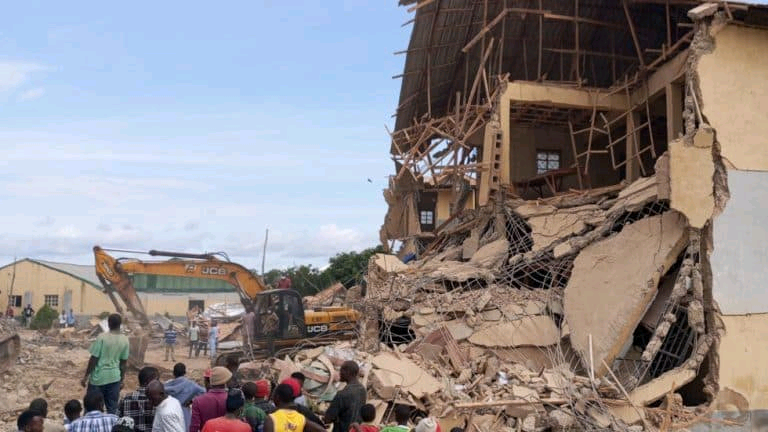
22 Buildings Collapse In Nigeria, Resulting In 33 Deaths Over 7-Month Period
The Council for the Regulation of Engineering in Nigeria (COREN) has reported that Nigeria witnessed 22 building collapses between January and July 2024, resulting in 33 fatalities. COREN President Sadiq Abubakar disclosed these figures during a press briefing in Abuja titled “The Incessant Spate of Building Collapse in Nigeria in Recent Times – A Call for Sustainable Collaboration by All Stakeholders……. CONTINUE READING
According to the News Agency of Nigeria, Abubakar highlighted that Lagos accounted for 27.27% of the collapses, with Abuja and Anambra each recording 18.18%. Ekiti and Plateau states followed with 9.09% each, and Kano, Taraba, and Niger states had 4.55% each.
“Lagos remains disproportionately affected by building collapse incidents,” noted Abubakar. “Since 2012, over 91 buildings have collapsed in Lagos, resulting in more than 354 fatalities. In Abuja, approximately 30 buildings have collapsed since 1993, leading to over 64 deaths and numerous injuries.”
Recent incidents cited by Abubakar included collapses near DMGS Onitsha, Anambra State, on June 12, and the collapse of Saint Academy school in Plateau on July 13, resulting in the tragic loss of 22 students and injuries to 134 others, alongside a collapse in Kubwa, Abuja.
Abubakar stressed the urgent need for reflection and collaboration among stakeholders to tackle this issue. “While expressing our sympathy to the victims and their families, we commend emergency and security services for their swift responses,” he remarked.
The causes of building collapses, Abubakar explained, vary widely but often include aging infrastructure, use of substandard materials, structural failures, unauthorized changes in building use, illegal additions of floors, inadequate supervision, and corruption. He also highlighted issues such as faulty foundations and the absence of soil or geotechnical investigations.
Abubakar commended state governments for establishing investigation panels and urged all stakeholders to unite in finding lasting solutions. “This is a time for collective action among all professionals in the built environment,” he emphasized.
He also raised concerns about illegal mining activities in residential areas, which pose risks to building stability.
COREN has initiated several measures to address building collapses, including the training and licensing of Engineering Regulation Monitoring (ERM) inspectors. The council has also reconstituted its Committee on Engineering Regulation Monitoring, expanding its enforcement responsibilities in line with the amended COREN Act. Additionally, COREN has set up an ERM&E Task Force in key regions such as Ibadan, Port Harcourt, Enugu, Kano, FCT, Gombe, and Lagos to comprehensively address the issue.







Comments
0 comments