
Latest
Breaking: Appeal Court Gives INEC Green Light For 2027 Election Timetable

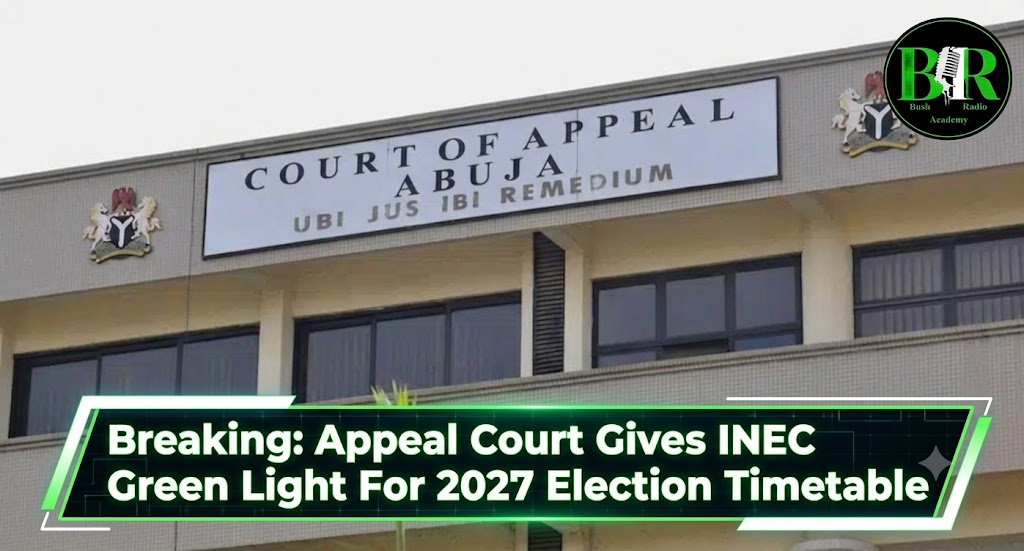
The Court of Appeal in Abuja has overturned a Federal High Court judgment that nullified portions of the Independent National Electoral Commission’s (INEC) revised timetable for the 2027 general elections.....KINDLY READ THE FULL STORY HERE▶
In a unanimous decision delivered on Thursday, a three-member panel upheld INEC’s appeal, ruling that the electoral commission acted within its statutory powers in issuing the Revised Timetable and Schedule of Activities for the elections.
The appellate court held that the Federal High Court failed to apply binding judicial precedents in its May 20 judgment.
According to the court, INEC’s revised timetable constitutes subsidiary legislation made pursuant to the Electoral Act, 2026, and therefore carries the force of law.
The panel further ruled that all deadlines contained in the timetable were consistent with the provisions of the Electoral Act.
INEC had challenged the lower court’s judgment through a nine-ground notice of appeal dated May 25, seeking to overturn the decision delivered by Justice Mohammed Umar of the Federal High Court, Abuja.
The commission argued that the trial court failed to determine its preliminary objection challenging the jurisdiction of the suit filed by the Youth Party.
INEC maintained that the case was hypothetical and academic, adding that the lower court’s failure to rule on the jurisdictional issues amounted to a denial of fair hearing.
The commission also contended that the Youth Party lacked the legal standing to institute the action and urged the Court of Appeal to strike out the suit.
In its judgment, the appellate court affirmed that INEC possesses the legal authority to prescribe timelines necessary for the orderly conduct of elections.
It held that the commission’s election timetable is more than an administrative guideline, describing it as subsidiary legislation made under powers conferred by the Electoral Act.
The court added that such subsidiary legislation has the same legal effect as the principal legislation, provided it remains within the limits of the enabling law.
Consequently, the appellate court upheld INEC’s deadlines for political party primaries, submission of candidates’ particulars, withdrawal and substitution of candidates, and other activities leading to the 2027 general elections.
Background to the Dispute
Justice Mohammed Umar of the Federal High Court had earlier ruled that INEC lacked the authority to prescribe timelines shorter than those expressly provided under the Electoral Act.
The judgment followed a suit instituted by the Youth Party, which challenged several deadlines contained in INEC’s revised election timetable.
The party argued that although INEC is empowered to receive notices of party primaries, monitor the exercises and collect candidates’ particulars, it cannot dictate when political parties must conduct their primaries.
The Federal High Court agreed with the argument and invalidated the commission’s deadlines for party primaries and the submission of candidates’ names.
Justice Umar also nullified INEC’s May 10 deadline requiring political parties to submit their membership registers and databases as a prerequisite for participation in the elections.
Relying on Section 29(1) of the Electoral Act, the trial court held that political parties are only required to submit the names and particulars of their candidates not later than 120 days before an election and that INEC could not lawfully impose an earlier deadline.
The court further held that political parties need only notify INEC at least 21 days before conducting their primaries, congresses or conventions.
Justice Umar also ruled that the commission could not shorten the period provided under Section 31 of the Electoral Act for the withdrawal and substitution of candidates, which permits such changes up to 90 days before an election.
Similarly, the court held that INEC could not publish the final list of candidates earlier than the minimum 60-day period prescribed under Section 32 of the Act.
Dissatisfied with the decision, INEC argued that the electoral process is sequential and requires clearly defined administrative deadlines to ensure the smooth and orderly conduct of elections.


Court Strips Achimugu Of ₦4.6bn Luxury Fleet, Priceless Jewellery In Asset Forfeiture Ruling

Drama In Senate As Fasina Secures Ambassadorial Confirmation Amid Protests

Fresh Twist! Gbajabiamila Slams Adeyemi With ₦15bn Lawsuit Over PFIPC Allegations

Full List: Davido Tops AFRIMMA 2026 Nominations, Leaves Burna Boy, Tyla Chasing

Breaking: Appeal Court Gives INEC Green Light For 2027 Election Timetable

Edo Governor Makes Major Shake-Up, Approves 20 Fresh Appointments

Mystery Deepens: New Details Surface In Mary Habila Death Investigation

BREAKING: Petrol Price Could Crash Below ₦800 As FG, Marketers Reach Key Understanding

Iyabo Ojo Reveals Why She Welcomed Her Ex-Husband To Their Daughter’s Wedding
