
Peter Obi Speaks Out On Soludo Relationship Amid Anambra Debt Controversy
 Follow us on Google News
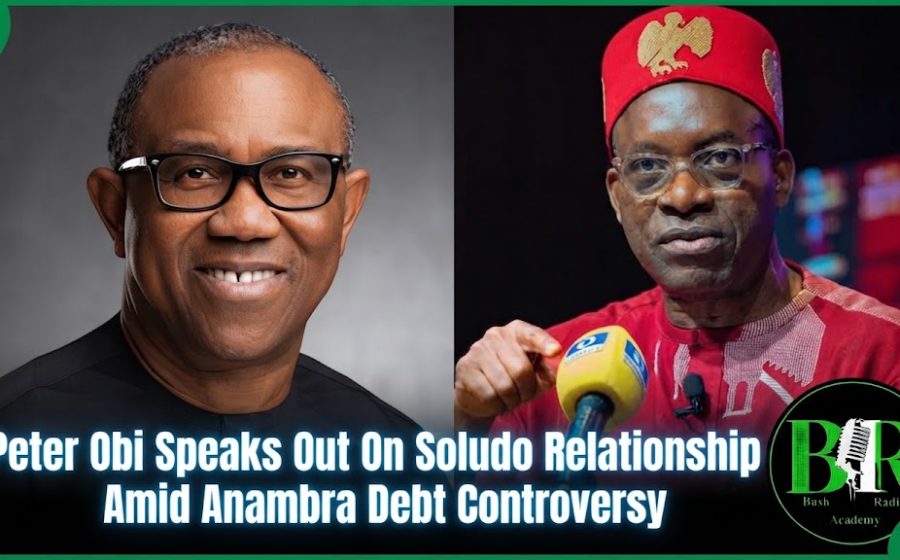
Former Anambra State Governor and Nigeria Democratic Congress (NDC) presidential candidate Peter Obi has said he has no disagreement with his successor, Governor Chukwuma Soludo, while insisting that he has no intention of seeking the governorship of any state again.
Obi made the clarification during an interview on Arise News on Thursday, where he also addressed the ongoing controversy over external financing linked to projects implemented during his eight-year administration in Anambra State.
According to Bush Radio Academy, Obi said he had remained silent in recent days because he was mourning his late elder brother and friend, Chief Okey Ezeibe, but decided to respond to issues that had generated public debate.
He said he had no disagreement with Soludo or any other governor in the country and dismissed suggestions that he was interested in returning to state-level politics.
“I don’t have any issue with the government of Anambra State,” Obi said, adding that he would not seek the governorship of any state again, even if the Constitution were amended.
The former governor also appealed to governors across the country to allow presidential candidates and other political contestants to campaign freely in their states regardless of their political affiliations. He said governors had the right to support candidates of their choice but should equally allow voters to hear from competing candidates before making their decisions.
The comments came amid a renewed dispute between Obi and the Anambra State Government over external facilities linked to projects implemented during his tenure.
The Anambra Government has said eight external borrowing facilities associated with projects under Obi had a combined contracted value of $123.77 million, with $92.35 million outstanding as of June 30, 2026. The state has attributed the figures to records from the Debt Management Office and said successive administrations have continued to service the obligations.
Obi, however, rejected the description of the $123.77 million as debt he personally left behind for Anambra. He maintained that he did not approach any financial institution to borrow money or issue a bond on behalf of the state during his tenure.
He argued that the facilities largely involved World Bank and International Fund for Agricultural Development (IFAD) development programmes obtained through the Federal Government and subsequently made available to participating states under subsidiary arrangements. Obi said the amount approved, the amount actually drawn and the outstanding balance should not be treated as identical figures.
Obi also questioned how the $123.77 million figure was being attributed to his administration, saying records he cited showed that Anambra’s external debt stood at about $18 million when he assumed office in March 2006 and approximately $30 million when he left office in March 2014. He further referred to a figure of about $45.15 million recorded in December 2014, nine months after he left office.
He therefore challenged the Anambra Government to explain how the $123.77 million figure was calculated and linked to his tenure.
The former governor further maintained that his administration left no unpaid salaries, gratuities or pensions, and no outstanding obligations to contractors or suppliers whose completed work had been verified and certified.
Obi also recalled former Debt Management Office Director-General Abraham Nwankwo’s reported comments at his farewell ceremony, where he said Obi was the only state governor during his tenure who had not approached him for approval to obtain a loan facility.
The Anambra Government has maintained a different position, saying the facilities remained liabilities of the state despite being federal government-guaranteed and used for development projects. Anambra Information Commissioner Law Mefor previously said the state was still repaying eight such facilities.
Obi said the controversy should not distract from the broader challenges facing Nigerians and urged political actors to focus on issues affecting citizens rather than allowing political disagreements to dominate public discourse.
He also reiterated his call for governors to provide a level playing field for political contestants, saying voters should ultimately be allowed to decide who they want to govern them.



Comments
0 comments